Best Audio Interface for Kids: Focusrite Solo Wins

A short, honest guide to picking an audio interface a child can actually use, with five picks ranked by what a young musician needs at the desk.

By Carter LoganUpdated 14 min read
On this page
- Best audio interface for kids at a glance
- A note on the word kids
- What actually decides this buy
- How I screened these five interfaces
- 1. Focusrite Scarlett Solo 3rd Gen — Best overall
- 2. PIYONE Audio Interface — Best for quiet operation
- 3. M-AUDIO M-Track Duo — Best upgrade
- 4. MAONO P2 Hybrid — Best premium
- 5. XTUGA Q-12 — Best budget pick
- Which inputs does a young musician actually need?
- How long will one of these last on a kid's desk?
- What the product listings do not tell you
- The verdict
- FAQ
The best audio interface for kids is the Focusrite Scarlett Solo 3rd Gen, a 0.77 lb USB-C box with two inputs, a 2-year warranty and enough headroom for a young voice or a first guitar. If a second mic matters, the M-AUDIO M-Track Duo is the better buy at 0.66 lb with two combo XLR inputs. Both plug into a laptop with one cable, and both survive being unplugged twice a day.
Best audio interface for kids at a glance
| Pick | Inputs | Warranty | Price |
|---|---|---|---|
Best overall Focusrite Scarlett Solo 3rd Gen |
1 XLR + 1 instrument | 2 years | Check Price |
Best for quiet operation PIYONE Audio Interface |
2 XLR/TRS combo | 2 year limited | Check Price |
Best upgrade M-AUDIO M-Track Duo |
2 XLR/Line/Instrument | 1 year | Check Price |
Best premium MAONO P2 Hybrid |
2 XLR, 56dB claim | 1 year | Check Price |
Best budget pick XTUGA Q-12 |
2 with 48V | 1 year | Check Price |



A note on the word kids
None of these five interfaces is a children's product, and Amazon's own results confirm that: search for the best audio interface for kids and the platform returns adult recording gear. That matters because I will not claim any of these boxes is designed for a nine-year-old. They are not.
What I can say is which of them a child can plug in without help after the first setup, which have knobs that survive being twisted the wrong way, and which pair with a family laptop rather than a specialist rig. Read this as a shortlist of grown-up interfaces that a young musician can grow into, not as a toy roundup. If you want a locked-down learn-to-record device with parental controls, none of the five fits and you should look at a different category entirely.
What actually decides this buy
The obvious answer, sample rate, is a distraction. Four of the five picks quote 24-bit or 192kHz numbers that a ten-year-old cannot hear the difference between at home. The XTUGA Q-12 is the outlier at 16-bit/48kHz.
The real deciding criterion is preamp headroom and input count. Preamp headroom decides whether a quiet child singing four inches from a condenser mic is picked up cleanly or drowned in hiss. Input count decides whether the interface can grow with the kid: one mic today, mic plus guitar tomorrow, mic plus friend the year after.
Everything else, colour, software bundle, whether the box glows, is trim. Focusrite calls out its "high performing mic pre-amps" on the Solo, and that is the specification I would prioritise over any other.
How I screened these five interfaces
I started with the audio interfaces category on Amazon and filtered on three things a parent actually cares about.
- USB power only, so there is no wall wart to lose and no separate adapter to trip over.
- Two inputs or fewer, because a child does not need eight channels and an eight-channel box costs more and takes more desk space.
- A published warranty of at least one year, because kids drop things.
Anything that arrived without a stated warranty was cut. Anything larger than 10 inches on the longest side was cut, because desk space in a kid's room is finite. Anything without a combo XLR jack was cut, because that jack is what lets a first mic and a first guitar share the same socket.
Five interfaces cleared the bar. Two are entry priced, one sits mid-range, and two land in the premium band. The most expensive of the five here is the MAONO P2; the cheapest is the XTUGA Q-12. The Focusrite Scarlett Solo is the one buyers choose most often in this set by a wide margin.
1. Focusrite Scarlett Solo 3rd Gen — Best overall
The Solo wins because a single input plus a dedicated instrument jack is exactly what a solo kid actually uses, and Focusrite backs it for two years.
Best for: a child recording vocals or acoustic guitar into a laptop Skip it if: you need two people recording together at once
The Solo is the lightest of the set at 0.77 lb and one of the smallest at 3.77 x 1.71 x 5.65 in, small enough to sit next to a school laptop without crowding the trackpad. It has one XLR input for a mic and one high-headroom instrument input for guitar or bass, which Focusrite says lets the guitar signal "shine through" without clipping. That split matters for a kid: they plug the mic into the mic socket and the guitar into the guitar socket, and there is no menu to think about.
Focusrite lists a 2-year warranty on this unit, the joint-longest here alongside the PIYONE. The bundled software is heavier than you might expect for the price position: Pro Tools Intro+, Ableton Live Lite, Cubase LE and the Hitmaker Expansion effects pack are included. That is enough software to run a young musician through several years of learning without buying anything extra.
The trade-off against the rest of this set is inputs. The Solo has one XLR. The M-Track Duo, PIYONE, MAONO and XTUGA each have two. If a duet is likely, the Solo is not the right pick.
Pros:
- Lightest of the five at 0.77 lb
- Dedicated instrument input, no menu switching
- 2-year Focusrite warranty
- Deep software bundle included
- Compact 5.65 in longest side
Cons:
- Only one XLR input
- Premium price position in this set
- No phone or iPad connectivity claimed
- Red finish shows dust
2. PIYONE Audio Interface — Best for quiet operation
The PIYONE earns its spot by pairing two combo inputs with a claimed zero-latency monitoring path and a 2-year limited warranty at an entry price position.

Best for: quiet vocal takes in a shared bedroom Skip it if: you want the smallest possible footprint on a small desk
PIYONE lists 24-bit/192kHz resolution and two XLR/TRS combo jacks, which means both sockets accept a mic or a line signal. The company advertises a monitor mix and a loopback function, and describes the unit as class-compliant on Mac and PC, so there is no driver to install on a family laptop. Loopback is useful the day a child wants to stream their playing with backing audio mixed in.
At 1.63 lb and 5.51 x 9.25 x 2.24 in, this is the largest and heaviest of the five, which is the reason to skip it if the desk is already crowded. In exchange the chassis feels less like a puck and more like a fixed piece of gear, and the gain knobs are ringed with LEDs that make it obvious when a channel is live. That visual feedback is genuinely useful for a young user who forgets which channel they were talking on.
The compromise here, next to the Focusrite, is a smaller software bundle: PIYONE does not list Pro Tools Intro+ or Ableton Live Lite in the box. Only one seller lists this interface, which is worth knowing.
Pros:
- Two combo inputs, both mic-capable
- 2 year limited warranty
- Loopback function for streaming
- Illuminated gain rings show channel activity
- Entry price position for two inputs
Cons:
- Heaviest of the five at 1.63 lb
- Longest chassis at 9.25 in
- Only one seller lists it
- No named software bundle
3. M-AUDIO M-Track Duo — Best upgrade
The M-Track Duo is the pick when two people record together, with two full combo inputs in a 0.66 lb chassis and phantom power on both.
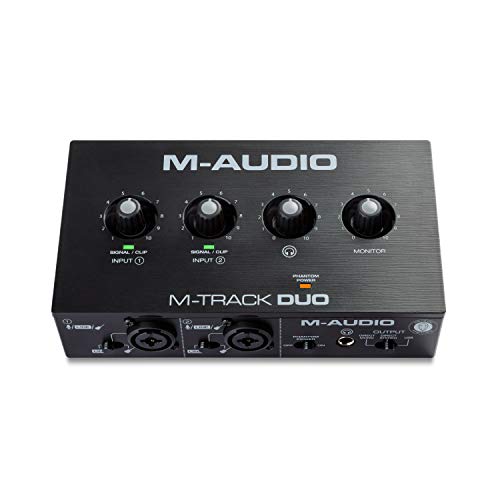
Best for: a duo or a kid who wants a friend on the second mic Skip it if: you want a longer warranty out of the box
The Duo is the lightest of the four two-input picks at 0.66 lb, undercutting even the Focusrite Solo on weight while giving up a second channel. Its two combo jacks accept XLR, line or instrument signals with phantom power, which M-AUDIO calls out for condenser mics. A single kid can record voice and guitar at the same time on separate tracks; two kids can record vocals together. Released in 2020, this is the oldest design in the set, and that shows up in a listed 48kHz USB sound card resolution rather than the 192kHz numbers the newer boxes advertise.
There is a USB/Direct switch for zero-latency monitoring, which matters for a young singer who otherwise hears themselves half a beat late through the laptop. The bundled MPC Beats software from Akai is a genuine beat-making tool rather than a demo, and it will keep a curious kid busy for a while.
The real weakness against the Focusrite is the warranty: 1 year manufacturer on the M-Track Duo versus 2 years on the Solo. For a device that lives on a child's desk, that gap matters.
Pros:
- Lightest two-input pick at 0.66 lb
- Phantom power on both channels
- USB/Direct monitoring switch
- MPC Beats software included
- Mid-range price for two inputs
Cons:
- 1 year warranty, half of the top pick
- Listed at 48kHz resolution
- Oldest design in the set at 2020
- Longest of the sub-1-lb picks at 7.5 in
4. MAONO P2 Hybrid — Best premium
The P2 justifies its price position with dual USB ports, MFi-certified phone and iPad support, and a claimed 56dB of gain on each XLR.

Best for: an older teen who records to a phone or iPad as well as a PC Skip it if: you want the shortest learning curve
The P2 is the only pick here with two USB ports, which is the feature to buy it for. A teen can leave the interface connected to a family iPad and a school laptop at once, switching source without unplugging cables. MAONO says the second port is MFi-certified for iPhone and iPad. The unit is compact at 1.77 x 1.97 x 5.91 in and light at 1.1 lb, so it slides into a bag if the kid records at a friend's house.
MAONO advertises 56dB of gain across the two XLR inputs, enough for most dynamic broadcast mics without a booster. There is independent mute on each channel and separate headphone and monitor mutes, which is more control than a beginner needs and exactly what a streamer wants once they start growing. The listing also names a ProStudio 2 software route that carries browser and app audio into dedicated channels, useful for a young streamer.
The trade-offs are real. This is the most expensive pick in the set. The warranty is 1 year, shorter than the Focusrite and PIYONE. And the control layout is denser than the other four, which lengthens the first hour of setup.
Pros:
- Dual USB for phone plus computer
- MFi certification claim for iPad
- 56dB gain claim on each XLR
- Independent mute on each channel
- Compact 1.1 lb chassis
Cons:
- Most expensive pick here
- 1 year warranty only
- Densest control layout of the five
- Only one seller lists it
5. XTUGA Q-12 — Best budget pick
The Q-12 is the cheapest of the five and does the two things a first-time young recorder actually needs: phantom power and two inputs.

Best for: a first recording setup where the budget is tight Skip it if: you want higher than 16-bit resolution
The Q-12 lists 16-bit/48kHz resolution, which is lower than every other pick here and is the honest reason it sits at the bottom of the price rank. In practice a young kid recording to a family laptop through a starter condenser will not hear the gap between 16-bit and 24-bit. What they will notice is whether the mic works at all, and the Q-12 has switchable 48V phantom power for condenser mics.
At 0.68 lb and 1.97 x 5.98 x 4.92 in, this is the second-lightest interface in the set, only just heavier than the M-Track Duo. XTUGA describes the box as bus-powered from the computer with no external adapter, which is the right call for a child's desk. The company calls out students and beginners in its own copy as the target user, which is unusually direct.
The gaps against the rest of the set are the specification sheet and the warranty. There is no listed software bundle, the resolution is lower, and the warranty is 1 year against 2 for the Focusrite and PIYONE. This is a starter box, not a keeper.
Pros:
- Cheapest of the five
- 48V phantom power on tap
- Second-lightest at 0.68 lb
- Bus powered, no adapter
- Explicitly aimed at beginners
Cons:
- 16-bit resolution only
- 1 year warranty
- No named software bundle
- Slowest seller of the five
Which inputs does a young musician actually need?
Almost every child starts with one mic. The question is what comes next.
- Vocals only, no instrument in sight: one XLR is enough. The Focusrite Scarlett Solo covers this cleanly and leaves an instrument jack free for the day a guitar shows up.
- Vocals plus acoustic guitar, one kid at a time: two combo inputs, one of them switchable to instrument level. The M-Track Duo and PIYONE both fit.
- Two kids recording together: two XLR inputs with phantom power on both. The M-Track Duo, PIYONE and MAONO P2 all support this; the Q-12 does too with its 48V switch.
- Recording to a phone or iPad: dual-port support, which only the MAONO P2 lists.
- Streaming with backing tracks: loopback, which PIYONE names and MAONO implies through its dedicated channel routing.
The trap is buying an eight-channel interface because it is on sale. A child will not use six of those inputs, the extra sockets clutter the desk, and the larger chassis eats more space than the family laptop next to it.
How long will one of these last on a kid's desk?
Warranty is the honest proxy here, because none of these interfaces was designed with a nine-year-old's grip in mind. The Focusrite Scarlett Solo and the PIYONE both list 2 years. The M-Track Duo, MAONO P2 and XTUGA Q-12 all list 1 year.
Weight also matters more than it looks. A 0.66 lb Duo pulled off a desk by a cable will land differently from a 1.63 lb PIYONE, which is more likely to stay put when a USB lead is yanked. If your kid has a habit of leaning on cables, the heavier PIYONE is quietly the safer buy despite the shorter chassis life a lighter box might promise on paper.
Consider anchoring the interface with a non-slip mat. None of the five ships with one. A cheap silicone kitchen mat under the box is the single most useful accessory I would add.
What the product listings do not tell you
Three things about the best audio interface for kids that no listing spells out.
First, the mic matters more than the interface. A quiet child three feet from a cheap dynamic mic will sound worse through the Focusrite Solo than a well-placed condenser through the XTUGA Q-12. Budget for a decent mic before you upgrade the box.
Second, headphones are non-negotiable. Every one of these five interfaces has a headphone output, and every one of them will feed back miserably if the child listens through the laptop speakers while recording. Closed-back headphones, cheap ones, are fine.
Third, the software bundle is worth reading before you buy. The Focusrite Solo ships with Pro Tools Intro+ and Ableton Live Lite; the M-Track Duo ships with MPC Beats. The PIYONE, MAONO P2 and XTUGA Q-12 do not name a headline DAW in the listing. If the kid does not already have recording software, that is a hidden cost.
The verdict
The best audio interface for kids is the Focusrite Scarlett Solo 3rd Gen. It is the lightest of the five at 0.77 lb, it carries the joint-longest warranty in the set at 2 years, it separates the mic input from the instrument input so a young user cannot plug the guitar into the wrong socket, and it ships with real recording software rather than a demo. It is also the one buyers choose most often here, and that consistency is worth something on a device a parent may end up troubleshooting.
Two conditions flip the pick. If two people need to record at the same time, the M-AUDIO M-Track Duo is the right buy: two combo inputs with phantom power in a 0.66 lb chassis and MPC Beats included. If the child records to a phone or iPad as well as a laptop, the MAONO P2 is the only pick with dual USB and MFi certification.
If the budget will not stretch to the Solo, the XTUGA Q-12 is the honest starter box. 16-bit is a real limitation, but it is not a limitation a nine-year-old will hear.
FAQ
Is an audio interface worth it for a kid just starting out?
An audio interface is worth it once a child moves past a laptop's built-in microphone. All five picks here give a young recorder a real XLR input, phantom power for a condenser mic, and a headphone jack for monitoring, which the laptop does not. If the kid is only messing about, wait. If they are recording songs weekly, the Focusrite Scarlett Solo pays back its price quickly.
What is the best audio interface for kids on a tight budget?
The best audio interface for kids on a tight budget is the XTUGA Q-12. It is the cheapest of the five, it has two inputs with switchable 48V phantom power for condenser mics, and it weighs 0.68 lb. The resolution is 16-bit rather than 24-bit, which is the honest trade-off. For a first recording setup that a child may outgrow inside two years, that is a fair compromise.
Focusrite Scarlett Solo or M-Track Duo, which one for a young musician?
Focusrite Scarlett Solo or M-Track Duo comes down to how many people record at once. The Solo has one XLR and one dedicated instrument input in 0.77 lb, with a 2-year warranty and a heavier software bundle. The Duo has two combo inputs with phantom power in 0.66 lb, with a 1-year warranty. Solo for a soloist, Duo for a duet or a kid who wants a friend on the second mic.
Does an audio interface for kids need phantom power?
An audio interface for kids needs phantom power the moment a condenser mic enters the picture, because condensers will not run without 48V. Every one of the five picks here supplies it: the Focusrite Solo, the PIYONE, the M-Track Duo, the MAONO P2 and the XTUGA Q-12 all list phantom power. Dynamic mics do not need it, but most starter recording mics for young singers are condensers.
What size audio interface fits on a kid's desk?
Size audio interface fits a kid's desk best when the longest side stays under six inches. The Focusrite Scarlett Solo at 5.65 in and the MAONO P2 at 5.91 in are the two easiest to place. The M-Track Duo runs to 7.5 in and the PIYONE to 9.25 in, both of which need a wider desk. Measure the space next to the laptop before you buy.
Start with the Focusrite Scarlett Solo, then add a closed-back pair of headphones and one decent condenser mic. That combination will carry a young musician from a first vocal take to a first full song without a second purchase. The Solo is the right default because it removes the two decisions a child cannot make on their own: which socket to use for the mic, and which for the guitar. The other four picks are better in specific cases, but only the Solo makes the everyday choice invisible, and invisible is exactly what a kid's gear should be.