Best Audio Interface for Windows 10 for Home Studios

Windows 10 lives or dies on drivers, not sample rate. Seven interfaces compared by connectivity, warranty and driver claims, with the Focusrite Scarlett Solo 4th Gen leading and cheaper picks for tighter budgets.

By Carter LoganUpdated 16 min read
On this page
- Best audio interface for Windows 10 at a glance
- Does Windows 10 actually change which interface you buy?
- How I narrowed seven listings to a ranked set
- 1. Focusrite Scarlett Solo 4th Gen USB-C Audio Interface — Best overall
- 2. M-AUDIO M-Track Duo USB Audio Interface — Best minimal setup
- 3. PIYONE Audio Interface — Best upgrade
- 4. MAONO P2 Hybrid USB Audio Interface — Runner-up
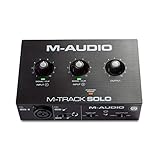
- 5. M-AUDIO M-Track Solo USB Audio Interface — Best for pros
- 6. Synido USB C Audio Interface — Best budget pick
- 7. Solid State Logic Harrison FleX-10 — Best premium
- One input or two: which do you actually need?
- What more money buys across this set
- Windows 10 setup pitfalls worth knowing
- The verdict
- FAQ
The best audio interface for Windows 10 is the Focusrite Scarlett Solo 4th Gen USB-C, a 0.9 lb desktop box with a 3-year manufacturer warranty and a single mic-plus-guitar setup. If you need two combo inputs on a tighter budget, the M-AUDIO M-Track Duo is the better buy at 0.66 lb. Here's the thing most guides get wrong: sample rate is not what splits this field. Driver support and input count are, and this set spreads widely on both.
Best audio interface for Windows 10 at a glance
| Pick | Inputs | Warranty | Price |
|---|---|---|---|
Best overall Focusrite Scarlett Solo 4th Gen |
1 mic + 1 instrument | 3 year | Check Price |
Best minimal setup M-AUDIO M-Track Duo |
2 combo XLR/line | 1 year | Check Price |
Best upgrade PIYONE 2x2 Interface |
2 combo XLR/TRS | 2 year | Check Price |
Runner-up MAONO P2 Hybrid |
2 XLR | 1 year | Check Price |
Best for pros M-AUDIO M-Track Solo |
1 XLR + 1 instrument | 1 year | Check Price |
Best budget pick Synido USB-C Interface |
2x2 | 30 day | Check Price |
Best premium SSL Harrison FleX-10 |
10 in / 2 out | 1 year | Check Price |




Does Windows 10 actually change which interface you buy?
Windows 10 does change which interface you buy, but not the way the search phrase suggests. Amazon's search treated "windows 10" loosely here. None of these seven listings names Windows 10 as a supported version in its published spec sheet, so I can't promise any one of them is certified for it. That's your call to verify on the live listing before you buy.
What the data does show is the real dividing line: driver type. On Windows, latency depends on an ASIO driver, and only some listings mention one.
- The SSL Harrison FleX-10 listing states it is class-compliant on Windows "with the provided ASIO driver."
- The PIYONE and Synido listings call themselves class-compliant or plug-and-play, which usually means they lean on the generic Windows driver.
- The Focusrite and M-AUDIO boxes come from brands with a long history of dedicated Windows drivers, though the listings here don't spell that out.
So treat "best audio interface for Windows 10" as a question about drivers and input count. Sample rate matters far less than shoppers think. Check the manufacturer's download page for a Windows 10 driver before you commit.
How I narrowed seven listings to a ranked set
I built the criteria first, then ranked against them. Here's the order I weighted things, and why.
- Driver clarity. On Windows, a proper ASIO path decides whether you get usable latency. This carried the most weight.
- Input count and type. One source or two changes what you can record at once. A combo jack that takes XLR or 1/4" is more flexible than XLR alone.
- Warranty length. The published figures range from 30 days to 3 years, a genuine spread that tells you how long each brand stands behind the box.
- Physical footprint. Weight and dimensions decide whether it fits a crowded desk.
Everything ran on the same published spec sheets. I did not handle any of these units. I compared the figures side by side and read every feature claim as the manufacturer's wording, not measured fact.
Two things pushed picks down rather than out. The Synido's 30-day warranty is the shortest here by a wide margin. The SSL Harrison FleX-10 is powerful but the heaviest and largest, so it can't win an all-round recommendation. Nothing was cut outright: all seven earned a place because each suits a clearly different buyer.
1. Focusrite Scarlett Solo 4th Gen USB-C Audio Interface — Best overall
The Scarlett Solo 4th Gen is the safest all-round pick because it pairs a trusted brand's driver track record with the longest warranty in this set.
Best for: solo songwriters recording one mic or guitar at a time Skip it if: you need two mics recorded on separate channels
The Scarlett Solo weighs 0.9 lb and measures 3.78 x 1.79 x 5.63 in, so it disappears on a desk. What sets it apart in this group is the 3-year manufacturer warranty. No other pick here matches it. Every other box tops out at 2 years or less, and two of them offer a single year.
Focusrite says the 4th Gen uses "the same converters as Focusrite's flagship interfaces" and claims a 120dB dynamic range. Those are the manufacturer's figures, not something I verified. The listing also describes an improved Air mode that "lifts vocals and guitars to the front of the mix." Take that as marketing until you hear it.
Released in 2023, it's the second-newest desktop model here. The bundled software is generous: Pro Tools Intro+, Ableton Live Lite, Cubase LE and the Hitmaker Expansion. That matters if you don't already own a DAW.
The trade-off is inputs. This is a single mic plus single instrument box. It's also the most expensive pick here that isn't the big premium unit, so you pay for the brand and the warranty.
Pros:
- Longest warranty in this set at 3 years
- Light at 0.9 lb and small desktop footprint
- Generous bundled DAW and plugin software
- Manufacturer claims flagship converters, 120dB range
- USB-C connection, released 2023
Cons:
- Only one mic input, no dual-mic recording
- Priced high for a single-channel interface
- Listing does not confirm Windows 10 certification
2. M-AUDIO M-Track Duo USB Audio Interface — Best minimal setup
The M-Track Duo is the cheapest way to get two combo inputs, making it the go-to for a two-person podcast.
Best for: podcasters and duos who want two combo inputs cheaply Skip it if: you want the longest warranty in this set
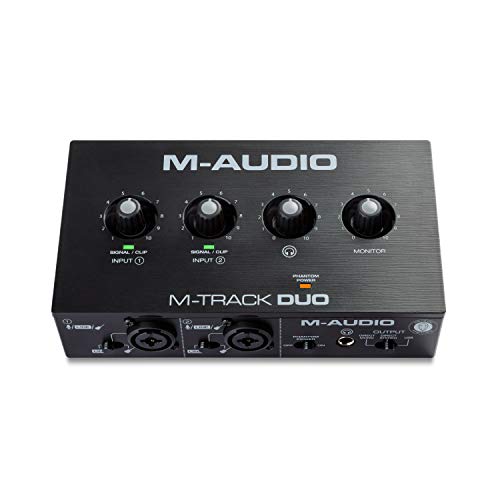
At 0.66 lb, the M-Track Duo ties for the lightest interface here. It measures 2.13 x 4.34 x 7.5 in and gives you two combo XLR/Line/Instrument inputs with phantom power. That's what earns its spot: two flexible inputs at a mid price, so you can record two voices or a voice and a guitar at once.
M-AUDIO says the box delivers 48kHz resolution and calls its preamps "transparent Crystal Preamps." Those are the manufacturer's words. The listing also mentions a USB/Direct switch for zero-latency monitoring, which is standard on interfaces at this level.
It bundles MPC Beats software from Akai, a beat-making tool rather than a full DAW. Released in 2020, it's the oldest model in this roundup.
The catch is the warranty. One year is short next to the Focusrite's 3-year cover, and the 48kHz ceiling sits below the 192kHz figures claimed by pricier picks. For most podcast and demo work that ceiling is irrelevant, but it's a real difference on paper against the M-Track Solo and PIYONE.
Pros:
- Two combo XLR/line inputs at a mid price
- Lightest in this set at 0.66 lb
- Phantom power for condenser mics
- Includes MPC Beats software
Cons:
- One-year warranty, short for this group
- 48kHz ceiling below rivals' 192kHz claims
- Oldest model here, released 2020
3. PIYONE Audio Interface — Best upgrade
The PIYONE 2x2 is the pick for creators chasing a loopback feature and higher sample-rate claims without spending big.

Best for: creators wanting a loopback feature and higher sample-rate claims Skip it if: desk space is tight
The PIYONE is the third-cheapest of the seven, yet its listing claims features usually reserved for pricier boxes. It advertises 24-bit/192kHz fidelity, two combo XLR/TRS jacks, and a monitor mix with loopback. Loopback is the standout: it routes computer audio back into your recording, which streamers and remote podcasters use to mix in music or a guest's voice.
PIYONE describes it as class-compliant and plug-and-play for Mac and PC. On Windows 10 that usually means the generic driver, so verify whether a dedicated ASIO download exists before you count on low latency.
At 1.63 lb and 5.51 x 9.25 x 2.24 in, it's the second-heaviest here and noticeably wider than the small Focusrite. The signature LED gain rings look sharp but eat desk depth.
The 2-year limited warranty is the second-longest in this set, behind only the Focusrite. That's a real point in its favour against the one-year M-AUDIO pair. The trade-off is a less-established name and only one seller listing it, so support and stock are less certain than a big-brand box.
Pros:
- Loopback and monitor mix functions
- Claims 24-bit/192kHz resolution
- Two combo XLR/TRS inputs
- Second-longest warranty here at 2 years
Cons:
- Second-heaviest and widest desktop unit
- Only one seller lists it
- Class-compliant claim suggests generic Windows driver
4. MAONO P2 Hybrid USB Audio Interface — Runner-up
The MAONO P2 is the pick for streamers who record from a phone and a PC at the same time.

Best for: streamers who record from a phone and a PC at once Skip it if: you want a documented multi-year warranty
The P2's differentiator is hybrid connectivity. Its listing describes dual USB ports with MFi-certified connection, so you can link a computer and a phone or iPad at the same time. No other pick here offers that. If you stream to a PC while pulling audio from a phone, this is the box built for you.
MAONO claims 56dB of dual XLR gain and independent mute controls for each channel, useful for cutting noise during a guitar swap mid-stream. Those are the manufacturer's figures. The listing also mentions direct monitoring for low-latency playback and software that routes apps like Spotify or a browser to dedicated channels.
It's compact at 1.1 lb and 1.77 x 1.97 x 5.91 in, a tall narrow box rather than a flat one. That vertical shape suits a crowded desk.
Two things keep it a runner-up rather than a winner. It sits in the higher price group despite a one-year warranty, and only one seller lists it. It's also a 2026 release, so there's less track record to lean on than the established M-AUDIO and Focusrite lines. Strong for streamers, less of an all-rounder.
Pros:
- Dual USB for phone and PC together
- Claims 56dB dual XLR gain
- Per-channel mute controls for streaming
- Compact at 1.1 lb
Cons:
- Premium price with only a one-year warranty
- One seller lists it
- New release with little track record
5. M-AUDIO M-Track Solo USB Audio Interface — Best for pros
The M-Track Solo is the pick for single-source recording on a strict budget, from a brand with a Windows driver history.
Best for: single-source recording on a strict budget Skip it if: you ever need to record two microphones together
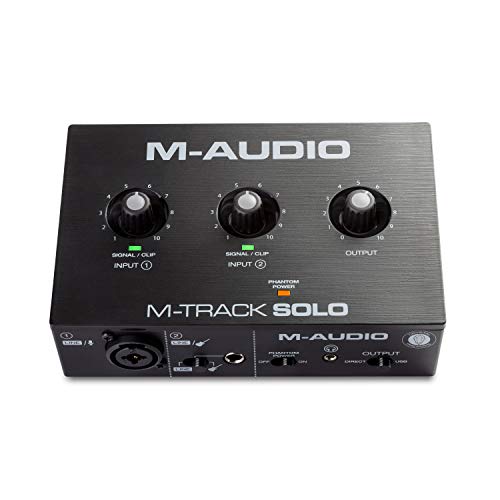
The M-Track Solo is the second-cheapest of the seven. It gives you one combo XLR/Line input with phantom power plus one Line/Instrument input, so you can track a mic and a line source but not two mics at once. That's the deliberate limit of a solo box.
At 0.66 lb it ties the Duo as the lightest here, measuring 2.14 x 4.46 x 6.43 in. M-AUDIO claims 48kHz resolution and the same "transparent Crystal Preamp" wording as its sibling. It also bundles MPC Beats software from Akai.
Released in 2022, it's newer than the Duo. One thing to note: its headphone output is a 1/8" jack with stereo RCA outputs, where the Duo steps up to 1/4" connectors. If your headphones use a full-size plug, you'll need an adapter.
The trade-offs are clear against the Duo. One year of warranty, a single mic input, and the smaller RCA-and-1/8" output set. It slots below its two-input sibling because most buyers who spend this little still want the option of a second voice. If you never will, the savings are real.
Pros:
- Second-cheapest pick in this set
- Light at 0.66 lb
- Phantom power and instrument input
- Includes MPC Beats software
Cons:
- Single mic input only
- 1/8" headphone jack and RCA outputs
- One-year warranty
6. Synido USB C Audio Interface — Best budget pick
The Synido is the cheapest way into recording, right for a first-timer testing whether the hobby sticks.

Best for: first-time recordists testing the water cheaply Skip it if: warranty length matters to you
The Synido is the cheapest of all seven, which is its whole reason for being here. It's a 2x2 USB-C interface at 0.91 lb and 1.77 x 4.53 x 5.51 in. Synido claims 24-bit/48kHz recording, 48V phantom power, and three switchable monitoring modes.
The listing describes an XLR input and intuitive controls split into three areas. It's plug-and-play, which on Windows 10 points to the generic driver, so don't expect the tuned latency of a brand with its own ASIO download. Verify what's available before you rely on it for live monitoring.
Everything about this pick is a compromise for price. The standout weakness is the warranty: 30 days is by far the shortest in this roundup, where the next-shortest is a full year. That tells you how much of a gamble the low price carries.
If you want to learn signal flow, phantom power and monitoring without much outlay, it does the job. Outgrow it and you sell it on. Just go in knowing the support window closes in a month, and that the brand is less established than M-AUDIO or Focusrite.
Pros:
- Cheapest pick in this set
- 48V phantom power and 2x2 I/O
- Three monitoring modes
- Light and compact USB-C box
Cons:
- 30-day warranty, shortest here by far
- 48kHz ceiling and generic driver
- Only one seller lists it
7. Solid State Logic Harrison FleX-10 — Best premium
The FleX-10 is the pick for producers who want ten inputs and analog tone shaping in one box.

Best for: producers who want ten inputs and analog tone shaping Skip it if: you want a compact desktop box
The FleX-10 is in a different weight class, literally. At 5.78 lb and 5 x 16.7 x 9.65 in, it's the heaviest and largest here by a wide margin. This is not a desk toy; it's a 10-in/2-out interface for tracking a whole session at once.
Crucially for this guide, it's the only listing that names its Windows driver directly. SSL states it is "class compliant with Mac OS and on Windows with the provided ASIO driver." That ASIO mention is what a Windows 10 user actually wants to read, because it points to a proper low-latency path.
SSL also claims 32-bit/192kHz USB/ADAT audio and "smooth analog tone shaping and classic saturation." Two independent channels carry XLR and 1/4" inputs. It bundles the Harrison Mixbus 12 DAW and Creator Pack. Those are the manufacturer's claims.
The barriers are size, price and warranty. It's the most expensive pick here, it has only a one-year warranty despite that price, and just one seller lists it. It's also a 2026 release with little track record. For a full band or a busy home studio it's the ceiling of this set. For a solo creator it's overkill.
Pros:
- Ten inputs for full-session tracking
- Listing names a provided Windows ASIO driver
- Claims 32-bit/192kHz USB/ADAT audio
- Bundled Mixbus 12 DAW
Cons:
- Heaviest and largest at 5.78 lb
- Most expensive pick with only a one-year warranty
- One seller lists it, new 2026 release
One input or two: which do you actually need?
This is the decision that saves you money or saves you a return. The interfaces here split cleanly into single-source and multi-source designs.
- One source at a time: the Focusrite Scarlett Solo and M-AUDIO M-Track Solo. You record a mic, then a guitar, then a vocal, one after another. Perfect for a solo songwriter or a single-host podcast.
- Two sources at once: the M-Track Duo, PIYONE and MAONO P2 all give two inputs, so two people or a mic and a guitar can track together.
- Many sources: the SSL FleX-10 alone offers 10 inputs, for tracking drums or a band live.
Buying a solo box and later needing a second mic means buying twice. Buying a 10-in interface for a podcast means paying for eight inputs you'll never plug in. Count your sources honestly. If two people ever talk into microphones at the same time, you need at least two inputs.
What more money buys across this set
The price spread here is wide, and it does not buy what you'd guess. Higher price does not reliably buy a longer warranty in this group.
- Entry tier covers the Synido, M-Track Solo and PIYONE. The Synido gets you recording for the least, with a 30-day warranty. The PIYONE, still entry-priced, adds loopback and a 2-year warranty.
- Mid tier is the M-Track Duo: two combo inputs and a brand with a driver history.
- Premium tier holds the Focusrite, MAONO P2 and SSL FleX-10. The Focusrite buys a 3-year warranty and flagship-converter claims. The FleX-10 buys ten inputs and a stated ASIO driver.
The oddity worth spotting: the premium MAONO P2 carries only a one-year warranty, while the entry-priced PIYONE carries two years. More money here often buys inputs, brand reputation or a documented driver, not longer cover. Decide which of those you're actually paying for.
Windows 10 setup pitfalls worth knowing
Getting an interface working smoothly on Windows 10 trips up more first-timers than any hardware fault. A few habits prevent most of it.
- Download the driver before you plug in. For brands like Focusrite and M-AUDIO, install the Windows driver from the manufacturer's site first. For a class-compliant box like the PIYONE or Synido, check whether an ASIO download even exists.
- Set your DAW to the ASIO driver. The generic Windows audio path adds latency you'll hear as delay. The SSL FleX-10 listing names a provided ASIO driver for exactly this reason.
- Use a proper USB-C cable. Several picks here are USB-C. A charge-only cable won't carry data reliably.
- Match sample rates. Set the interface and DAW to the same rate to avoid dropouts.
None of these listings confirms Windows 10 certification outright, so confirm driver availability on the maker's page before buying. That single check is the difference between a clean setup and an afternoon of troubleshooting.
The verdict
The best audio interface for Windows 10 is the Focusrite Scarlett Solo 4th Gen. It wins on the combination that matters most for a solo creator: a brand with a real Windows driver history, a 3-year warranty that no rival here matches, and a light 0.9 lb body that fits any desk. For one mic and one guitar, it's the safe default.
Two conditions flip that. If you record two sources at once, drop to the M-AUDIO M-Track Duo. It's the cheapest way here to get two combo inputs with phantom power, at 0.66 lb, and one year of warranty is a fair trade for the saving. If you need to track a full band or a drum kit, only the SSL Harrison FleX-10 delivers, with 10 inputs and the only listing in this set that names a provided Windows ASIO driver.
The runner-up's edge is narrower and specific. The MAONO P2's dual-USB design lets you record a phone and a PC together, which no other pick can do. Choose it only if that exact hybrid streaming workflow is your reason for buying. Otherwise the Focusrite is the sounder all-round choice.
FAQ
Is the Focusrite Scarlett Solo worth it over cheaper picks?
Whether the Focusrite Scarlett Solo is worth it comes down to warranty and brand support. It carries a 3-year warranty, triple the one-year cover on the M-AUDIO pair and far beyond the Synido's 30 days. You also get a driver history and a generous software bundle. For a single-source setup you plan to keep, that's a reasonable premium.
What is the best audio interface for Windows 10 on a tight budget?
The best audio interface for Windows 10 on a tight budget is the Synido USB-C, the cheapest of these seven. It offers 2x2 I/O, 48V phantom power and three monitoring modes. The catch is a 30-day warranty and a plug-and-play design that likely uses the generic Windows driver. It suits first-timers testing the hobby, not long-term studios.
How many inputs do I need for a two-person podcast?
For a two-person podcast you need at least two inputs, one per microphone recorded on its own channel. The M-Track Duo, PIYONE and MAONO P2 all provide two. A single-input box like the Scarlett Solo or M-Track Solo forces you to mix both voices into one channel, which removes the ability to edit each speaker separately later.
Focusrite Scarlett Solo or M-AUDIO M-Track Duo for beginners?
Between the Focusrite Scarlett Solo and M-AUDIO M-Track Duo, the choice is input count. The Scarlett Solo takes one mic and one instrument, with a 3-year warranty. The M-Track Duo takes two combo inputs at a lower price, with a one-year warranty. Pick the Solo for solo work and longer cover, the Duo if two sources must record together.
Do these interfaces need a special Windows 10 driver?
These interfaces need a Windows driver, but the type varies. On Windows 10, an ASIO driver gives the low latency you want. The SSL FleX-10 listing names a provided ASIO driver directly. Class-compliant or plug-and-play models like the Synido and PIYONE likely use the generic Windows driver. Check the manufacturer's download page before buying to confirm what's available.
Start by counting your sources, then match that to a pick above. One voice or guitar at a time points you at the Focusrite Scarlett Solo, whose 3-year warranty and driver pedigree make it the low-risk default for a Windows 10 desk. Two voices point you at the M-Track Duo, a band at the FleX-10. Before you order, open the manufacturer's support page and confirm a Windows driver exists for your version. That one check settles most of the uncertainty this category creates.