Best Budget Gimbal Stabilizer for Phone Vloggers

Six phone gimbals ranked by weight, tracking and battery life, with a clear winner for casual vloggers and a hohem alternative for all-day shooting.

By Carter LoganUpdated 16 min read
On this page
- Best budget gimbal stabilizer at a glance
- How I picked from a crowded shelf
- What the word budget actually covers here
- 1. DJI Osmo Mobile 7 — Best overall
- 2. hohem iSteady X3 SE — Best for heavy use
- 3. DJI Osmo Mobile 8 — Best for families
- 4. hohem iSteady V3 Ultra — Best premium
- 5. AOCHUAN Smart XE — Most versatile
- 6. Coovoamae Gimbal Stabilizer — Best budget pick
- 1-axis vs 3-axis: which one do you need?
- How long will the battery really last?
- What to check before you press buy
- The verdict
- FAQ
The best budget gimbal stabilizer for phone shooters right now is the DJI Osmo Mobile 7, a 0.66 lb 3-axis rig with a foldable body and built-in tripod that lands mid-pack on price in this set of six. If you need longer runtime for full-day shoots, the hohem iSteady X3 SE claims 11 hours on a 2-hour charge and costs less. Both handle iPhone and Android, and both fold flat enough to travel in a jacket pocket.
Best budget gimbal stabilizer at a glance
| Pick | Weight | Axes / key trick | Price |
|---|---|---|---|
Best overall DJI Osmo Mobile 7 |
0.66 lb | 3-axis, ActiveTrack 7.0 claim | Check Price |
Best for heavy use hohem iSteady X3 SE |
0.79 lb | 3-axis, 11-hour battery claim | Check Price |
Best for families DJI Osmo Mobile 8 |
0.82 lb | 3-axis, tracking + audio + light | Check Price |
Best premium hohem iSteady V3 Ultra |
0.94 lb | 3-axis, 1.22" touchscreen remote | Check Price |
Most versatile AOCHUAN Smart XE |
0.76 lb | 3-axis, 2600mAh, 10-hour claim | Check Price |
Best budget pick Coovoamae Gimbal |
7.84 oz | 1-axis, app-free selfie stick | Check Price |



How I picked from a crowded shelf
I started with buyer profiles, not spec sheets. A first-time vlogger filming from a stroller has different needs from a live-streamer running two-hour beauty sessions from a countertop. So the six picks below map to six real jobs, and each is judged on the specifications that matter to that job.
Four decisions did the sorting.
- Axes of stabilization. Five of the six are 3-axis rigs. One is a 1-axis stabilizer that behaves more like a smart selfie stick. Both belong in a budget guide, but they solve different problems.
- Weight in the hand. Every pick sits between 7.84 oz and 0.94 lb. That range matters because you feel every ounce after ten minutes of arm-out filming.
- Battery claims and tracking. I read the manufacturer battery figures and tracking software names, then said out loud who they were written for.
- What comes in the box. Built-in tripods, extension rods, detachable remotes and fill lights are not equal, and I flagged them where they change the buying decision.
The word "budget" here is a shopping constraint, not a hardware category. Amazon's search returned mid-tier and premium rigs alongside entry-level ones for this best budget gimbal stabilizer query, so I treat "budget" as a spread that runs from the cheapest pick in the set to the most expensive, and I say where each one sits.
What the word budget actually covers here
The six picks in this best budget gimbal stabilizer roundup sit across three price positions. Two are entry-tier, two are mid-tier, and two are premium. That spread is honest to what shoppers actually see when they type the query, and it matters because the extra money buys real things.
At the entry position, the Coovoamae is a 1-axis stabilizer with a 31.5-inch extension. It is the cheapest of the six. The hohem iSteady X3 SE is the second-cheapest and jumps straight to 3-axis with an 11-hour battery claim, which is the sharpest value shift in the set.
Mid-tier gets you the AOCHUAN Smart XE, then the DJI Osmo Mobile 7 as the winner. Both are 3-axis and foldable. The Osmo Mobile 7 shaves weight; the AOCHUAN adds a 2600mAh battery and a broader shooting-mode list.
At the premium end sit the DJI Osmo Mobile 8 and the hohem iSteady V3 Ultra. These add features most beginners will not use: audio reception, native lighting, a touchscreen remote, an 8-inch extension rod. Worth it for creators who already know what they want to shoot.
1. DJI Osmo Mobile 7 — Best overall
The lightest 3-axis gimbal in this set, with the tracking software most beginners actually stick with.
Best for: casual vloggers who want the lightest 3-axis rig here Skip it if: you need a built-in fill light or a touchscreen remote
At 0.66 lb, the Osmo Mobile 7 is the lightest 3-axis pick in this best budget gimbal stabilizer roundup, and that is the whole argument. Arm fatigue is what makes people stop using a gimbal after a month, and every ounce below 12 you carry translates into more minutes of shooting before the elbow gives up. Its 3.66 x 10.9 x 4.21 in folded profile fits sideways into a jacket pocket.
DJI says the rig runs ActiveTrack 7.0 through the Mimo app for subject tracking, and describes a foldable design with a built-in tripod. The 2025 model year is the most recent in this set, and the DJI warranty is spelled out on the listing.
The trade-off is honest: this is a mid-tier pick, not the cheapest option here. You are paying for weight savings and DJI's app ecosystem, not for a built-in fill light or a touchscreen remote. If those matter more than grams, look at the V3 Ultra below.
Pros:
- Lightest 3-axis pick in this set at 0.66 lb
- Foldable body with built-in tripod
- ActiveTrack 7.0 tracking claim via DJI Mimo
- Sells faster than most rivals here
- 2025 model year, most recent in the set
Cons:
- Mid-tier price, not the cheapest 3-axis option
- No built-in fill light like the V3 Ultra
- No touchscreen remote, unlike the hohem V3 Ultra
- Warranty term is not stated in months on the listing
2. hohem iSteady X3 SE — Best for heavy use
The longest battery claim in the set, paired with a magnetic detachable remote.

Best for: creators filming for hours between charges Skip it if: you already own a newer DJI phone and want tighter app polish
The iSteady X3 SE is the second-cheapest pick in this best budget gimbal stabilizer set, and hohem's claim is aggressive: 11 hours of continuous operation on a 2-hour charge. Take that as the manufacturer's number, not a measured one. It still positions this rig as the endurance play in the group.
Weight is 0.79 lb. The folded footprint of 3.86 x 1.73 x 6.32 in is the narrowest here, thanks to a slim body. Hohem includes a detachable magnetic remote it says reaches 32.81 feet, which is the practical bit: you can prop the gimbal on a table, walk back and start the shot without an assistant. The listing also names iSteady 8.0 stabilization and the Hohem Joy app for shooting modes.
Warranty is 1 year, spelled out on the listing, which is more concrete than DJI's block.
The compromise is app polish. Beginners who already use an iPhone often find DJI Mimo faster to learn. If your goal is to shoot all afternoon at a market or a car meet, the X3 SE earns its award.
Pros:
- 11-hour battery claim, longest here
- Detachable magnetic remote with 32.81 ft claim
- Second-cheapest pick in this set
- Stated 1-year warranty
- Compact 3.86 x 1.73 x 6.32 in folded body
Cons:
- Heavier than the Osmo Mobile 7 by 0.13 lb
- Third-party app less polished than DJI Mimo
- No built-in fill light
- No touchscreen on the remote
3. DJI Osmo Mobile 8 — Best for families
The pick that adds native audio reception and lighting to DJI's tracking, aimed at parents and vloggers shooting people.

Best for: parents and vloggers who film kids, pets and group shots Skip it if: you want the cheapest way into 3-axis stabilization
Sitting at 0.82 lb, the Osmo Mobile 8 is the most expensive DJI in the set and the fifth of six on price. It carries a 2-year warranty on the listing, the longest here, and a 2025 model year.
DJI describes native subject tracking with audio reception, lighting, 360° pan rotation, a built-in extension rod and tripod, and direct phone connection for tracking. Read that list as the difference between filming yourself and filming other people. A gimbal for a solo talking-head vlog does not need audio reception or fill light; a rig that follows a toddler across a park does, and this is where the Mobile 8 earns its keep.
The built-in tripod plus extension rod is the bit families feel most. You get low-angle shots of kids and pets without buying more gear, and group selfies without an assistant.
Skip it if you just want the cheapest 3-axis rig you can buy. This is the second-most expensive pick here, and the reason is features that only some households will use.
Pros:
- Native tracking, audio reception and lighting claims
- Built-in extension rod plus tripod
- 2-year warranty on the listing, longest in this set
- 360° pan rotation claim
- 2025 model year
Cons:
- Second-most expensive pick in the set
- Heavier than the Osmo Mobile 7 by 0.16 lb
- Features overlap with the V3 Ultra
- Not the pick if you shoot mostly solo talking-head
4. hohem iSteady V3 Ultra — Best premium
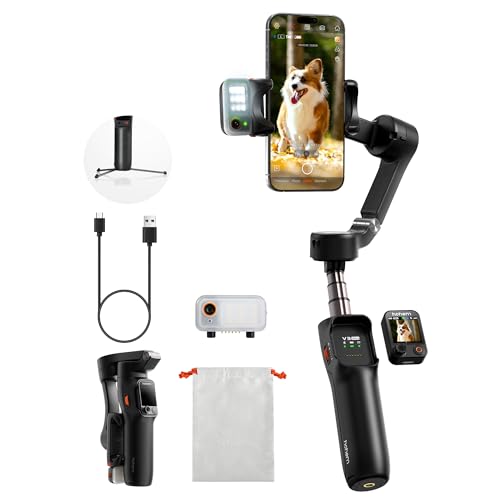
Adds a 1.22-inch touchscreen remote and a smart fill light to hohem's stabilization.
Best for: solo creators who want a touchscreen remote and fill light in one rig Skip it if: portability matters more than features
The V3 Ultra is the heaviest and the most expensive pick in this best budget gimbal stabilizer group at 0.94 lb, so it has to justify the position. It does that with a 1.22-inch touchscreen on the detachable remote that hohem says reaches 33 ft, plus a smart fill light with adjustable brightness and colour temperature. Hohem also names iSteady 9.0 stabilization and an 8-inch extension rod paired with a built-in tripod.
For solo creators, that combination replaces two accessories. You do not need a separate video light, and you do not need to fumble with your phone screen mid-shot. Set the frame, walk into it, adjust with the remote.
The folded dimensions of 2.64 x 7.48 x 4.84 in are the shortest here, which slightly softens the weight penalty. Warranty is 1 year on the listing.
The trade-offs are real. This is the slowest seller of the six in the input. It is also 0.28 lb heavier than the Osmo Mobile 7, and if you shoot handheld for long stretches, you feel it. Buy it because you want the features, not because you want the lightest rig.
Pros:
- 1.22-inch detachable touchscreen remote claim
- Built-in fill light with colour temp control
- 8-inch extension rod plus tripod
- Shortest folded footprint in the set
- iSteady 9.0 stabilization claim
Cons:
- Heaviest pick at 0.94 lb
- Most expensive pick in this set
- Slowest seller of the six here
- 1-year warranty is shorter than the Osmo Mobile 8's
5. AOCHUAN Smart XE — Most versatile
A mid-price 3-axis rig with a 2600mAh battery aimed at long-format creators.
Best for: food, beauty and live-stream creators doing long static sessions Skip it if: you shoot mostly while walking
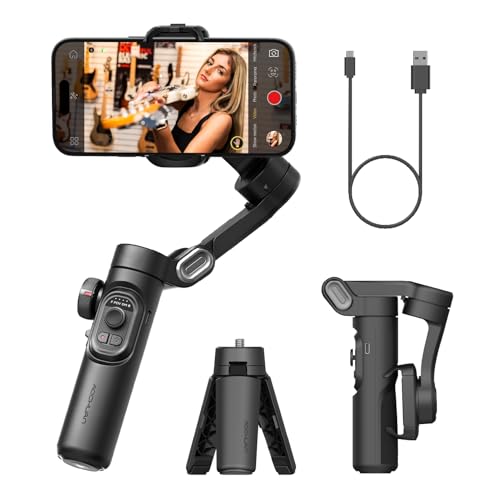
The Smart XE weighs 0.76 lb and sits third out of six on price, which puts it a step below the Osmo Mobile 7 in the same mid-tier band. AOCHUAN describes a 2600mAh battery good for up to 10 hours of continuous shooting, a 250-gram payload, and its SMART 7.0 anti-shake algorithm with brushless motors. The listing names food photography, beauty live-streaming, vlogging and YouTube as the use cases the company has in mind.
Read that as a rig built for people who set up, press record and stay in one place. The extended battery claim matches a live-stream workflow better than a walking vlog, where the Osmo Mobile 7 is the smarter buy.
The AI Face Track 4.0 label and gestural control via the AOCHUAN app fill out the software side. Panorama, wide-angle, cinematic and movie modes are named on the listing, which is a wider mode list than most picks here publish.
Compatibility is broad: iPhone and most Android phones. Warranty is 1 year from the manufacturer, on the listing.
Pros:
- 10-hour battery claim on 2600mAh
- Named modes: panorama, wide-angle, cinematic, movie
- Lighter than the Osmo Mobile 8 by 0.06 lb
- Broad iPhone and Android compatibility
- Stated 1-year manufacturer warranty
Cons:
- Heavier than the Osmo Mobile 7 by 0.1 lb
- No detachable touchscreen remote
- No built-in fill light
- Software less polished than DJI Mimo
6. Coovoamae Gimbal Stabilizer — Best budget pick
The cheapest of the six, and the only 1-axis pick: a smart selfie stick more than a gimbal.

Best for: first-time users who mainly want a smart selfie stick Skip it if: you want true 3-axis correction for run-and-gun shots
At 7.84 oz and folded to 7.5 inches, the Coovoamae is the lightest and cheapest pick in this best budget gimbal stabilizer set. It is also the only 1-axis stabilizer here, which is the fact that decides whether it fits your shooting or not. Coovoamae describes a built-in sports gyroscope that reduces hand shake, one-button switching between horizontal and vertical, and a 31.5-inch extendable pole with a wireless remote. Compatible smartphones run 4.0 to 6.2 inches, and a 1/4-inch adapter lets you mount a GoPro.
Understand what 1-axis means before you buy. It smooths one plane of movement, not three, so panning shots and static selfies look clean while walking shots keep some bounce. For travel photos, TikTok clips shot standing still and family group selfies, that is enough. For chasing a skateboarder, it is not.
The Coovoamae has the highest sales rank of the six in the input, meaning it moves the slowest here, and only two sellers list it. Warranty is 1 year on the listing.
Pros:
- Cheapest of the six picks
- Lightest at 7.84 oz
- 31.5-inch extendable pole
- App-free one-button vertical-horizontal switch
- GoPro compatible via 1/4-inch adapter
Cons:
- Only 1-axis stabilization, not 3
- Slowest seller of the six here
- Only two sellers list it on Amazon
- No AI subject tracking claim
1-axis vs 3-axis: which one do you need?
This is the deciding question in the whole best budget gimbal stabilizer category, and most guides skip it. Cheaper does not mean worse. It means different.
A 3-axis gimbal motors correct pitch, roll and yaw. Every one of the top five picks here is 3-axis. They compensate for the way your hand bobs when you walk, the way your wrist rolls when you turn, and the way your arm tilts when you crouch. Five of six picks here use 3-axis motors, so that is the default assumption in this set.
A 1-axis gimbal, like the Coovoamae, stabilizes one plane through a sports gyroscope. It is not trying to be a 3-axis rig at a lower price. It is trying to be a smart, extendable selfie stick that keeps your phone upright when you switch orientation. That is a real product for real people.
Rule of thumb:
- Walking, panning, following a subject: 3-axis.
- Standing still, group shots, travel selfies, static tabletop clips: 1-axis is enough.
If you cannot answer confidently which describes 80% of your shooting, buy 3-axis. It handles the other case; the reverse is not true.
How long will the battery really last?
Battery claims are the most exaggerated numbers in this category, so read them carefully. Every figure below is what the listing states, not a tested measurement.
- hohem iSteady X3 SE: 11 hours on a 2-hour charge, per hohem.
- AOCHUAN Smart XE: up to 10 hours from a 2600mAh cell, per AOCHUAN.
- DJI Osmo Mobile 7, DJI Osmo Mobile 8, hohem iSteady V3 Ultra, Coovoamae: runtime not stated on their listings in the input.
Two things drag those numbers down in practice. Fill lights and remote-charging your phone through the gimbal both draw current. If you plan to keep the V3 Ultra's fill light on continuously, or top up your phone from an Osmo Mobile 8, expect meaningful cuts to whatever headline the box shows.
The safer question is not "how many hours" but "how many shooting sessions between charges." For a weekly vlog, one charge a week is plenty on any 3-axis pick here. For a full weekend at a wedding or a road trip, the X3 SE and Smart XE claims are the ones that give you margin.
Bring a power bank either way. It is the cheapest insurance in a camera bag.
What to check before you press buy
Three quick checks stop most returns.
- Phone fit and weight. Every gimbal here supports iPhone and Android, but the payload matters. The AOCHUAN listing names a 250-gram payload. If you shoot with a large-body phone in a heavy case, weigh it first. A payload mismatch stops the motors from levelling and no software fixes that.
- What comes in the box. The DJI Osmo Mobile 7, Osmo Mobile 8 and hohem V3 Ultra all list built-in tripods. The V3 Ultra and Osmo Mobile 8 add extension rods. If you assume a tripod is included on a pick that does not list one, you are buying a second accessory.
- The app you will actually use. DJI's Mimo app pairs with both the Osmo Mobile 7 and Osmo Mobile 8. Hohem uses the Joy app. AOCHUAN uses its own AOCHUAN app. The 1-axis Coovoamae is deliberately app-free. Try a free app before committing to its hardware if you can: the interface, not the motors, is what people abandon.
A fourth check, if you shoot outdoors: the ergonomic grip and anti-slip handle DJI names on the Osmo Mobile 7, and the folded footprint of your pick. Anything longer than 8 inches folded stops being a jacket-pocket item, and that changes whether you actually bring it.
The verdict
The best budget gimbal stabilizer for most phone shooters is the DJI Osmo Mobile 7. At 0.66 lb it is the lightest 3-axis rig in this set, its foldable body includes a tripod, and DJI's ActiveTrack 7.0 through the Mimo app is the tracking software beginners keep using instead of abandoning after a week. The mid-tier price is fair for what you get.
Two conditions flip that pick.
Choose the hohem iSteady X3 SE if you shoot long. Its 11-hour battery claim and detachable magnetic remote are built for creators who record for hours between charges, and it costs less than the Osmo Mobile 7. The 0.13 lb weight penalty is real but manageable.
Choose the DJI Osmo Mobile 8 if you film other people, especially kids and pets. Native audio reception, lighting and the built-in extension rod plus tripod add up to a rig that follows moving subjects better than the Mobile 7, and its 2-year warranty is the longest here.
The Coovoamae is the right pick only if you have decided you want a smart selfie stick, not a 3-axis gimbal. That is a valid choice, but a different product category.
FAQ
Is a budget gimbal stabilizer worth it for casual phone video?
A budget gimbal stabilizer is worth it if you shoot phone video weekly and post it. The 3-axis picks here at 0.66 to 0.94 lb replace the shaky handheld look with something watchable, which is what most viewers notice first. For a monthly holiday clip, phone software stabilization is probably enough. For anything you publish, a mid-tier 3-axis rig pays back fast.
Is the DJI Osmo Mobile 7 worth it over the older DJI Osmo Mobile 8?
The DJI Osmo Mobile 7 is worth it when weight and price matter more than features. It is lighter at 0.66 lb versus 0.82 lb, and cheaper: the Mobile 7 sits mid-tier, the Mobile 8 premium. The Mobile 8 adds audio reception, lighting and a 2-year warranty. Pick the Mobile 8 if you film people; pick the Mobile 7 for solo vlogs.
How much does gimbal weight matter for phone video?
Gimbal weight matters more than beginners expect. Every ounce you hold at arm's length compounds over ten minutes, and arm fatigue is the top reason people stop using a gimbal within the first month. The lightest 3-axis pick here is 0.66 lb, the heaviest is 0.94 lb, and the 1-axis Coovoamae is 7.84 oz. Under 0.8 lb is the sweet spot for handheld vlogs.
DJI Osmo Mobile 7 vs hohem iSteady X3 SE, which should I buy?
DJI Osmo Mobile 7 vs hohem iSteady X3 SE comes down to what you value more. The Osmo Mobile 7 is lighter, uses the more polished DJI Mimo app, and folds smaller. The X3 SE costs less, claims 11 hours of battery on a 2-hour charge, and includes a detachable magnetic remote hohem says reaches 32.81 feet. Pick the Osmo for walking vlogs, the X3 SE for endurance shoots.
What is the most common mistake buying a gimbal stabilizer?
The most common mistake buying a gimbal is confusing 1-axis with 3-axis. A 1-axis rig like the Coovoamae smooths one plane through a sports gyroscope, which is enough for selfies and static clips but not for walking shots. If your footage shakes when you move, you needed 3-axis. Read the axis count before the price, always.
Pick your rig by the shoot you actually do, not by the shoot you plan to do next year. If you already film weekly on a phone and want the shots to look publishable, the Osmo Mobile 7 is the safe default: lightest 3-axis pick here, mid-tier price, DJI's tracking. Order it, charge it overnight, then film the same scene you filmed last week and compare. If you film long sessions or you film your family, the X3 SE and Osmo Mobile 8 respectively are the smarter buys. The 1-axis Coovoamae is a different product for a different job, and honest about it.