Best Budget Thermal Monocular by Sensor and Refresh

Five thermal monoculars compared on the two numbers that actually matter: detector resolution and refresh rate. Plus the warranty gap nobody mentions and who should skip the category entirely.

By Carter LoganUpdated 15 min read
On this page
- Best budget thermal monocular at a glance
- Why three picks were cut before the shortlist
- What does a budget thermal monocular actually decide on?
- 1. TOPDON TS004 Thermal Imaging Monocular — Best overall
- 2. RIX Pocket K2 Portable Thermal Monocular — Most versatile
- 3. Pulsar Axion XQ19 Compact Thermal Monocular — Best premium
- 4. AGM Global Vision Taipan V2 10-256 — Best for families
- 5. GOYOJO G210 Thermal Monocular — Best budget pick
- Is 256x192 enough, or do you need 384x288?
- What does the warranty column tell you here?
- When a different pick wins
- The verdict
- FAQ
The best budget thermal monocular in this set is the TOPDON TS004, because it pairs a 256x192 detector with a 50Hz refresh rate and an IP67 rating in a body listed at 2.47 oz. If you'd rather carry something with a published 800x600 OLED viewfinder and a 5-year warranty, the RIX Pocket K2 at 7.05 oz is the better buy. Getting this wrong is expensive in a specific way: a 25Hz unit smears anything that moves, so you scan a treeline, see a warm blob stutter across the frame, and never work out what it was. That's the failure mode. Not blurry pictures. Missed identification.
Best budget thermal monocular at a glance
| Pick | Sensor | Refresh | Price |
|---|---|---|---|
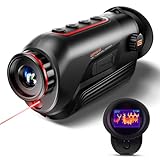
Best overall TOPDON TS004 Thermal Imaging Monocular |
256 × 192 | 50Hz | Check Price |
Most versatile RIX Pocket K2 Portable Thermal Monocular |
256x192 12μm claim |
50Hz | Check Price |
Best premium Pulsar Axion XQ19 Compact Thermal Monocular |
384x288 17μm |
not listed (AMOLED 640x400) |
Check Price |
Best for families AGM Global Vision Taipan V2 10-256 |
256 (12μm) sub-35mK claim |
not listed | Check Price |
Best budget pick GOYOJO G210 Thermal Monocular |
256x192 12μm claim |
25Hz | Check Price |


Why three picks were cut before the shortlist
I started with a wider pool of listings in the night vision monocular and monocular categories, then cut on three grounds before ranking anything.
- No stated detector resolution. Plenty of listings describe "HD thermal imaging" and never publish a pixel count. If the sensor size isn't on the page, you're buying a mystery.
- No published warranty term. A line reading "warranty available" tells you nothing. Four of the five survivors here name a term or a manufacturer commitment.
- Digital night vision sold as thermal. These are different technologies. An infrared illuminator device needs a light source; a thermal detector reads heat. Listings blur the line, and the ones that did got dropped.
What survived is a set of five where every pick publishes a detector figure and four publish a warranty. That's the floor. Above the floor, the picks separate on refresh rate, weight and whether the device records on its own.
Two things I could not screen for: real-world detection distance, and image quality. Detection range claims come from the manufacturer and depend on target size, humidity and contrast. I've quoted them where they exist and attributed them. I've never treated them as measured.
What does a budget thermal monocular actually decide on?
Most guides to the best budget thermal monocular lead with detection range. That's the wrong number to compare. A stated 410 metres means a heat source that size was distinguishable from background under whatever conditions the manufacturer used. Change the humidity and it changes.
Refresh rate is what decides it. A thermal sensor at 25Hz redraws the image twenty-five times a second. At 50Hz it does it fifty times. The difference is invisible on a static wall and obvious the moment you pan across a field or track something walking. At 25Hz the image drags behind your hand, and a moving deer becomes a smear you can't count legs on.
Three of the five picks here state 50Hz or better. The GOYOJO G210 states 25Hz. That single line is the biggest practical gap in this comparison, and it costs less to fix than any resolution upgrade.
Second criterion: weight, and whether you'll actually carry the thing. A monocular that stays in the truck detects nothing. The RIX Pocket K2 is listed at 7.05 oz with a 2.9 x 4.9 x 1.8 in body. The GOYOJO G210 is listed at 2.2 lb with a 4.33 x 9.44 x 5.51 in footprint. That's a genuinely different object.
Third: does it record without your phone? Only the AGM Taipan V2 lists onboard storage, at 16GB.
1. TOPDON TS004 Thermal Imaging Monocular — Best overall
The TS004 is the pick that gets the two decisive numbers right at a mid position in this set, and adds a stated IP67 rating on top.
Best for: wet-weather scanning where a drop rating matters Skip it if: you need long recording without a phone
Two figures do the work. The TS004 publishes a 256x192 detector and a 50Hz refresh rate, and it's the third-cheapest of the five. Every other 50Hz pick either costs more or, in the Pulsar's case, sits at the top of this field. That combination is why it leads.
TOPDON says the body is silicone-encased and rated IP67, with drop resistance from up to 2 metres. It's the only pick here publishing an ingress rating at all. The listing also claims an 11-hour runtime from a 5000mAh cell and a 13mm lens with detection to 410 metres, plus clear detail inside 100 yards. Treat those as the manufacturer's numbers, not verified ones.
The trade-off is recording. Photos and video route through the TopInfrared app on your phone, and the listing describes offline capture through the app rather than storage on the device. The AGM pick puts 16GB inside the housing instead. The published weight of 2.47 oz reads low against a 3.8 x 9.8 x 6 in packaged dimension, which suggests the figure covers the device rather than a kit. And only one seller lists it.
Pros:
- 256x192 detector at a stated 50Hz refresh
- Only pick here with a published IP67 rating
- Stated 2-metre drop resistance and silicone casing
- Claimed 11-hour runtime from 5000mAh
- Mid price position, not the top of the set
Cons:
- Recording depends on a phone app, no onboard storage listed
- Warranty listed without a stated number of years
- Only one seller stocks it
- No display resolution published
2. RIX Pocket K2 Portable Thermal Monocular — Most versatile
The Pocket K2 is the one you'll actually have in your pocket, at 7.05 oz with a published 800x600 OLED viewfinder.

Best for: carrying one in a jacket pocket every night Skip it if: you want the widest sensor available
This is the second-cheapest pick in the set and it doesn't read like it. RIX publishes a 256x192 sensor at 50Hz, claims a 12μm pixel pitch and NETD under 25mK, and lists an 800x600 OLED display. That display figure is the highest published here, above the Pulsar's stated 640x400 AMOLED. What you see through the eyepiece matters as much as what the detector reads, and this is the only sub-mid pick that tells you.
The body is 2.9 x 4.9 x 1.8 in and 7.05 oz. RIX calls it lighter than a smartphone. The integrated sliding lens cover is a small design decision that removes a real annoyance, because a loose cap is a cap you lose in the dark on the first outing.
Warranty is 5 years, matching the two premium picks and beating the TOPDON's unspecified term.
Where it gives ground: RIX publishes no runtime, no ingress rating and no onboard storage capacity. It mentions Wi-Fi, so recording likely routes to a phone, but the listing doesn't specify a memory module the way AGM does. And the sensor stays at 256x192, so anyone who needs the extra pixel count is looking at the Pulsar instead. "Resolution Enhanced Technology" is processing, not a bigger detector.
Pros:
- Highest published display resolution here at 800x600 OLED
- 50Hz refresh at the second-cheapest position
- 7.05 oz and genuinely pocketable dimensions
- 5-year warranty, matching the premium picks
- Integrated sliding lens cover
Cons:
- No runtime figure published
- No ingress or drop rating stated
- Onboard storage capacity not listed
- 256x192 detector, not the widest in this set
3. Pulsar Axion XQ19 Compact Thermal Monocular — Best premium
The Axion XQ19 is the only pick with a 384x288 detector, and it's the one worth stretching for if you need to identify rather than just detect.

Best for: identifying shapes at mid range in fog or rain Skip it if: you are shopping the bottom of the market
Everything else here runs a 256-wide detector. The Axion XQ19 runs 384x288 at a 17μm pitch, which is roughly 50% more horizontal pixels than the rest of this field. More pixels on a target means the difference between "something warm is standing there" and "that's a dog, not a coyote."
Pulsar states NETD under 18mK, the lowest sensitivity figure published in this set, and describes it as helping in low-contrast conditions like rain, humidity and fog. The listing also specifies a 19mm f/1.0 lens with 1.5–6x digital zoom and a 640x400 AMOLED display. Weight is 0.55 lb in a 2.8 x 5.3 x 1.5 in body, so it's the smallest footprint here despite the bigger sensor. Released in 2025, with a 5-year limited warranty.
The honest problem: this is the most expensive pick in the set, which puts it at the far edge of what most people shopping this category will spend. Pulsar doesn't publish a refresh rate on the listing, which is a strange omission on the pick that publishes everything else. There's an export control notice attached under the EAR, worth reading before you order. Two sellers list it.
Pros:
- Only 384x288 detector in this set
- Lowest published NETD figure at under 18mK
- 19mm f/1.0 lens with 1.5–6x digital zoom
- Smallest listed dimensions at 2.8 x 5.3 x 1.5 in
- 5-year limited warranty
Cons:
- Most expensive pick here by a clear margin
- No refresh rate published on the listing
- Export-controlled under EAR
- No stated runtime or ingress rating
4. AGM Global Vision Taipan V2 10-256 — Best for families
The Taipan V2 is the only pick that records to itself, with 16GB of onboard storage and a swappable battery.

Best for: handing round a shared device with onboard storage Skip it if: you need a published weight before you buy
Hand a phone-dependent monocular to three people in turn and someone loses the pairing. The Taipan V2 sidesteps that. AGM lists a 16GB integrated memory module for photo and video with sound, so it works standalone. It's the one device here that does.
The battery is described as a single replaceable rechargeable cell rated to 7 hours, which means a spare in a pocket rather than a power bank and a cable. AGM also claims a tilt sensor that blanks the display when the device is lowered, and a sub-35mK 12μm detector with multiple digital zoom levels. Warranty is 5 years. The body measures 2.4 x 6.23 x 2.2 in, and it's the second-most expensive pick here.
Two data gaps count against it. AGM publishes no weight, which is awkward on a device sold on portability, and no refresh rate. Its detector is described as 256 with a sub-35mK sensitivity, which is a looser figure than the RIX's claimed under 25mK or the Pulsar's under 18mK. So you're paying a premium position for onboard recording and a replaceable battery, not for a better sensor than the TOPDON's. That's a fair trade for some buyers and a bad one for others.
Pros:
- Only pick with published onboard storage, at 16GB
- Replaceable rechargeable battery, stated 7 hours
- Tilt sensor blanks the display when lowered
- 5-year manufacturer warranty
- Records video with sound on the device
Cons:
- No published weight
- No refresh rate stated
- Sub-35mK sensitivity is the loosest of the three published figures
- Premium price position without a wider detector
5. GOYOJO G210 Thermal Monocular — Best budget pick
The G210 is the cheapest way into thermal here, and the 25Hz refresh rate is exactly what you're giving up.

Best for: a first thermal device at the lowest position here Skip it if: you scan fast-moving animals
This is the cheapest of the five, and it does publish the sensor figure that matters most: a 256x192 detector with a claimed 12μm infrared pitch, matching three of the four picks above it. On a stationary target in a fixed field of view, you're looking at the same class of image.
Then it moves. GOYOJO states 25Hz, half the refresh of the TOPDON and the RIX. Pan across a hedgerow and the frame lags your hand. Track something walking and the outline blurs. That's the whole cost of the saving, and whether it matters depends entirely on how you use the device. Glassing a static field edge from a chair, you'll barely notice. Walking a fenceline, you will.
The listing describes multiple display palettes, app-based image sharing and weather-resistant construction, though no ingress rating is given. Warranty is 1 year, the shortest here by four years. It's also the bulkiest pick, listed at 2.2 lb and 4.33 x 9.44 x 5.51 in, which is a different proposition from the RIX at 7.05 oz.
It's the slowest seller of the five by a wide margin, and only one seller lists it.
Pros:
- Cheapest pick in this set
- 256x192 detector matching three costlier picks
- Multiple display palette modes
- App-based real-time sharing
Cons:
- 25Hz refresh, half the rate of the top two picks
- 1-year warranty, shortest here
- Heaviest and bulkiest at 2.2 lb
- Weather resistance claimed without an ingress rating
- Slowest seller of the five
Is 256x192 enough, or do you need 384x288?
Short answer: 256x192 is enough to detect, and 384x288 is what you need to identify. Four of the five picks here sit at 256x192. Only the Pulsar Axion XQ19 goes wider.
Detection means noticing that something warm is present. Identification means knowing what it is. At 256x192, a warm animal at 150 metres occupies a handful of pixels and reads as a bright smudge. The 384x288 sensor gives you roughly 50% more horizontal detail on the same target, which is often the difference between a shape and a species.
Two other numbers interact with resolution:
- NETD, quoted in millikelvin. Lower is better. The published figures here run from under 18mK on the Pulsar, to under 25mK on the RIX, to sub-35mK on the AGM. Lower NETD helps most in rain, fog and humid air, where target-to-background contrast collapses.
- Pixel pitch, in micrometres. The 12μm sensors here pack pixels tighter than the Pulsar's 17μm. A smaller pitch on the same sensor width means a narrower field of view per pixel, which trades scanning width for reach.
If your honest use is spotting whether a field is empty, 256x192 at 50Hz is the better value. If you need to tell two animals apart at range, resolution is the only lever that helps.
What does the warranty column tell you here?
Warranty is the one field in this comparison where the differences are stark and easy to read.
- RIX Pocket K2: 5-year manufacture
- AGM Taipan V2: 5-year manufacturer
- Pulsar Axion XQ19: 5-year limited
- TOPDON TS004: manufacturer warranty, no term stated
- GOYOJO G210: 1 warranty year
The interesting line is the RIX. It's the second-cheapest pick and it carries the same 5-year term as the two premium picks. That's unusual, and it's a reason to take it seriously as more than a compact alternative.
The GOYOJO's 1-year term is the shortest by four years. Thermal detectors are the expensive component in one of these devices, and a sensor failure outside coverage is not an economic repair. A one-year window on the cheapest pick in the field is a real risk, not a paperwork detail.
TOPDON's listing states a manufacturer warranty without naming a length. I won't guess at the term. Check the current listing before you commit, because an unnamed period is not the same as a long one.
When a different pick wins
Three conditions flip the recommendation away from the TOPDON.
If you need to identify targets past about 150 metres, the Axion XQ19 wins. It's the only 384x288 sensor here, and no amount of processing on a 256-wide detector substitutes for real pixels. That's the threshold where the cost stops looking like overspend.
If the device gets shared or handed round, the AGM Taipan V2 wins on its 16GB of onboard memory and replaceable battery. Nobody has to pair a phone, and a dead cell gets swapped in the field instead of tethered to a power bank.
If it lives in a jacket pocket, the RIX Pocket K2 wins at 7.05 oz in a 2.9 x 4.9 x 1.8 in body, with a published 800x600 OLED viewfinder and a 5-year warranty behind it.
One note on the word budget. Amazon's search for the best budget thermal monocular returns devices across a wide spread of price positions, and thermal detectors are simply expensive to make. So treat "budget" as relative to this set, not as a promise about any absolute figure. Two picks here sit in premium territory. What you can compare confidently is what each one publishes.
The verdict
Think of this field in three tiers.
At the entry end sit the GOYOJO G210 and the RIX Pocket K2, and they are not equivalent buys. Both publish a 256x192 detector, but the RIX doubles the refresh to 50Hz, drops from 2.2 lb to 7.05 oz, publishes an 800x600 OLED display, and carries 5 years of warranty against the GOYOJO's 1. If your budget lands here, the RIX is the one to buy and the G210 is the one to take only if you're glassing static scenes and want the lowest possible outlay.
The middle tier is a single device, the TOPDON TS004, and it's the winner. It matches the RIX on detector and refresh, adds the only published IP67 rating and 2-metre drop claim in this set, and claims an 11-hour runtime from 5000mAh. That's the most published capability per position in this comparison. Its weakness is real: recording runs through a phone app, and the warranty term isn't stated.
At the premium end, the Pulsar Axion XQ19 buys you resolution and sensitivity, 384x288 and NETD under 18mK, while the AGM Taipan V2 buys you independence from your phone with 16GB inside the housing and a swappable battery. Pick between them on which one you need, because they don't overlap.
FAQ
Is a budget thermal monocular worth the money?
A budget thermal monocular is worth it if your job is detection rather than identification. Spotting a warm animal in a dark field, checking a treeline, finding a pet, or scanning a barn all work fine on a 256x192 detector. If you need to tell two similar animals apart at 200 metres, the entry tier will frustrate you and the wider 384x288 sensor is the real answer.
What is the cheapest pick here and what does it cost you?
The cheapest pick here is the GOYOJO G210, and the cost is refresh rate. It publishes 25Hz against 50Hz on the TOPDON TS004 and the RIX Pocket K2, so panning and moving targets smear. It's also the heaviest at 2.2 lb and carries a 1-year warranty against 5 years on three other picks in this comparison.
TOPDON TS004 or RIX Pocket K2: which should I buy?
TOPDON TS004 or RIX Pocket K2 comes down to durability against pocketability. Both publish 256x192 at 50Hz. The TOPDON adds an IP67 rating, a 2-metre drop claim and a stated 11-hour runtime from 5000mAh. The RIX is 7.05 oz, publishes an 800x600 OLED display, and carries a stated 5-year warranty where the TOPDON gives no term.
Does refresh rate matter more than resolution?
Refresh rate matters more than resolution for scanning, and resolution matters more for identification. At 25Hz the image lags your hand and moving targets blur, which ruins a walked survey regardless of pixel count. Once you're at 50Hz, extra pixels start paying off. The Pulsar Axion XQ19's 384x288 sensor is the only step up available in this set.
Which pick records video without a phone?
The pick that records without a phone is the AGM Taipan V2, which lists a 16GB integrated memory module for photos and video with sound. Every other pick here routes capture through a companion app over Wi-Fi. If you want footage without pairing a handset each time, or you share the device between people, that onboard storage is the deciding feature.
Start with the two numbers on the listing before anything else: detector width and refresh rate. If both read 256x192 and 50Hz, you're looking at the useful floor of this category, and the TOPDON TS004 hits it while adding the only IP67 rating and 2-metre drop claim in this comparison. That's why it's the default here. Step up to the Pulsar Axion XQ19 only when you genuinely need to name what you're looking at rather than notice it's there, and step down to the GOYOJO G210 only if your scanning is static and slow.