Best Camera Bag for Beginners: K&F Concept Leads

A beginner's first camera bag has to protect gear, ride comfortably, and stay light. Five picks compared on size, weight, and what each one actually carries.

By Carter LoganUpdated 13 min read
On this page
- How I cut the field down to five
- Best camera bag for beginners at a glance
- 1. K&F Concept Camera Backpack — Best overall
- 2. CADeN Camera Backpack D6 — Best for families
- 3. RAINSMORE Vintage Canvas Sling — Most versatile
- 4. MOSISO Camera Backpack — Best for heavy use
- 5. Canon EOS Rebel T7 DSLR Bundle — Best premium
- What actually decides a first camera bag?
- Backpack, sling or shoulder bag: which suits a beginner?
- How much gear does a beginner really carry?
- What the listings do not tell you
- A note on the fifth pick
- The verdict
- FAQ
The best camera bag for beginners is the K&F Concept Camera Backpack, a 13-liter pack that weighs just 1.96 lb and fits a first DSLR or mirrorless kit without swallowing it. The CADeN D6 is the better buy if you also need to carry an iPad and small family gear alongside the camera, at 1.74 lb in a 15 x 11 x 5.9 in body. The deciding specification is not capacity. It is how the bag rides when the camera is inside.
How I cut the field down to five
I started with the criteria a beginner actually cares about, then weighted them:
- Weight of the empty bag, because a heavy shell wastes carry capacity.
- Interior dimensions, so the gear fits without forcing.
- Access pattern, front-opening versus top-loading versus sling.
- Weather protection, a listed rain cover or waterproof fabric.
- Warranty, when the listing publishes one.
Anything sold as a hard case, a rolling case, or a body-only pouch was cut. So was anything with no published dimensions, because a beginner cannot judge fit from marketing copy. Five products came through: three backpacks in different sizes, one sling, and one camera-plus-bag bundle that landed here for a different reason (see the last section). Award labels are given per pick in the table below.
Best camera bag for beginners at a glance
| Pick | Weight | Capacity | Price |
|---|---|---|---|
Best overall K&F Concept Camera Backpack |
1.96 lb | 13 L 15.2 x 15.2 x 5.1 in |
Check Price |
Best for families CADeN D6 Camera Backpack |
1.74 lb | 15 x 11 x 5.9 in | Check Price |
Most versatile RAINSMORE Canvas Sling |
Not listed | 10.2 x 5.7 x 7.5 in | Check Price |
Best for heavy use MOSISO Camera Backpack |
3.2 lb | 17.3 x 11.8 x 7.5 in | Check Price |
Best premium Canon EOS Rebel T7 Bundle |
3.81 lb | Camera bundle, not a bag | Check Price |



1. K&F Concept Camera Backpack — Best overall
A 1.96 lb, 13-liter pack that carries a beginner kit without carrying its own weight problem.
Best for: a first mirrorless or DSLR kit with one or two lenses Skip it if: you carry a full-size tripod and three lenses every outing
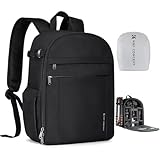
Of the three backpacks here, this is the lightest at 1.96 lb, and it is also the cheapest of the six. That combination is the reason a beginner should start here. The 15.2 x 15.2 x 5.1 in body is deep enough for a body with a kit lens attached, plus a second lens and small accessories, and the equipment compartment measures 9.8 x 4.9 x 14.1 in. K&F says the shell is 600D fabric with a rain cover included, and the interior uses detachable dividers so the whole bag converts to a day bag when you leave the camera at home. A tripod holder is fitted on the outside. The listing publishes a 1-year warranty, which the RAINSMORE sling does not. The trade-off against the MOSISO is real: this bag holds less. If your kit is already two lenses plus a flash, size up.
Pros:
- Lightest full backpack in this set at 1.96 lb
- 13-liter capacity with detachable dividers
- Front-opening main compartment for quick camera access
- Rain cover and 600D fabric listed
- 1-year warranty published
Cons:
- 5.1 in depth is tight for a large zoom
- No dedicated laptop sleeve mentioned
- One colour option in the listing
2. CADeN Camera Backpack D6 — Best for families
The lightest bag in the set at 1.74 lb, sized for a camera plus an iPad and daily gear.

Best for: parents packing a camera, iPad, and kid gear together Skip it if: you want the lightest possible daily carry
The CADeN D6 comes in a hair under the K&F at 1.74 lb, in a 15 x 11 x 5.9 in shell. CADeN says the layout fits one body plus four lenses, a flash, an iPad, and a tripod on the side, which reads as marketing copy rather than a realistic beginner load. The useful part of that claim is the iPad sleeve, which the K&F does not publish and which matters if you edit on a tablet or you are also hauling a kid's tablet to the park. The listing describes scratch and waterproof fabric, a hidden front pocket, and an inner divider system. CADeN publishes a 1-year replacement policy in the listing. Against the K&F, the trade-off is depth: this bag is 5.9 in deep versus 5.1 in, so it swallows a bit more, but it forgoes the K&F's stated 13-liter volume figure and its rain cover. If you're choosing between the two, decide on the iPad sleeve.
Pros:
- Lightest bag in the set at 1.74 lb
- iPad sleeve stated in the listing
- Deeper 5.9 in main compartment than the K&F
- Waterproof fabric claim from the brand
- 1-year replacement policy
Cons:
- No published capacity in liters
- No rain cover mentioned
- Marketing copy overpromises the internal load
- Divider layout details thin in the listing
3. RAINSMORE Vintage Canvas Sling — Most versatile
A 10.2 x 5.7 x 7.5 in crossbody sling for people who want the camera on their hip, not their back.

Best for: street shooters who want quick side access Skip it if: you need to carry a laptop or a tripod
This is the only sling in the shortlist, and it is here because a first camera bag does not have to be a backpack. A sling swings around your body, the camera comes out in one motion, and the bag stays on. RAINSMORE says the shell is high-density waterproof canvas with microfiber leather trim, metal hardware rather than plastic, and reinforced stitching at stress points. Dimensions are 10.2 x 5.7 x 7.5 in, which is enough for a compact mirrorless body with a short prime, or a DSLR with a kit lens if the lens is not oversized. The listing does not publish an empty weight, which is the main knock against it, and there is no stated warranty. Two sellers stock it, the only pick in this set with more than one offer. Against the two entry backpacks, the sling gives up capacity and gains speed. If you shoot street or travel light, that trade is the point.
Pros:
- Sling access is faster than any backpack here
- Waterproof canvas and microfiber leather stated
- Metal hardware rather than plastic
- Two sellers listed, the only pick with a second offer
Cons:
- No published weight in the listing
- No stated warranty
- Not sized for a laptop or a full-size tripod
- Smaller total capacity than the backpacks
4. MOSISO Camera Backpack — Best for heavy use
A 3.2 lb, 17.3 x 11.8 x 7.5 in backpack with a hardshell front for bigger beginner kits.
Best for: beginners already building a two-lens plus flash kit Skip it if: you want to keep the bag under two pounds
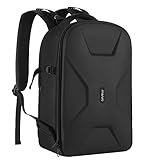
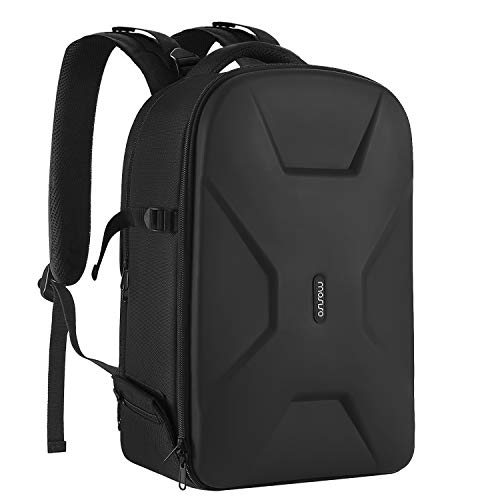
MOSISO sits at the top of the price positions here, and it earns that spot with size, not features. At 17.3 x 11.8 x 7.5 in and 3.2 lb, this is the biggest and heaviest bag in the set. The trade is real: the internal camera compartment measures 16.54 x 11.42 x 5 in per the listing, which fits a body with a mid-range zoom attached and leaves room for a second lens. The front panel uses waterproof PU leather over foam padding for shock protection, and the tripod strap sits on one side. Two compartments split the load, with cable and card pockets on the back face. The shoulder strap adjusts from 17.72 to 39.4 in. Against the K&F, this bag doubles down on protection and capacity at the cost of nearly a pound of empty weight and a higher price position. Skip it if your kit is just a body plus one lens; you are paying for space you will not use.
Pros:
- Largest internal compartment in this set
- Hardshell PU front for impact protection
- Tripod strap fitted on the side
- Two-compartment split with dedicated back-face pockets
Cons:
- Heaviest bag here at 3.2 lb
- Highest-positioned backpack of the three
- No warranty stated in the listing
- Overbuilt for a single-lens starter kit
5. Canon EOS Rebel T7 DSLR Bundle — Best premium
A camera-plus-accessory bundle, not a bag on its own. Here because many beginner shoppers are still picking the camera.

Best for: someone who still needs the camera itself, not the bag Skip it if: you already own a body and are shopping for a bag
I'll be straight about this one. The Canon EOS Rebel T7 bundle is not a camera bag. It is a DSLR kit with a 18-55mm lens, an LP-E10 battery, a charger, a body cap, a neck strap, and a 10-piece accessory count per the listing. It appears in this roundup because the search for a first camera bag often overlaps with the search for a first camera, and the bundle sells faster than most bag-only listings in this category. The body weighs 3.81 lb as bundled, and Canon publishes a 1-year warranty. If you have not bought a camera yet, buy this bundle first and pair it with the K&F backpack above. If you already own a body, ignore this pick and choose one of the four bags. This is the only pick here with a Digital Cameras category path.
Pros:
- Complete starter kit with body, lens, battery, and charger
- Canon EF and EF-S lens compatibility for future upgrades
- Built-in Wi-Fi and NFC for phone transfer
- 1-year warranty published
Cons:
- Not a camera bag
- Highest price position in this set
- Bundle contents will still need a bag afterwards
- Adds 3.81 lb of camera to whatever you carry
What actually decides a first camera bag?
Most guides compare liters. That number is not what decides it, because a 13-liter bag from one brand fits differently to a 13-liter bag from another. What decides a beginner's first camera bag is three things, in order:
- How the bag rides with the camera loaded. Empty weight below 2.5 lb is the useful line here. The K&F at 1.96 lb and the CADeN at 1.74 lb sit under it; the MOSISO at 3.2 lb does not.
- How you get to the camera. Front-opening backpacks (K&F, MOSISO) let you swing the pack around and reach in. Sling bags (RAINSMORE) rotate to the hip. Top-loading is the slow option and none of these are top-loaders.
- Whether the interior actually fits your body plus your longest lens attached. The compartment depth is the number to check: 5.1 in on the K&F, 5.9 in on the CADeN, 7.5 in on the MOSISO. A DSLR with a mid-range zoom attached wants at least 6 in.
Read those three figures before you read a single feature bullet.
Backpack, sling or shoulder bag: which suits a beginner?
A beginner is deciding between two shapes: the backpack and the sling. Each solves a different problem.
The backpack wins on capacity, comfort over long distances, and protection. Two straps spread the weight, which matters once the loaded bag is over five or six pounds. A backpack also carries a tripod, a water bottle, and a jacket without the camera compartment getting cramped. The K&F, CADeN and MOSISO are all backpacks.
The sling wins on access speed and travel comfort. You never take a sling off to shoot. It rotates from your back to your front in one motion, you unzip, you shoot, you rotate it back. The RAINSMORE is the sling here. The catch: capacity is smaller, and slings put all the weight on one shoulder, which starts to hurt past about four pounds loaded.
The rule of thumb: backpack if you carry more than a body and one lens, sling if you carry a body, one lens, and a spare battery. Beginners often think they'll travel light and then don't. Size up if you're honest with yourself.
How much gear does a beginner really carry?
A first-year kit is usually smaller than the marketing implies. In practice, it's:
- One body, likely a mirrorless or an entry DSLR like the Rebel T7 above.
- One kit lens, typically an 18-55mm or a 24-70mm zoom, mounted on the body.
- A spare battery and charger.
- Two or three SD cards.
- A cleaning cloth and a rocket blower.
- A phone, always.
That whole set fits inside the K&F's 9.8 x 4.9 x 14.1 in equipment compartment with room to spare. It fits the RAINSMORE sling too, if the kit lens is short. It does not need the MOSISO's 16.54 x 11.42 x 5 in interior; that pack is built for a two-lens or two-body future you may not reach for a year. Buy for the kit you have plus one lens, not for the kit you imagine.
What the listings do not tell you
Three things are missing from every product page in this set, and they are worth naming so you can judge them yourself in the reviews (which I am not citing, because the input carries no review data at all).
- Actual back panel comfort over an hour. Padding thickness is not published for any of these bags.
- Zipper feel and long-term durability. CADeN claims a 5-year zipper lifespan, and the RAINSMORE listing highlights metal hardware over plastic. Neither is a tested figure.
- How well the rain cover deploys in wind. The K&F says a cover is included. The others do not.
The K&F publishes the most complete specification set here: liters, weight, external and internal dimensions, warranty, and model number. That completeness is itself a reason to pick it as a first bag. You are buying a known quantity.
A note on the fifth pick
The Canon Rebel T7 bundle is in this roundup because search intent around "best camera bag for beginners" splits. Some readers already own a camera; some are still choosing one. If you're in the second group, buy the camera first, then a bag sized to what you actually own. The K&F Concept backpack is the right pairing for the T7 as bundled: the T7 body measures 2.9 x 5.7 x 4.4 in and 3.81 lb bundled with the 18-55mm lens, which sits comfortably inside the K&F's equipment compartment with room for the LP-E10 battery, the charger and a couple of SD cards.
The verdict
The best camera bag for beginners is the K&F Concept Camera Backpack. It is the cheapest of the six, the lightest full backpack at 1.96 lb, and the only bag in the shortlist that publishes a full specification set with a rain cover, a 13-liter capacity, and a 1-year warranty. For most first kits, that combination is enough.
Two conditions flip the pick. If you also carry an iPad and small family gear alongside a body, the CADeN D6 is the better buy: it weighs 1.74 lb, adds an iPad sleeve, and gives up almost nothing in exchange. If you shoot street, travel, or events where speed of access matters more than capacity, the RAINSMORE sling is the right shape, and the fact that it puts the camera on your hip instead of your back is worth a smaller compartment.
Skip the MOSISO unless your kit already includes two lenses and a flash. It is a good bag; it is not a beginner's bag. Skip the Rebel T7 bundle unless you also need a camera, and if you do, pair it with the K&F.
FAQ
What size camera bag is best for a beginner?
What size camera bag is best depends on your longest lens, not on a liter figure. Aim for a compartment at least 5 in deep, 10 in wide, and 12 in tall. The K&F's 9.8 x 4.9 x 14.1 in equipment compartment fits a body with a kit lens attached plus a second lens. Anything larger is over-buying for a first-year kit.
Is a camera backpack or a sling bag better for a beginner?
A camera backpack or a sling is a choice between capacity and access. A backpack like the K&F carries more, spreads the load across both shoulders, and fits a tripod. A sling like the RAINSMORE rotates to your hip in one motion and never comes off. Choose the backpack if you carry more than a body and one lens; choose the sling if you don't.
Do camera bags need to be waterproof?
Camera bags need to be splash-resistant, not fully waterproof. Every bag in this shortlist claims either waterproof fabric or a splash-proof shell in the listing. The K&F additionally includes a separate rain cover, which is what you actually want if you get caught in real weather. A sealed shell alone is not enough once water finds the zippers.
How heavy should an empty camera bag be?
How heavy an empty camera bag should be matters more than most beginners realise. Every ounce of shell is an ounce you can't spend on the kit. Below 2.5 lb is the useful line. The CADeN at 1.74 lb and the K&F at 1.96 lb both sit under it. The MOSISO at 3.2 lb doesn't, and you feel it after an hour.
K&F Concept or CADeN D6: which should I pick?
K&F Concept or CADeN comes down to whether you carry a tablet. The K&F is 13 liters with a rain cover and published liter capacity, and it publishes the most complete specification set here. The CADeN adds an iPad sleeve and shaves 0.22 lb. If you edit or read on a tablet, choose the CADeN. Otherwise the K&F is the more complete beginner pick.
Start with the K&F Concept if you're picking one bag today and you're not sure which. It is the lightest full backpack in this shortlist at 1.96 lb, it publishes the most complete specification set of the four bags, and its 13-liter capacity is sized for the kit a beginner actually carries in the first year: a body, a kit lens, a spare battery, a few cards, and the small stuff. Grow into a bigger bag when your kit grows, not before. The MOSISO is waiting when you need it, and the sling is a useful second bag once you know how you shoot.