Best Office Stereo: Panasonic SC-PM270 Leads

Wattage is what splits this field of six, and the numbers run from 4.5W up to 80W. Here's which office stereo suits a small room, a shared floor, and a desk with almost no space left on it.

By Carter LoganUpdated 17 min read
On this page
- Best office stereo at a glance
- How I ranked these six, and what the criteria weigh
- What actually decides an office stereo: watts or footprint?
- 1. Panasonic Compact Stereo System with CD Player — Best overall
- 2. Philips Bluetooth Stereo System for Home with CD Player — Best premium
- 3. HANLIM Home Stereo System with CD Player — Runner-up
- 4. Jensen JBS-300 Home Bluetooth Stereo Shelf Music System — Best for pros
- 5. Philco Stereo Shelf System with Digital FM Radio — Best for beginners
- 6. Baolira Retro Bluetooth Speaker — Best budget pick
- How much desk space does each one eat?
- Do you still need a CD player at work?
- What the listings do not tell you
- The verdict
- FAQ
The best office stereo is the Panasonic SC-PM270PP-K, a 20W RMS shelf system that fits CD, FM radio and Bluetooth into an 8.1 lb chassis. If your room is large enough that 20W disappears into it, the Philips 80W system is the better buy, at 15.1 lb and 15 x 20 x 12 in.
Wattage is what splits this field. The published outputs run from 4.5W to 80W, a seventeen-fold spread, and that single figure decides more than any feature list here does. Everything else on these six listings is roughly the same set of inputs.
Best office stereo at a glance
| Pick | Output | Footprint | Price |
|---|---|---|---|
Best overall Panasonic Compact Stereo System with CD Player |
20W RMS (10+10) | 8.8 x 9.1 x 18.1 in | Check Price |
| 80W RMS claim | 15 x 20 x 12 in | Check Price | |
| 30W max (15+15) | 8.46 x 11.8 x 7.09 in | Check Price | |
| 10W claim | Wall-mountable, size not listed | Check Price | |
Best for beginners Philco Stereo Shelf System with Digital FM Radio |
Not published | 8.74 x 7.28 x 12 in | Check Price |
Best budget pick Baolira Retro Bluetooth Speaker |
4.5W claim | 4.3 x 2 x 2.8 in | Check Price |


How I ranked these six, and what the criteria weigh
I weighted four things, and I weighted them unevenly.
- Published output, at roughly 40%. It is the one figure that is stated in comparable units across most of this set, and it maps directly to whether a stereo can fill your room or just your desk.
- Footprint, at roughly 30%. An office stereo competes with a monitor, a keyboard and a notebook for the same surface. Width matters more than depth here.
- Input coverage, at roughly 20%. CD, FM, USB, aux and Bluetooth. Most of these cover most of it, so it separates picks less than you'd expect.
- Published specification completeness, at roughly 10%. A listing that states weight, size and warranty is a listing you can plan around.
Why those weights? Because the failure mode in this category is not bad sound. It is a box that either cannot be heard over a laptop fan or cannot physically go where you wanted it. Both of those are predictable from the numbers before you buy, which is more than you can say for tone quality.
Feature bullets got the least weight of anything. Every one of these six claims good sound; none of them defines it.
What actually decides an office stereo: watts or footprint?
Most guides to the best office stereo lead with inputs. Bluetooth version, CD-R compatibility, how many FM presets. That is the least useful comparison you can run on this set, because five of these six offer Bluetooth plus a physical input plus radio. The inputs are commodity.
Output and width are what actually decide it, and they pull against each other.
Look at the spread. The Baolira claims 4.5W from a 4.3 x 2 x 2.8 in body. The Philips claims 80W from a 15 x 20 x 12 in body. That is not a small difference in kind, it's a different product doing a different job. One is a desk ornament that plays music. The other is a room system that happens to sit on a shelf.
Here's the trick with an office: the room is usually smaller than a living room and the noise floor is usually lower. You are not competing with a television. You are competing with a keyboard, a fan and possibly a colleague. That pushes the useful answer toward the middle of this range rather than the top.
The threshold I'd use is 20W. Below it, you are buying background audio for one person at one desk. At or above it, you are buying something that stays clear when you push it and still fills a room with the door shut. The Panasonic sits exactly on that line, which is why it wins.
1. Panasonic Compact Stereo System with CD Player — Best overall
The Panasonic hits the useful output threshold for an office at the lowest weight of any full shelf system here.
Best for: a private office of moderate size that needs CD, radio and Bluetooth in one box Skip it if: your desk cannot spare an 18-inch run of width
Panasonic publishes 20W RMS as 10W plus 10W, and it publishes the driver sizes behind it: a 10cm woofer and a 6cm tweeter per side. That combination of a stated RMS figure and stated driver dimensions is unique in this set. Every other pick gives you one or the other, or neither.
At 8.1 lb it is the lightest of the three full shelf systems, and the 2024 release date makes it the newest listing here. The 8.8 x 9.1 x 18.1 in dimensions are the catch: this is a wide unit, because the speakers sit either side of the CD deck rather than detached from it. Panasonic says a Bluetooth Re-Master function compensates for signal lost to compression, and the listing describes bass and treble buttons plus "My Sound" presets on the front panel.
It is also the one buyers choose most often among the shelf systems here. The trade-off against the Philips is straightforward: a quarter of the claimed output for a little over half the weight. Against the HANLIM, you give up the ability to separate the speakers.
Pros:
- 20W RMS stated, not a peak figure
- Driver sizes published: 10cm woofer, 6cm tweeter
- Lightest full shelf system here at 8.1 lb
- Newest listing in this set, released 2024
- Bass and treble controls on the front panel
Cons:
- 18.1 in wide, the second-widest footprint here
- The most expensive pick after the Philips
- Bluetooth Re-Master benefit is a manufacturer claim only
- Only two sellers list it
2. Philips Bluetooth Stereo System for Home with CD Player — Best premium
Four times the claimed output of the Panasonic, at nearly twice the weight and the highest price position in this set.

Best for: a large studio or open office room that needs to fill the space Skip it if: you work in a shared room or want something you can lift one-handed
The 80W RMS figure is the headline, and Philips backs it with 2-way bookshelf speakers and 4" woofers. Those are the largest drivers described anywhere in this set. It is also the only pick here that names its Bluetooth version, 5.4, and the only one claiming Auracast support.
Input coverage is the broadest of the six. The listing describes CD, CD-R/RW and MP3 CD playback, FM digital radio with presets, a 3.5mm input, and USB handling MP3, WAV, WMA and FLAC. FLAC support is not mentioned by any other pick. There's also a companion app with digital sound control and custom EQ, plus a clock, alarm and sleep timer.
Size is where an office buyer has to think hard. At 15 x 20 x 12 in and 15.1 lb, it is the largest and heaviest thing here by a wide margin, and 80W in a small room with thin walls is a social problem rather than an audio one. The 2020 release date also makes it the oldest listing in the set. Only one seller lists it.
Pros:
- Highest published output here at 80W RMS
- Largest described drivers: 4" woofers, 2-way design
- Bluetooth 5.4 with Auracast, the only version stated
- FLAC, WAV, WMA and MP3 over USB
- App-based EQ plus bass and treble adjustment
Cons:
- Heaviest and largest pick at 15.1 lb and 15 x 20 x 12 in
- Highest price position of all six
- Oldest listing here, released 2020
- Only one seller lists it
3. HANLIM Home Stereo System with CD Player — Runner-up
The only pick that ships as a separate main unit plus two detached speakers, which changes what you can do with a shelf.

Best for: someone who wants separate speakers they can place apart on a shelf Skip it if: you want a single sealed unit with nothing to wire
HANLIM publishes 30W max as 15W plus 15W, the second-highest figure here. More useful for an office is the three-piece construction: one main unit at 6.3 x 8.5 x 7 in, plus two speakers at 5.2 x 7.2 x 6.3 in each, joined by cables. You choose the spacing. On a bookshelf behind a desk that means real stereo width without one continuous 18-inch block.
The listing describes a silk tweeter for high frequencies and a braided carbon fibre woofer, plus resume play that picks up a disc where you stopped it. Inputs cover CD, CD-R and CD-RW, FM from 87.5 to 108MHz, Bluetooth, aux, USB and a headphone jack. Total shipping weight is 8.6 lb.
Two things to weigh. The 30W is stated as a maximum rather than RMS, so it is not directly comparable to the Panasonic's 20W RMS. And three boxes means two speaker cables to route, which is more cable management than a one-piece unit demands. The published count field also reads as 0, which tells you something about how carefully this listing was assembled.
Pros:
- Separate speakers you can space apart
- 30W stated output, 15W per channel
- Smallest main-unit depth here at 7.09 in
- Headphone jack, aux and USB all listed
- Resume play after pausing a disc
Cons:
- 30W is a maximum figure, not RMS
- Two speaker cables to route and hide
- Driver materials described but not sized
- Listing details are inconsistent in places
4. Jensen JBS-300 Home Bluetooth Stereo Shelf Music System — Best for pros
The only pick here that mounts to a wall, which is the answer when your desk has no surface left to give.
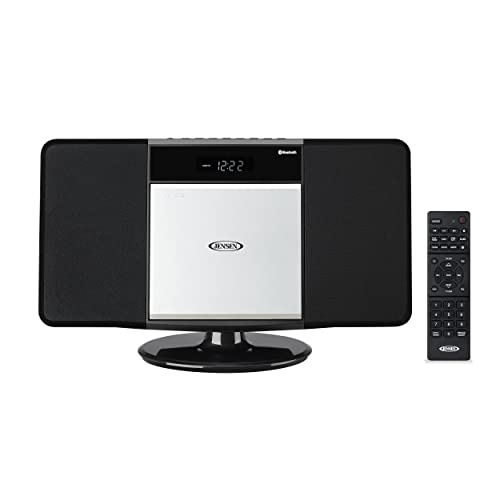
Best for: an office with no free desk space that can mount to a wall Skip it if: you need published weight and size figures before you commit
Wall mounting is the differentiator, and in a working office it is a bigger deal than the 10W claim suggests. Get the unit off the desk and you reclaim the whole footprint. The CD deck loads vertically rather than on a tray, which is what makes flat mounting workable in the first place.
Jensen describes AM and FM reception with digital PLL tuning and 20 presets on each band. That AM tuner is worth flagging: it is the only one in this set. If you keep a talk or sports station on in the background, no other pick here covers it. The listing also names four EQ presets, rock, jazz, pop and classic, plus a headphone jack, aux input, USB playback, and an alarm that wakes to radio, CD or USB. Bluetooth supports A2DP and AVRCP, so track controls work from the unit.
The published data is thin. No weight, no dimensions, no release date. Warranty is stated as one year direct. That's a real problem when the whole appeal is mounting it somewhere specific, and 10W is the second-lowest claimed output here.
Pros:
- Wall-mountable, the only one in this set
- Only pick with an AM tuner, 20 presets per band
- Vertical CD loading suits flat mounting
- Four named EQ presets plus headphone jack
- Alarm wakes to radio, CD or USB
Cons:
- No published weight or dimensions
- 10W is the second-lowest claimed output here
- Slowest-selling shelf system among these picks
- Only one seller lists it
5. Philco Stereo Shelf System with Digital FM Radio — Best for beginners
The simplest full system here, and the only one that isn't black or silver.

Best for: a first stereo for a small office where the look matters Skip it if: you want a published wattage figure or an AM band
Rose gold is not a spec, but in an office it functions as one. Every other shelf system here is black, silver, or black and silver, and if your desk setup has any warmth to it this is the only pick that won't read as equipment. At 8.74 x 7.28 x 12 in it is also the narrowest full shelf system in this set, roughly six inches less width than the Panasonic wants.
Philco lists digital FM radio, Bluetooth, USB playback, an aux port, an LCD display and a remote. That covers what most office listening actually consists of. It is the second-cheapest pick here and the second-lightest on price position overall.
The listing is the thinnest of the six, and that's the honest weakness. There is no published output figure, no weight, no warranty, no release date and a single feature bullet. You cannot tell from the data whether this is closer to the HANLIM's 30W or the Jensen's 10W, which makes it hard to match to a room size with any confidence. It is also the slowest seller in this whole group. If you want to know what you're getting before it arrives, one of the picks above tells you more.
Pros:
- Narrowest full shelf system here at 12 in wide
- Rose gold finish, the only non-black option
- Second-cheapest of the six
- FM, Bluetooth, USB, aux and remote all covered
- LCD display for source and station
Cons:
- No published output, weight or warranty
- Thinnest listing detail in this set
- No AM band and no CD-R specifics stated
- Slowest seller of the six
6. Baolira Retro Bluetooth Speaker — Best budget pick
A 6.4 oz pocket speaker with a 2-year warranty, and the only pick you can move between desks without unplugging anything.

Best for: a hot desk, a cubicle, or a bag you carry between offices Skip it if: you need CD, radio or genuine stereo separation
This is the odd one out, and it earns its place on portability alone. It weighs 6.4 oz and measures 4.3 x 2 x 2.8 in, which is small enough to live in a laptop bag. Baolira claims dual drivers producing 4.5W, Bluetooth 5.0 compatibility with Android and iOS, and 5 to 6 hours of playback depending on volume. Battery power means no outlet, which is the whole argument if you work from a shared desk or a rotating one.
It also carries the longest warranty in this set at 2 years, double the one-year terms on the shelf systems. It is the cheapest pick here and the one buyers choose most often across the whole group, which for a small green retro speaker is not surprising.
Be clear on what you give up. There is no CD deck, no radio and no aux input in the published details. Stereo from a single 4.3-inch enclosure is nominal at best, whatever the dual-driver claim says. And 4.5W is under a quarter of the Panasonic's 20W, so this fills a desk area, not a room. Treat it as a companion to a laptop rather than a replacement for a shelf system.
Pros:
- Lightest pick by far at 6.4 oz
- Longest warranty here at 2 years
- Battery powered, 5 to 6 hours claimed
- Cheapest of all six picks
- Fits a 4.3 x 2 x 2.8 in pocket space
Cons:
- 4.5W claim is the lowest output in this set
- No CD, no radio, no aux listed
- Stereo width is nominal from one small enclosure
- Needs recharging, unlike every other pick
How much desk space does each one eat?
Width is the number to check, not volume. Monitors, keyboards and document trays all compete for horizontal run, and depth is usually free behind them.
Ranked by published width, narrowest first:
- Baolira: 4.3 in
- HANLIM main unit: 6.3 in, plus two 5.2 in speakers placed wherever you like
- Philco: 12 in
- Philips: 15 in
- Panasonic: 18.1 in
- Jensen: not published, but wall-mountable
Note what the HANLIM does to that list. Three small boxes total more inches than the Panasonic's single 18.1 in span, but they don't need a continuous run of clear surface. Two speakers can go on a shelf above, on filing cabinets either side, or on bookends. That flexibility is worth more in a cramped office than a smaller total.
The Jensen sidesteps the question entirely by going on the wall. Without published dimensions you're mounting blind, though, so measure your intended spot and be ready for it to sit differently than you pictured.
Do you still need a CD player at work?
Four of these six include one, so the market clearly thinks yes. Whether you need it depends on one question: do you own discs you can't easily stream?
Reasons a CD deck still earns its place on an office stereo:
- Audiobooks and language courses on disc, which often aren't on streaming services
- Archived recordings, lectures or personal compilations
- Playback with no account, no app and no data allowance
- A source that keeps working when the office network doesn't
The Panasonic, Philips, HANLIM and Jensen all handle CD-R or CD-RW as well as pressed discs, so burned compilations play. The Philips and Jensen both name MP3 CD support, which means one disc can hold hours of audio rather than one album.
If you stream everything, the deck is dead weight and you should weigh the other specs harder. The Philco keeps a CD deck without publishing a wattage figure. The Baolira drops the deck and gets down to 6.4 oz. Both are legitimate answers to the same question, from opposite directions.
What the listings do not tell you
Three gaps run through this set, and knowing them changes how much confidence to put in the numbers.
Output figures are not measured the same way. Panasonic and Philips both state RMS. HANLIM states a maximum. Jensen and Baolira give a bare watt number with no standard attached. Philco gives none. Comparing 30W max against 20W RMS is not a like-for-like comparison, and the RMS figure is the more conservative of the two.
Nobody publishes a frequency response. Driver sizes appear on three listings, materials on one, and that's the extent of it. You can infer that 4" woofers move more air than a 6cm tweeter, but you cannot infer how low anything goes.
Speaker placement isn't described for the one-piece units. The Panasonic and Philips both put speakers alongside the deck, but nothing tells you how far apart. On a desk at close range that affects the stereo image more than watts do, and it's the strongest practical argument for the HANLIM's detachable pair.
One more thing on the keyword itself. Only one of these six is marketed for office use in its own title, and it's the smallest. Everything else here is a home shelf system that happens to work at a desk. That's fine, but it means you're judging office suitability from size, output and power source yourself rather than taking a manufacturer's word for it.
The verdict
If you have a private office with a door and a shelf you can spare, the Panasonic SC-PM270PP-K is the office stereo to buy. It publishes 20W RMS with driver sizes to back it, weighs 8.1 lb, and covers CD, FM, USB and Bluetooth in one 2024-vintage box. Front-panel bass and treble means you adjust it without reaching for an app.
If you have a large room, an open studio, or you just want headroom, the Philips 80W system is the better buy. The cutoff is roughly the size of a single-occupant office. Below that, 20W is plenty and 80W is a nuisance. Above it, the Philips 4" woofers and 80W RMS are what stop music thinning out across the room, and the 15.1 lb weight stops mattering once it's placed.
Two conditions flip both answers. If your desk has no clear 12-inch run, the HANLIM's three-piece layout puts speakers where a one-piece unit can't go. If you have no desk to speak of, the Jensen goes on the wall and the Baolira goes in your bag at 6.4 oz. Pick the constraint first, then the wattage.
FAQ
Is a premium office stereo worth it over a budget one?
A premium office stereo is worth it when room size demands the output. The gap between the Baolira's 4.5W claim and the Philips 80W RMS is real and audible in anything larger than a cubicle. In a small private office, though, the Panasonic's 20W RMS covers the same job for less, and the extra money mostly buys headroom you'll never reach.
What size office stereo fits a standard desk?
Office stereo size comes down to width, and 12 in is the practical ceiling for most desks alongside a monitor. The Philco fits at 8.74 x 7.28 x 12 in. The Panasonic needs 18.1 in and the Philips 15 in, so both really want a shelf. The HANLIM splits into a 6.3 in main unit plus two separate speakers.
Panasonic or Philips: which office stereo should I pick?
Choosing between Panasonic and Philips comes down to room volume. Panasonic gives 20W RMS at 8.1 lb in an 18.1 in wide chassis, with front bass and treble buttons. Philips gives 80W RMS with 4" woofers, Bluetooth 5.4 and FLAC support, but weighs 15.1 lb and measures 15 x 20 x 12 in. Small room, Panasonic. Large room, Philips.
Do any of these office stereo picks receive AM radio?
Only one office stereo here covers AM: the Jensen JBS-300, with digital PLL tuning and 20 AM presets alongside 20 FM presets. Every other pick lists FM only, and the HANLIM specifies 87.5 to 108MHz. If AM talk or sports coverage matters at your desk, the Jensen is the sole option, despite its 10W claim.
What mistake do office stereo buyers make most often?
The most common office stereo mistake is buying on wattage without measuring the shelf. A 15 x 20 x 12 in unit that won't fit is worthless regardless of output. The second mistake is comparing a maximum figure against an RMS figure as though they match. HANLIM's 30W max and Panasonic's 20W RMS are measured differently.
Measure your available width first, then pick the highest output that fits. For most single-occupant offices that lands on the Panasonic SC-PM270PP-K: it hits the 20W threshold where music stays clear at working volume, it publishes enough about its drivers that you know what you're getting, and it's the newest listing in this group. If your tape measure says you have less than a foot of clear surface, look at the HANLIM's separate speakers or put the Jensen on the wall instead.