Best Overhead Camera Tripod for Pros: NEEWER TP63
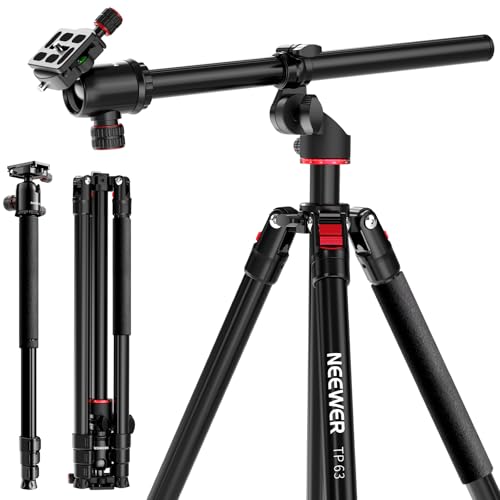
Six horizontal-column tripods compared on reach, load, weight and build. The NEEWER TP63 leads on published capability; the K&F premium wins on stability.

By Carter LoganUpdated 16 min read
On this page
- Best overhead camera tripod for professionals at a glance
- How I screened this shortlist
- 1. NEEWER TP63 90 Inch Tall Overhead Horizontal Camera Tripod — Best overall
- 2. K&F CONCEPT 90"/230cm Ultra High Horizontal Overhead Camera Tripod — Best premium
- 3. K&F Concept 76 in Overhead Camera Tripod — Best for pros
- Why a horizontal center column is the whole point
- How much reach do you actually need overhead?
- 4. SmallRig CT25 64.5"/164cm Horizontal Overhead Tripod — Runner-up
- 5. NEEWER 72 inch Camera Tripod Monopod — Best for beginners
- 6. Pozliv Overhead Camera Mount with Ring Light — Best budget pick
- Does the professionals label hold up here?
- What the listings do not tell you about overhead work
- The verdict
- FAQ
The best overhead camera tripod for professionals is the NEEWER TP63, a 90 in horizontal-column rig rated to 22 lb that converts to a monopod and ships with an Arca-type plate. If you want a heavier center column and the sturdiest studio build in this set, the K&F CONCEPT 90"/230cm at 4.45 lb is the better pick. Reach, load and column diameter are the three specs that decide this category, and this shortlist splits cleanly along those lines.
Best overhead camera tripod for professionals at a glance
| Pick | Max reach | Load / weight | Price |
|---|---|---|---|
Best overall NEEWER TP63 90 in |
90 in | 22 lb load 4.1 lb tripod |
Check Price |
Best premium K&F CONCEPT 90"/230cm |
90 in | 22 lb claim 4.45 lb tripod |
Check Price |
Best for pros K&F Concept 76 in |
76.7 in | 8 kg claim 3.64 lb tripod |
Check Price |
Runner-up SmallRig CT25 64.5" |
64.5 in | Load not listed 3.53 lb tripod |
Check Price |
Best for beginners NEEWER 72 in |
72.4 in | 33 lb claim 3.77 lb tripod |
Check Price |
Best budget pick Pozliv Overhead Mount |
Desktop | Phone/webcam Load not listed |
Check Price |



How I screened this shortlist
Every entry was judged against the criteria a working overhead shooter cares about, weighted in this order.
- Horizontal reach and column length. The whole reason to buy an overhead camera tripod for professionals is to get the sensor plane parallel to the surface below, from far enough back that the legs are out of frame. Two rigs here hit 90 in. Two land in the 64 to 77 in range. One is a desktop mount.
- Rated load with a real number. The NEEWER TP63 states 22 lb. The K&F CONCEPT 90"/230cm states 22 lb. The NEEWER 72 in claims 33 lb. The K&F 76 in claims 8 kg. Anything without a load figure on the listing was a strike.
- Column diameter and build. A horizontal column is a lever, and lever arms flex. K&F CONCEPT's premium listing calls out a 28 mm column and a 28 mm ball head. That is the specification I compared everything against.
- Monopod convert or removable boom. Three picks here separate into a monopod or a detachable extension arm. That flexibility earns a professional's slot in the bag.
The two picks that got cut from the longlist had no stated load capacity and no stated horizontal-column diameter, which for the best overhead camera tripod for professionals is disqualifying.
1. NEEWER TP63 90 Inch Tall Overhead Horizontal Camera Tripod — Best overall
The TP63 is the only rig here that pairs a 90 in horizontal column with a 22 lb load rating, a monopod convert and an Arca-type plate, all at 4.1 lb.
Best for: product and food shooters who need a full 90 in horizontal reach and a monopod in one rig Skip it if: you shoot heavy medium-format bodies with long glass
The TP63's case rests on what the listing actually publishes. Reach is 90 in, weight is 4.1 lb, load capacity is 10 kg or 22 lb, and folded dimensions are 7.48 x 29.1 x 7.48 in. NEEWER says the center column raises for higher angles and rotates into a horizontal position for 360° overhead work, with three adjustable leg angles and an inverted-leg mode. One leg unscrews to become a monopod, which is the feature working shooters actually use on location. The head is a 360° ball head with +90 to -90 tilt, Arca-type plate, locking knobs and a scaled pan base. Warranty is one year.
Within this set of six, the TP63 is the lightest of the two 90 in options at 4.1 lb versus 4.45 lb, and it is the only one that publishes full folded dimensions alongside the reach and load. The trade-off is body class. If you routinely mount a large medium-format body with a long telephoto, both 90 in rigs sit at the same 22 lb ceiling, and neither is built for that job.
Pros:
- 90 in horizontal reach, the tallest in this set
- 22 lb published load rating
- Monopod convert from one leg
- Arca-type QR plate, ball head with +90 to -90 tilt
- 4.1 lb, lightest of the two 90 in picks
Cons:
- 22 lb ceiling caps the biggest studio setups
- Only one seller lists it
- 2025 release, so the field record is thin
2. K&F CONCEPT 90"/230cm Ultra High Horizontal Overhead Camera Tripod — Best premium
The K&F CONCEPT premium matches the 90 in reach and 22 lb load, and adds the beefiest published column diameter in the set.

Best for: studio shooters who want the beefiest published center column in the set Skip it if: you want the lightest carry
K&F CONCEPT publishes a max height of 90 in / 2.3 m, a 28 mm center column and a 28 mm ball head rated to 22 lb / 10 kg. It weighs 4.45 lb. K&F says the enlarged 28 mm column is what reduces camera shake when the column swings horizontal, and that is a claim worth taking seriously: the column is the pivot the whole rig hangs off. It also converts to a monopod, and K&F describes the tilt range as 0-180° with 360° panoramic rotation. Warranty is one year. Model number is KF09.119.
The premium price position in this set is what you pay for stated column diameter and studio-grade build. The TP63 matches it on reach and load, but neither NEEWER listing calls out the column tube size the way K&F does. The trade-off is weight and carry. It is the heaviest of the six at 4.45 lb, and the most expensive pick here. If your overhead work is stationary, the price is easy to defend; if you travel with it, the TP63 is 0.35 lb lighter.
Pros:
- 90 in max reach
- 22 lb load claim, 28 mm ball head
- 28 mm column diameter, the only one stated
- One-year manufacturer warranty
- Detachable monopod
Cons:
- Heaviest tripod in the set at 4.45 lb
- The most expensive pick here
- Listed dimensions read as folded footprint only
3. K&F Concept 76 in Overhead Camera Tripod — Best for pros
The 76 in K&F trades the full horizontal column for a removable extension boom arm, which is the setup many working pros actually prefer.

Best for: working photographers who want a removable boom arm rather than a full horizontal column Skip it if: you need to clear a 90 in subject overhead
This one takes a different approach. Instead of pivoting the whole center column horizontal, K&F ships a removable extension boom arm that mounts to any 3/8" tripod interface, moves 0 to 180°, and pans 360°. K&F rates it to 8 kg. The tripod itself extends from 17.3 in / 44 cm to 76.7 in / 195 cm through four leg sections with flip locks. It weighs 3.64 lb, the lightest full tripod in this set. Ball head is 28 mm. Released 2024.
Why the professional label here? Because a removable boom is a modular tool. It comes off, it goes on another tripod, it stores flat. A full horizontal column stays with the rig and adds bulk you carry whether you use it that day or not. The trade-off is reach and rated load: 76 in versus 90 in, and 8 kg versus 22 lb on the top two picks. If you shoot tabletop, this is fine. If you need to clear a full dining table with a person standing at the edge, the two 90 in picks are the answer.
Pros:
- Removable extension boom, transfers to any 3/8" tripod
- 76.7 in max height
- Lightest full tripod in the set at 3.64 lb
- Flip leg locks, one-hand deploy
- One-year warranty
Cons:
- 8 kg load claim is the lowest stated ceiling
- No stated column tube diameter
- Boom-arm design means two things to keep track of
Why a horizontal center column is the whole point
A standard tripod points the camera outward. An overhead tripod points it downward from a position where the legs are not in the shot. That is the whole job description, and there are only two ways to do it.
- Pivot the center column horizontal. The NEEWER TP63 and both K&F 90 in options do this. One knob loosens, the column rotates, the head hangs the camera over the subject. Reach is limited by column length.
- Bolt on a removable boom arm. The K&F 76 in does this. You get the arm's length as reach, and the arm comes off when you do not need it.
Both work. The horizontal-column design is faster and has fewer parts. The boom-arm design is more modular and easier to counterweight. When you evaluate any overhead camera tripod for professionals, the deciding question is which of those two mechanisms suits how you work, not which brand name is on the box.
How much reach do you actually need overhead?
Reach is not height. Reach is the horizontal distance from the central mast to the lens's optical center when the column is out. That matters because the legs sit under the mast, and everything on the surface within the tripod's footprint has to move.
Rough thresholds from this shortlist:
- Up to a small tabletop, roughly 24 in wide. Any pick clears it, including the desktop Pozliv.
- A standard 30 in kitchen counter with a person standing at one edge. The 64.5 in SmallRig CT25 is borderline. The 72 in NEEWER 72 or the K&F 76 in are safer.
- A full 36 to 42 in island or a dining table with a plated setup and hands in frame. The two 90 in picks pull well clear, and the extra reach lets you work with a wider lens without shooting your own legs.
The trick is to budget an extra 6 to 10 in of reach beyond the widest thing you shoot. Column flex increases with extension, and running an arm to its stop is where wobble creeps in.
4. SmallRig CT25 64.5"/164cm Horizontal Overhead Tripod — Runner-up
The SmallRig CT25 is the hybrid pick, with a universal mount and phone holder that swap in without an adapter.

Best for: hybrid shooters flipping between an iPhone and a mirrorless body Skip it if: you need more than 64.5 in of reach
SmallRig lists a 64.5 in / 164 cm max height, a five-section collapsible leg design, 360° rotation and tilt, aluminum leg tubes, and a 3.53 lb weight, the lightest full tripod on this list. The horizontal arm handles overhead composition, and SmallRig calls out a universal horizontal tripod mount and phone holder so you can move between a camera and an iPhone without swapping heads. A carrying bag is included. Model 12768.
This is the pick for creators who shoot content on two devices in the same session, which is a huge slice of the professional short-form market now. Where the CT25 loses ground is reach and stated load. 64.5 in is the shortest of the four full-height tripods here, and the listing does not publish a load capacity in kilograms or pounds. For a lightweight mirrorless body plus an iPhone, that is fine. For an SLR with a fast zoom, the two 90 in picks and the NEEWER 72 in are on firmer footing.
Pros:
- Lightest full tripod at 3.53 lb
- Universal mount plus phone holder, both included
- Five-section legs collapse for travel
- Carrying bag included
- Aluminum construction
Cons:
- 64.5 in reach is the shortest full-size in the set
- No stated load capacity
- No stated warranty on the listing
5. NEEWER 72 inch Camera Tripod Monopod — Best for beginners
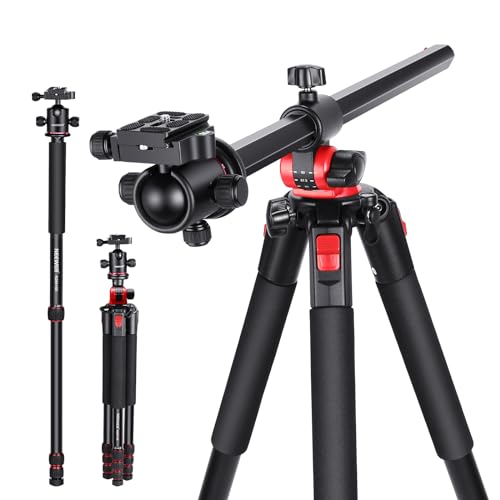
The NEEWER 72 in publishes the highest load claim in the set at 33 lb, and it is the easiest horizontal-column workflow to learn on.
Best for: first-time overhead shooters learning the horizontal-column workflow Skip it if: you need the tallest reach on offer
NEEWER states a maximum tube diameter of 28 mm, an aluminum-alloy build, a 33 lb / 15 kg load, and a five-detent center column that locks at 0°, 22.5°, 45°, 67.5° or 90°. That last detail is why this is the friendliest of the six for a shooter who is new to overhead. You are not eyeballing the angle. You feel the click, you lock, you shoot. The tripod extends to 72.4 in / 184 cm on four aluminum leg sections with twist locks, folds to 26.4 in / 67 cm, and weighs 3.77 lb. The panoramic ball head takes an Arca-type plate. A carrying bag ships in the box. Released 2019, so the field record on this one runs longest of the six.
The catch is that the 33 lb figure is a manufacturer claim, not a measured value, and older listings tend to be optimistic on load. Treat it as a headroom marker, not a specification to run to. The 72.4 in reach also sits below the two 90 in picks, which will matter more than the extra rated load for most overhead subjects.
Pros:
- 33 lb load claim, the highest stated in this set
- Five-position center column detent
- 72.4 in max height
- 3.77 lb, one of the lighter full tripods here
- Carrying bag and Arca-type plate included
Cons:
- 72.4 in reach short of the two 90 in picks
- 33 lb figure is unverified marketing claim
- 2019 release, older component design
6. Pozliv Overhead Camera Mount with Ring Light — Best budget pick
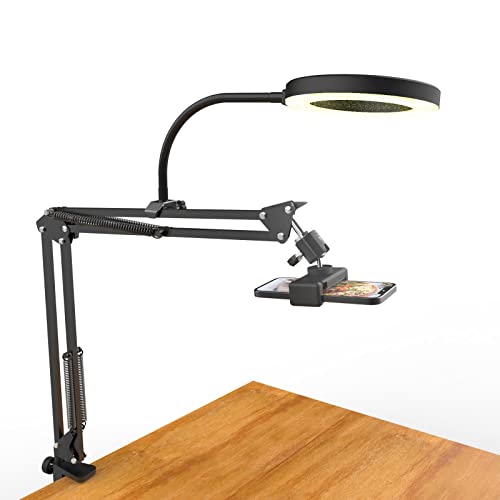
The Pozliv is not a floor tripod at all: it is a desk-mounted articulated arm with a 6 in ring light, aimed at nail, cooking and unboxing shots.
Best for: desk-bound creators shooting nails, cooking or unboxing from directly above Skip it if: you need a full-size floor tripod at any point
The Pozliv sits in a different product category on Amazon (Flashes & Selfie Lights) and is included here because the listing name says overhead camera mount and because the mechanics are relevant. It is a C-clamp desk base with a scissor boom arm, a ball head, and a phone clip, plus a 6 in dimmable ring light with three color modes and ten brightness levels. Pozliv says the head, arm ball joint and base are all articulated. Threads are 1/4 in universal, so it accepts Logitech Brio, C920, C922 webcams and any smartphone in the supplied clip. Sales rank in its category is 2,993, and there are two sellers listed.
For a working professional this is a supplement, not a main rig, and the listing carries no published load rating. Treat it as the tool you clamp to a desk when you need a fixed overhead angle on a phone or a webcam and the studio tripod is set up for something else.
Pros:
- The cheapest pick here
- Integrated 6 in ring light with three modes
- 1/4 in universal thread, fits phones and webcams
- C-clamp base saves floor space
- Two sellers listed, more availability
Cons:
- Not a floor tripod, desk-mount only
- No stated load capacity or weight
- Listed in the selfie-lights category, not tripods
Does the professionals label hold up here?
Amazon's search for the phrase best overhead camera tripod for professionals returned this set, and only partially honored the professionals qualifier. Nothing on this shortlist carries a professional certification, a load-test document or a stated column-deflection figure. What professional means on Amazon is closer to "capable enough to make client work with", which is a judgement call the buyer has to make.
The way to judge it yourself:
- Does the listing publish an actual load rating in pounds or kilograms? Four of six do here.
- Does it publish a column tube diameter? One of six does, and it is the K&F CONCEPT 90"/230cm.
- Does it include an Arca-type plate you can share with the head on your other tripod? Three of six explicitly say yes.
- Does the tripod convert to a monopod, or does it accept a removable boom? Four of six do one or the other.
Score any tripod against those four questions before you buy, and the professional label starts to mean something concrete.
What the listings do not tell you about overhead work
Three things you will only learn once the rig is set up over your subject.
- Counterweighting matters more than the load rating. When the column swings horizontal, the head plus camera become a lever pulling against the legs on the opposite side. A tripod rated to 22 lb straight up may wobble noticeably with 4 lb of camera hanging out at 90 in. Hang a weighted bag from the bottom of the mast on the opposite side, and the whole rig calms down.
- Cable management pulls the head off level. A tethered USB-C cable or an HDMI monitor cable exerts a small constant torque on the ball head. If your shots start drifting between frames on a long stop-motion sequence, the cable is the culprit.
- Focus mode and stabilization behave differently pointing down. Some mirrorless bodies rely on gravity-based sensor cues for in-body stabilization, and pointed straight down they can behave oddly. Test with IBIS off before you shoot a job.
None of this is on any product listing. All of it decides whether the tripod earns its slot.
The verdict
The winner is the NEEWER TP63. It is the only pick that combines a 90 in horizontal center column, a 22 lb published load rating, a monopod convert, an Arca-type plate and a 4.1 lb carry weight. If your work is product photography, food overheads, flat-lay content or any shot where the camera has to be parallel to the surface with the legs out of frame, that combination is what you want.
Two conditions flip the recommendation. First, if you shoot in a fixed studio and portability is irrelevant, the K&F CONCEPT 90"/230cm is the better pick, because its 28 mm column is the only stated column diameter in the set and column diameter is what controls horizontal flex. Second, if 90 in of reach is overkill and you want the modularity of a removable boom, the K&F Concept 76 in at 3.64 lb is the professional's compromise: shorter reach, lighter carry, boom arm transfers to any 3/8" tripod you already own.
For hybrid iPhone-plus-camera creators, the SmallRig CT25 is the runner-up. For a first horizontal-column rig, the NEEWER 72 in is the friendliest learner.
FAQ
What is the best overhead camera tripod for professionals overall?
The best overhead camera tripod for professionals overall is the NEEWER TP63. It reaches 90 in on a horizontal center column, carries a 22 lb published load, converts one leg into a monopod, and weighs 4.1 lb. Nothing else in this shortlist pairs those four specifications in one rig, and the Arca-type plate keeps it compatible with the head systems most working shooters already own.
Is a 90 in horizontal tripod worth it over a 72 in one?
A 90 in horizontal tripod is worth it if you shoot subjects wider than about 30 in or work with a person standing at the edge of the frame. The extra 18 in of reach clears a full dining table or a kitchen island without cropping. If your subjects fit inside a 24 in square, a 72 in tripod like the NEEWER 72 in delivers the same result for less carry weight.
What load capacity should an overhead tripod support?
An overhead tripod should support at least twice the weight of your heaviest camera-plus-lens combination, because a horizontal column loads the head as a lever and doubles the effective torque. For a mirrorless body under 3 lb, the 8 kg K&F 76 in claim is fine. For a full-frame DSLR with a 24-70mm f/2.8, the 22 lb ratings on the two 90 in picks are the safer floor.
NEEWER TP63 or K&F CONCEPT 90"/230cm, which wins?
Between the NEEWER TP63 and the K&F CONCEPT 90"/230cm, the TP63 wins on carry weight (4.1 lb vs 4.45 lb) and price position. The K&F wins on published column diameter, at 28 mm, which is the specification that controls flex when the column swings horizontal. Choose the K&F for a fixed studio, the TP63 for anything that leaves the room.
What is the biggest mistake buyers make with overhead tripods?
The biggest mistake buyers make is chasing height instead of reach. A 90 in vertical tripod that only tilts the head down still leaves the legs in frame. What you actually need is a tripod that pivots the column or extends a boom, so the mount sits over the subject and the legs sit outside the shot. Check the horizontal spec, not the vertical one.
Once you know which mechanism you want, the shortlist above narrows fast. If reach and load are your top two criteria and the rig has to travel, order the NEEWER TP63 and set it up over your most demanding subject before anything else lands on the desk. Extend the column horizontal, hang the camera, add a weighted bag under the mast, and shoot a test frame at your normal shutter speed. That first setup tells you whether a horizontal-column tripod belongs in your kit permanently, or whether you needed a boom arm on a tripod you already own. Either way, the answer is in the first ten minutes.