Best 48V Phantom Power Supply for Home Studios

One winner, five picks, and the one specification that actually decides which phantom power supply belongs in your signal chain.

By Carter LoganUpdated 13 min read
On this page
- How I screened these five down
- Best 48v phantom power supply at a glance
- What actually decides this purchase?
- 1. Neewer 1-Channel 48V Phantom Power Supply — Best overall
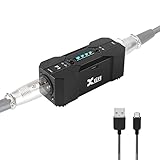
- 2. Xvive P1 Phantom Power Supply 48V/12V Switch — Runner-up
- 3. Mackie M48 48V Phantom Power Supply — Best premium
- 4. Fotoconic 1-Channel 48V Phantom Power Supply — Best budget pick
- 5. StudioMan PS200 Professional 2-Channel Phantom Power Supply — Best for beginners
- One channel or two?
- Do you need battery power?
- When a different pick wins
- The verdict
- FAQ
The best 48v phantom power supply for most home studios is the Neewer 1-Channel 48V Phantom Power Supply, a single-channel unit with balanced XLR in and out, a 1-year warranty, and an 8-foot cable in the box. If you record away from a wall outlet, the Xvive P1 is the better buy, because Xvive rates it for up to 40 hours of use on a charge. Both feed a condenser mic when your mixer can't. The deciding specification isn't voltage. It's how you power the box itself.
How I screened these five down
Every unit here does the one job the name promises: it sends 48 volts up an XLR cable to a condenser microphone. That's the floor, not a feature. So I compared the published listings side by side and asked what separates them once the voltage is equal.
Three things did most of the sorting:
- Channel count. Four of the five power one mic. Only the StudioMan PS200 lists dual MIC-1 and MIC-2 terminals.
- Power source. Most run off an included adapter. The Xvive P1 charges and runs cordless; the Mackie M48 takes an adapter or a 9V battery.
- Published specs. Some listings give weight, dimensions, and warranty. The Fotoconic gives almost none.
What I cut for: nothing here needed cutting on the basics. What ranked lower: units with thin published data or a price position that buys no extra listed capability. The Neewer leads because it pairs a full spec sheet with the second-cheapest price of the five and a bundled cable.
Best 48v phantom power supply at a glance
| Pick | Channels | Power source | Price |
|---|---|---|---|
Best overall Neewer 1-Channel 48V |
1 | Included adapter | Check Price |
Runner-up Xvive P1 48V/12V |
1 | Rechargeable, 40hr claim | Check Price |
Best premium Mackie M48 |
1 | Adapter or 9V battery | Check Price |
Best budget pick Fotoconic 1-Channel 48V |
1 | Included adapter | Check Price |
Best for beginners StudioMan PS200 |
2 | DC12V adapter | Check Price |


What actually decides this purchase?
Most guides to the best 48v phantom power supply compare voltage. That's a dead end. All five here deliver 48 volts, and Fotoconic even prints a note on its own listing that phantom power doesn't improve your mic's sound or volume. Voltage is the entry ticket, not the tiebreaker.
Here's what actually decides it. A phantom power supply exists to solve one situation: your mixer, interface, or preamp has no phantom power button, but your condenser mic needs 48 volts to work. If your interface already has that button, you don't need any box on this page.
Given that, three questions sort the field:
- How many mics? One box per channel, unless you buy a dual unit.
- Where do you record? At a desk, an adapter is fine. In the field, you want a charge or a battery.
- What's in the box? A bundled XLR cable saves a separate purchase.
Answer those three and the pick falls out. Everything else is packaging.
1. Neewer 1-Channel 48V Phantom Power Supply — Best overall
The Neewer wins because it pairs a full published spec sheet with a bundled 8-foot cable at the second-lowest price of the five.
Best for: a single condenser mic into a mixer or interface without phantom power Skip it if: you record away from a wall outlet
This is the pick I'd hand to most people. It weighs 1.65 lb, carries a 1-year manufacturer warranty, and ships in black with the model number 40085860. Neewer says it delivers 48V through universal balanced XLR input and output, with a single channel wired in-line between your mic and mixer. There's an on/off switch and an LED indicator, so you can see at a glance whether the box is live.
The reason it beats the rest of the entry field is the bundle. It includes an 8-foot XLR cable and an adapter, so you plug in and record. The Fotoconic is cheaper but publishes almost no specs and lists only one seller. The Neewer sells faster than any other unit here, and two sellers stock it.
The trade-off: it runs on the included adapter only. There's no battery option and no cordless mode, so it lives at your desk. For a fixed home setup, that's no loss.
Pros:
- Bundled 8-foot XLR cable in the box
- Full spec sheet with weight and warranty listed
- 1-year manufacturer warranty
- Second-cheapest of the five
- On/off switch and LED indicator
Cons:
- Adapter power only, no battery mode
- Plastic housing, not metal
- Single channel, so no second mic
- Model dates to 2015
2. Xvive P1 Phantom Power Supply 48V/12V Switch — Runner-up
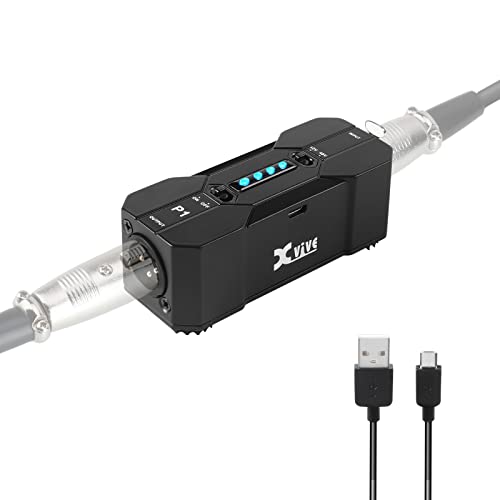
The Xvive P1 is the one to buy when there's no outlet nearby, because Xvive rates it for up to 40 hours of cordless use.
Best for: field recordists who work away from mains power Skip it if: you never leave your desk
This is the field unit. Xvive says the P1 is rechargeable and runs up to 40 hours on a charge, which is the single feature no other pick here offers. It weighs just 5.11 oz and measures 39.6 x 1.73 x 1.3 inches, and the chassis is all-metal rather than plastic. A 48V/12V switch means it can feed shotgun mics and other gear that wants the lower voltage.
Xvive lists balanced XLR input and output and a 1-year warranty. For anyone recording interviews, location sound, or a mic where the nearest wall socket is a hassle, the cordless run time changes what you can do.
The trade-off is price and stock. It sits in the most expensive band here alongside the Mackie, and only one seller lists it. The listed size is for the unit without an XLR cable, so budget for one. If you record at a fixed desk, you're paying for portability you'll never use, and the Neewer does the same core job for less.
Pros:
- Up to 40 hours cordless, per Xvive
- All-metal chassis, per the listing
- 48V/12V switch for shotgun mics
- Light at 5.11 oz
- 1-year warranty listed
Cons:
- Most expensive band in this set
- Only one seller lists it
- No XLR cable at the listed size
- Overkill for a desk-only setup
3. Mackie M48 48V Phantom Power Supply — Best premium
The Mackie M48 is the pick for someone who wants a rugged metal box that runs on either an adapter or a 9V battery.

Best for: someone who wants a metal-chassis unit that runs on adapter or 9V battery Skip it if: you want the cheapest way to power one mic
Mackie's M48 splits the difference between the desk unit and the field unit. It's powered by the included AC adapter or a 9V battery, so you get a backup power path without buying a rechargeable box. It weighs 0.8 lb, measures 1.5 x 3.4 x 5.8 inches, and Mackie describes it as built-like-a-tank construction with transparent, noise-free operation.
It carries XLR input and output, a power indicator, and a low-battery indicator, which is the detail the field crowd will want. The warranty is a 1-year all-inclusive, non-transferable cover.
Here's the honest trade-off. It's the most expensive pick on the page and it powers one channel, the same as the Neewer. The 9V battery option is real value, but it isn't 40 hours of rechargeable run time like the Xvive, and it isn't the low price of the Neewer or Fotoconic. You're paying for the Mackie name and the heavier chassis. If that reassurance matters to you, it's a fair deal. If not, the runner-up or the winner do more for the money.
Pros:
- Adapter or 9V battery power
- Metal, tank-style build per Mackie
- Low-battery indicator listed
- Light at 0.8 lb
- 1-year all-inclusive warranty
Cons:
- Highest price position in the set
- Single channel only
- No included XLR cable listed
- Battery isn't rechargeable
4. Fotoconic 1-Channel 48V Phantom Power Supply — Best budget pick
The Fotoconic is the cheapest way onto this list, and it still ships with an XLR cable, but the listing tells you almost nothing else.

Best for: a first condenser mic on the tightest budget Skip it if: you want a published warranty and full specs
If price is the whole decision, this is the pick. The Fotoconic is the cheapest of the five. Like the Neewer, it delivers 48V through universal XLR input and output and includes an XLR cable and an adapter in the box. It has an on/off switch, an LED indicator, and a single balanced channel wired in-line between mic and mixer. The listing notes an input voltage of 110V.
I respect that the listing is honest. Its own note says phantom power supplies 48 volts to the mic but does not improve sound quality or volume, which is exactly right and rare to see spelled out.
The catch is the thin data. There's no published weight, no dimensions, and no stated warranty, and only one seller lists it. Compared with the Neewer, which costs a little more but publishes a full spec sheet and a 1-year warranty, the Fotoconic asks you to buy partly on trust. For a first mic where every dollar counts, that can be an acceptable trade.
Pros:
- Cheapest pick in the set
- Includes XLR cable and adapter
- Universal balanced XLR in and out
- On/off switch and LED indicator
Cons:
- No published weight or dimensions
- No stated warranty
- Only one seller lists it
- Slower seller than the Neewer
5. StudioMan PS200 Professional 2-Channel Phantom Power Supply — Best for beginners
The StudioMan PS200 is the only two-channel pick here, so it's the beginner box for anyone starting with a pair of mics.

Best for: a two-mic podcast or interview setup Skip it if: you only ever run one microphone
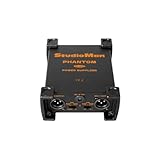
This is the odd one out, in a good way. The PS200 has dedicated MIC-1 and MIC-2 input terminals with matching outputs, so it powers two condenser mics from one box. For a co-hosted podcast or a two-person interview, that saves buying two single-channel units. It measures 2 x 6.5 x 6.5 inches, ships in black, and carries a 1-year manufacturer warranty. StudioMan lists a switchable 12V/24V/48V design and an included DC12V 1A adapter with a power switch and LED indicator.
The reason it's the beginner pick rather than the overall winner is fit. If you run one mic, half of this box sits idle, and it costs more than the single-channel Neewer. The listing also trails off mid-spec on its distortion figure, so I won't quote a number I can't read in full.
The trade-off against the field: you get a second channel and voltage switching, but you give up the bundled XLR cable that the Neewer and Fotoconic include, and it's a slower seller than the winner. For two mics, it's still the sensible starting point.
Pros:
- Only two-channel unit here
- Switchable 12V/24V/48V power
- Included DC12V 1A adapter
- 1-year manufacturer warranty
- Power switch and LED indicator
Cons:
- Wasteful if you run one mic
- No bundled XLR cable listed
- Distortion spec is cut off in the listing
- Slower seller than the Neewer
One channel or two?
This is the fork that sends most buyers to the right box. Four of the five picks power a single microphone. Only the StudioMan PS200 powers two.
- One mic, one voice. A solo podcaster, a vocalist, a single-instrument recordist. Any single-channel unit fits: Neewer, Xvive, Mackie, or Fotoconic.
- Two mics at once. A two-host show, an interview, a stereo pair. The PS200's dual MIC-1 and MIC-2 terminals do in one box what two single-channel units do separately.
The mistake I see is buying two single-channel boxes when one dual unit would be tidier and cheaper, or buying a dual box for a solo setup and leaving half of it dark. Count your mics before you count anything else. If you'll grow from one voice to two within a year, the PS200 is worth the extra now. If you'll stay solo, a single channel is the honest buy and you'll spend less on it.
Do you need battery power?
Short answer: only if the wall socket is a problem. Most home recording happens within a cable's reach of an outlet, and for that the adapter-powered Neewer or Fotoconic is all you need.
Battery and cordless power earn their keep in two cases. First, field recording, where the Xvive P1's up-to-40-hour rechargeable run time lets you work with no mains at all. Second, backup, where the Mackie M48's 9V battery option keeps you going if the adapter fails or the outlet's busy.
Here's the trick most shoppers miss. A rechargeable unit like the P1 needs charging before a session, so it adds a habit to your workflow. A 9V battery like the Mackie's is swappable on the spot but costs you a battery now and then. An adapter never needs either, as long as there's a socket. Match the power source to where you actually record, not to the feature that sounds most flexible.
When a different pick wins
The Neewer is the default, but three concrete conditions flip the recommendation:
- If you record on location, the Xvive P1 wins. Its up-to-40-hour rechargeable run time and 5.11 oz weight are built for a bag, and no adapter-only box can follow you off-grid.
- If you run two mics, the StudioMan PS200 wins. Its dual MIC-1 and MIC-2 channels do the job of two single boxes, and switchable 12V/24V/48V power covers mixed mic types.
- If price is the only line that matters, the Fotoconic wins. It's the cheapest here and still bundles an XLR cable, though you accept a thin spec sheet and no stated warranty.
One more: if you want a metal chassis with a battery fallback and the Mackie name reassures you, the M48 is worth its premium position. Outside those cases, the Neewer's mix of full specs, a bundled cable, and a low price is the one I'd start with.
The verdict
The Neewer 1-Channel 48V Phantom Power Supply is the winner for most people. It publishes a full spec sheet, weighs 1.65 lb, carries a 1-year warranty, includes an 8-foot XLR cable, and sits at the second-lowest price of the five. It sells faster than any other unit here and has two sellers behind it. For a fixed home studio powering one condenser mic, nothing on this page does more for less.
Two conditions flip that. If you record away from a wall outlet, buy the Xvive P1 instead. Its up-to-40-hour rechargeable run time is the one capability the Neewer simply lacks, and its 5.11 oz all-metal body travels well. If you run two mics, buy the StudioMan PS200 for its dual MIC-1 and MIC-2 channels, which spare you a second box.
The runner-up's exact advantage over the winner is power independence, not sound. Both feed 48 volts up a balanced XLR line the same way. The P1 just does it with no cord attached. Decide where you record first, then let that answer pick the box.
FAQ
Is a 48v phantom power supply worth buying at all?
A 48v phantom power supply is worth buying only when your mixer or interface lacks a phantom power button and your condenser mic needs 48 volts to work. If your interface already has that button built in, one of these boxes adds nothing. Check your existing gear first; the cheapest fix is often the one you already own.
How much does the best 48v phantom power supply cost?
How much the best 48v phantom power supply costs depends on the features you actually need. The Fotoconic sits at the lowest price here, the Neewer just above it with a full spec sheet, and the Xvive P1 and Mackie M48 occupy the top band for battery and cordless power. Tap any Check Price link for the current figure.
Does more voltage or a switch improve microphone sound quality?
More voltage does not improve microphone sound quality. Every pick here delivers 48 volts, and the Fotoconic listing states plainly that phantom power supplies voltage to the mic without enhancing sound or volume. The voltage simply lets a condenser mic function. What changes your sound is the mic, the room, and the preamp, not the power box.
Neewer or Xvive P1: which single-channel unit should I pick?
Neewer or Xvive comes down to where you record. The Neewer runs on an included adapter, bundles an 8-foot XLR cable, and costs less, making it the desk choice. The Xvive P1 runs up to 40 hours cordless and weighs 5.11 oz, making it the field choice. Pick by location, not by brand.
What is the most common phantom power supply mistake to avoid?
The most common phantom power supply mistake is buying one when your interface already provides 48 volts. The second is matching channels wrong: two single boxes for one mic, or a dual PS200 left half-idle on a solo setup. Count your mics and check your existing gear before you buy, and you'll skip both errors entirely.
Start by checking whether your interface or mixer already has a phantom power switch. If it doesn't, and you record one mic at a desk, the Neewer 1-Channel 48V Phantom Power Supply is the box I'd order first: full specs, a bundled cable, a 1-year warranty, and a price that undercuts most of the field. It fixes the exact problem this category exists to solve, without paying for battery power or a second channel you won't use. Match the box to where you record, and this one covers the common case cleanly.