Best Amplifier for Beginners on a First Rig

Five practice amps ranked for new players, from a 1.28 lb rechargeable mini to a 25-watt combo with 30 presets. The winner earns its spot on tone controls and a published warranty.

By Carter LoganUpdated 13 min read
On this page
- Watts, size or presets: what actually decides a first amp?
- Best amplifier for beginners at a glance
- How I ranked five practice amps
- 1. Fender Frontman 10G Electric Guitar Amplifier — Best overall
- 2. Fender Mustang LT25 Guitar Amplifier — Best premium
- 3. Demusea Electric Guitar Amplifier 20w — Most versatile
- 4. flatsons 10W Mini Guitar Amp — Best budget pick
- 5. Ermik Electric Guitar Amp 20W — Best warranty
- How loud is a 10-watt practice amp, really?
- When a different amp wins
- What the listings leave out
- The verdict
- FAQ
The best amplifier for beginners is the Fender Frontman 10G, a 10-watt combo weighing 8.38 lb with real gain, treble, bass and volume knobs on the front. If you want built-in tones instead of dialing your own, the Fender Mustang LT25 packs 25 watts, an 8-inch speaker and 30 presets. Watts alone won't tell you which to buy. What splits this field is whether you learn on physical tone knobs or lean on presets, and how loud you can actually get away with at home.
Watts, size or presets: what actually decides a first amp?
Most first-amp guides lead with wattage. That number matters least at this level. A 10-watt combo and a 20-watt combo are both far louder than an apartment allows after 9pm, so headroom isn't your problem. Your problem is learning to hear the difference a gain knob makes.
Here is what actually separates these five, in the order that matters for a beginner:
- Real front-panel controls. Gain, treble, bass and volume you can twist teach you what those words mean. Three of these picks have that full set.
- A headphone jack. Silent practice keeps the peace and keeps you playing. Four of the five offer one.
- Speaker size. A 6-inch or 8-inch speaker moves more air and sounds fuller than a tiny mini-amp cone.
- A published warranty. A stated term tells you the maker expects the thing to last.
The keyword here carries a catch. Amazon's search for the best amplifier for beginners returns amps that suit beginners, but none of them is labelled or built as a dedicated beginner model. So treat "beginner-friendly" as something you judge from the controls and size, not a promise any listing makes. That's why the deciding criterion below is learning value, not a marketing tag.
Best amplifier for beginners at a glance
| Pick | Power | Headphone jack | Price |
|---|---|---|---|
Best overall Fender Frontman 10G |
10 Watt | Not listed | Check Price |
Best premium Fender Mustang LT25 |
25 Watt | Yes (claim) | Check Price |
Most versatile Demusea 20W Amp |
20 Watt | Yes (claim) | Check Price |
Best budget pick flatsons 10W Mini Amp |
10 Watt | Yes (claim) | Check Price |
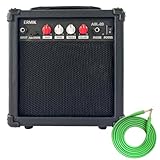
Best warranty Ermik 20W Amp |
20 Watt | Yes (claim) | Check Price |


How I ranked five practice amps
I lined up the published specs side by side, then judged them against what a first-year player actually needs. Learning value led. An amp with real tone knobs teaches faster than one with buttons that hide the controls, so I weighted the control set heavily and the raw wattage lightly.
The criteria, in the order I applied them:
- Control set (highest weight). Full gain, treble, bass and volume beats a two-mode switch.
- Speaker and build. A 6-inch or larger cone and a stated weight point to a real cabinet, not a toy.
- Silent practice. A headphone jack keeps a beginner playing when the house is asleep.
- Warranty length. A published term is a small promise you can hold the maker to.
Wattage got the lowest weight of all. At home, 10 watts and 25 watts both go past neighbour-friendly long before you reach the ceiling.
Two picks pulled ahead on tone knobs and a name behind the build. Two entry picks earned spots on portability and a stated 2-year warranty. One mid-priced pick won its label on the free cables and picks bundled in the box, which softens the cost of a first setup.
1. Fender Frontman 10G Electric Guitar Amplifier — Best overall
The Frontman 10G is the best amplifier for beginners because it pairs a full set of real tone knobs with a name that publishes a 2-year warranty.
Best for: a new player who wants real tone knobs and a stated warranty Skip it if: you need battery power or headphone-only silent practice
This is the only pick in the set from a maker whose amps you'll see on stages, and that matters when you're deciding what a first sound should be. Fender lists gain, an over-drive select switch, volume, treble and bass on the front. That's the whole vocabulary a beginner needs to learn by ear, one knob at a time.
The cabinet weighs 8.38 lb and measures 11 x 5.75 x 10.3 in, so it sits on a desk without dominating it. Fender says the 6-inch Special Design speaker covers blues to metal, and the closed-back design adds bass response. I can't verify the tone, but a 6-inch cone in a sealed box will move more air than the palm-sized minis here.
The trade-off: it sits at the more expensive end of this group, it's one of the priciest picks, and no headphone jack appears in the specs. If quiet practice is your whole reason for buying, look lower down.
Pros:
- Full gain, treble, bass and volume knobs
- 6-inch closed-back speaker, claimed blues to metal
- Manageable 8.38 lb, 11 x 5.75 x 10.3 in body
- Fender name with a stated 2-year limited warranty
- Over-drive select switch for clean or driven
Cons:
- One of the most expensive picks here
- No headphone jack in the listed specs
- No battery power for practice away from an outlet
2. Fender Mustang LT25 Guitar Amplifier — Best premium
The Mustang LT25 is the amp to buy if you'd rather browse 30 built-in tones than dial your own from scratch.

Best for: someone who wants presets and room to grow past year one Skip it if: you want the lightest, cheapest way to start
The LT25 is the highest-powered pick here at 25 watts, and the only one with a screen. Fender lists a 1.8-inch color display and 30 preloaded presets covering a wide range of music. For a beginner unsure what "drive" or "reverb" should sound like, hearing a finished tone and copying it is a fast way in.
It carries the biggest speaker in the group, an 8-inch Fender special design cone, and the heaviest body at 15.2 lb, with dimensions of 12.8 x 8.25 x 14.5 in. That's a real combo, not a desk toy, so a spare bedroom suits it better than a dorm shelf.
Fender calls the interface simple and aimed at beginners, and the presets are the reason. The catch cuts two ways. It's the most expensive pick here, and presets can let you skip the manual dial-in that actually teaches your ear. That's the exact skill the Frontman forces you to build.
Pros:
- 25 watts, the most power in this set
- 30 preloaded presets across many styles
- 8-inch speaker, the largest cone here
- 1.8-inch color display, claimed beginner-friendly
- Fender name with a stated 2-year limited warranty
Cons:
- The most expensive pick in this group
- Heaviest at 15.2 lb, less grab-and-go
- Presets can delay learning tone by ear
3. Demusea Electric Guitar Amplifier 20w — Most versatile
The Demusea 20W earns its spot by shipping with the cables, adapter and picks a first-time buyer would otherwise shop for separately.

Best for: a player carrying an amp to lessons who wants free cables in the box Skip it if: you care about a long published warranty
This is the pick that thinks about the rest of your setup. Demusea lists a bundle of free accessories: a 3-metre noiseless cable, a 6.5mm-to-3.5mm headphone adapter, guitar picks, an aux cable and an earphone. For someone buying their first amp, that removes a whole second order.
It's rated at 20 watts through a listed 6.5-inch speaker, with dimensions of 13 x 5.9 x 13 in. Demusea describes a carry handle, corner protectors and leather covering, framing it as an amp built to travel to lessons or band practice. The full control set is here too: gain, bass, treble, volume and a drive/distortion button for clean or gritty sounds.
The weak spot is the warranty. Demusea lists a 1-year term, the shortest of any pick in this roundup, against 2 years from three of the others. It also sells slower than the two entry picks here. The bundle is the real reason to choose it.
Pros:
- Free cable, adapter, picks and earphone in the box
- Full gain, bass, treble and volume controls
- 20 watts through a 6.5-inch speaker
- Carry handle and corner protectors for travel
- Headphone and aux jacks for silent play-along
Cons:
- Shortest warranty here at 1 year
- Slower seller than the two entry picks
- No stated weight to judge portability
4. flatsons 10W Mini Guitar Amp — Best budget pick
The flatsons mini is the cheapest way in, and the one you can charge up and play on the couch without a wall socket.

Best for: a couch practicer who wants Bluetooth and a rechargeable battery Skip it if: you plan to play with a drummer or another guitarist
At 1.28 lb and 3.89 x 5.98 x 2.95 in, this is far and away the smallest and lightest pick. It's the cheapest of the five and the one you can carry in a jacket pocket. flatsons lists a rechargeable design with 5.3 wireless audio, so you can stream a backing track from your phone and play over it with no cables.
The controls are simpler than the combos above. flatsons describes two tone modes, clean and drive, rather than a full knob set, plus a 3.5mm headphone jack and an aux input. It claims pure analog technology with a 100Hz-20kHz frequency response. That's fine for solo practice, though a two-mode switch teaches your ear less than four separate knobs.
The honest limit is air. A cabinet this size can't compete with a 6.5-inch or 8-inch speaker in a room with other instruments. Treat it as a quiet personal amp, not a jam amp, and it does that job for the least money.
Pros:
- Cheapest pick and lightest at 1.28 lb
- Rechargeable battery, no wall socket needed
- Bluetooth 5.3 streaming for backing tracks
- Headphone and aux jacks for silent practice
- Stated 2-year warranty despite the low price
Cons:
- Two tone modes, not a full knob set
- Too small to keep up with a drummer
- No listed speaker size to judge output
5. Ermik Electric Guitar Amp 20W — Best warranty
The Ermik 20W offers the full control set and a 2-year manufacturer warranty for entry-level money, if you can do without a name brand.

Best for: a cautious buyer who wants a 2-year manufacturer warranty for little money Skip it if: you want the reassurance of a name brand behind it
The Ermik is the second-cheapest pick here, and it comes with a 2-year manufacturer warranty. That term ties the two Fenders while costing a fraction as much, which is exactly why it earns the warranty label.
It's rated at 20 watts with the full beginner control set Ermik lists: gain, bass, treble and volume, plus a drive button for distortion. That's the same learning vocabulary as the Frontman, on a body measuring 11.6 x 4.1 x 11.2 in. Ermik adds a headphone jack for silent practice and an aux input for play-along, and describes secure rubber corner edges for durability.
Two caveats. It's the slowest seller of the five by a wide margin, so it's the least chosen amp in this group. And no speaker size or weight is listed, which leaves you guessing at how much air it moves. The warranty and the knob set are the case for it, and against an unknown brand, that's a fair trade.
Pros:
- 2-year warranty at entry-level price
- Full gain, bass, treble and volume knobs
- 20-watt rating with a drive button
- Headphone and aux jacks included
- Rubber corner edges for durability
Cons:
- Slowest seller of the five picks
- No speaker size or weight listed
- Unknown brand with no track record
How loud is a 10-watt practice amp, really?
New buyers fixate on wattage, fearing 10 watts is too quiet. In a home, the opposite is true. A 10-watt guitar amp with a 6-inch speaker, like the Frontman 10G, gets loud enough to fill a bedroom well before the dial hits halfway.
Wattage doesn't scale the way it feels like it should. Jumping from 10 watts to 25 watts, as the Mustang LT25 does, doesn't make the amp two and a half times louder. It adds headroom, meaning the tone stays clean at higher volume. That headroom only matters once you're playing with other people.
So here's the practical read for a beginner:
- Solo bedroom practice: 10 watts is plenty. The flatsons mini gets you even quieter.
- Jamming with one other player: 20 to 25 watts helps you stay heard.
- Silent hours: any pick with a headphone jack solves it outright.
Buy for the room you'll actually play in, not the stage you imagine.
When a different amp wins
The Frontman 10G is the default, but three specific situations flip the pick. Each is a condition you can check against your own setup before you buy.
- If you have no wall socket where you practice, the flatsons mini wins. It's the only rechargeable pick, at 1.28 lb, and it streams over Bluetooth so you can play along without wiring anything.
- If you'd rather copy finished tones than build them, the Mustang LT25 wins. Its 30 presets and 1.8-inch display let you audition sounds instead of guessing what a gain knob does.
- If your budget is tight but you still want a full knob set, the Ermik 20W wins on its 2-year warranty at the second-lowest price in this group.
And if you're buying a complete first setup in one order, the Demusea's bundled cable, adapter, picks and earphone quietly saves you a second purchase.
What the listings leave out
Product pages tell you watts and dimensions. They stay quiet on a few things that shape daily use, so judge these yourself.
- Speaker size on two picks. The flatsons mini and the Ermik don't list a cone diameter. That's the single biggest driver of how full an amp sounds, and its absence is worth noting.
- Weight on two picks. The Demusea and Ermik give no stated weight, so you can't fully gauge portability from the page.
- Effects depth. Only the Mustang LT25 lists presets. The others are dry amps unless you add pedals later.
- What "warranty" covers. The Frontman lists "Manufacturer Warranty" in one field and a 2-year term in its feature text. Read the fine print before you count on it.
None of these is a dealbreaker. They're the gaps to fill with your own eyes on the listing.
The verdict
The Fender Frontman 10G is the best amplifier for beginners for most people. It gives you the full tone vocabulary on real knobs, gain, over-drive, treble, bass and volume, in an 8.38 lb cabinet with a 6-inch speaker and a name that stands behind a 2-year warranty. That combination teaches your ear faster than a preset menu or a two-mode switch, and it's the sound you'll recognise from records.
Two conditions flip it. If you want to learn by copying finished tones rather than dialing your own, the Fender Mustang LT25 is the better buy: 25 watts, an 8-inch speaker and 30 presets on a color display, at the top of this price range. Its exact advantage over the Frontman is those presets and the extra headroom, which pay off the moment you play with someone else.
And if you practice where there's no outlet, the flatsons mini is the only rechargeable, Bluetooth pick at 1.28 lb. Buy the Frontman as your default, the Mustang if you want presets, the mini if you want cordless couch practice.
FAQ
Is the best amplifier for beginners worth buying over a headphone amp?
The best amplifier for beginners is worth it if you want to feel a speaker move air, which a plug-in headphone amp can't do. A combo like the Frontman 10G teaches you how volume and gain interact in a real room. That said, four of these five picks also include a headphone jack, so you get both silent practice and a real speaker in one purchase.
How many watts does a beginner amp actually need?
How many watts a beginner needs is fewer than most people expect. For solo home practice, the 10 watts in the Frontman 10G or flatsons mini is plenty and gets loud fast. Step up to the 20 to 25 watts of the Demusea, Ermik or Mustang LT25 only when you plan to play alongside another instrument and need clean headroom.
Fender Frontman 10G or Mustang LT25 for a first amp?
Fender Frontman 10G or the Mustang LT25 comes down to how you want to learn. The Frontman's real knobs, gain, treble, bass and volume, build your ear from scratch. The LT25 offers 25 watts, an 8-inch speaker and 30 presets to copy. Choose the Frontman to learn tone yourself, the LT25 for ready-made sounds and more power.
Does a practice amp need a headphone jack?
A practice amp needs a headphone jack if you share walls or practice at night. The flatsons mini, Demusea 20W, Ermik 20W and Mustang LT25 all list one, letting you play in silence. The Frontman 10G does not list a headphone jack in its specs, so if quiet practice is essential, that gap should steer you toward one of the others.
What is the biggest mistake buying a first amp?
The biggest mistake buying a first amp is chasing wattage over control. A 25-watt amp isn't better for a beginner than a 10-watt one at home; both are loud enough. What teaches you is a full set of tone knobs, like the gain, treble, bass and volume on the Frontman 10G. Prioritise the controls and speaker over the power figure.
Start with the room you actually play in. If that room has a wall socket and a door you can close, the Fender Frontman 10G is the right default: real tone knobs, a 6-inch speaker in an 8.38 lb box, and a maker that publishes a 2-year warranty. You'll spend your first months learning what gain and treble do by twisting them, which is the skill every later amp assumes you already have. Pick the Mustang LT25 if presets appeal, or the flatsons mini if you need to play cordless. Then plug in and get your hands dirty.