Best Lightweight Camera Strap by Weight and Length
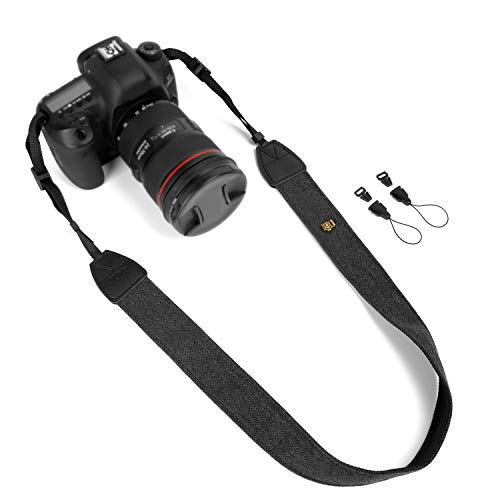
A weight-first comparison of six camera straps, from a 1.41 oz canvas neck strap to a 200 lb-rated sling. Which one you want depends on how your camera attaches and how long you carry it.

By Carter LoganUpdated 17 min read
On this page
- Best lightweight camera strap at a glance
- How the six picks map to six kinds of shooter
- Does a lightweight camera strap actually feel lighter?
- 1. WANBY Camera Strap Canvas — Best overall
- 2. Peak Design Slide Camera Strap — Best premium
- 3. K&F CONCEPT Camera Neck Strap — Best compact
- 4. USA Gear TrueSHOT Camera Strap — Most versatile
- 5. waka Rapid Camera Neck Strap — Best for heavy use
- 6. Peak Design Cuff Camera Wrist Strap — Best for families
- How does your camera attach: lugs, screw or anchors?
- Which lightweight camera strap length do you need?
- What the listings do not tell you
- The verdict
- FAQ
The best lightweight camera strap is the WANBY Camera Strap Canvas, a cotton canvas neck strap listed at 1.41 oz with 28 inches of adjustable length and quick-release buckles. If you want one strap that reconfigures between neck, shoulder and sling, the Peak Design Slide adjusts from 39 to 57 inches instead. What splits this field is not padding or price. It's the published weight, which runs from 1.41 oz to 0.62 lb across these six, a spread of roughly 7x.
Best lightweight camera strap at a glance
| Pick | Listed weight | Length | Price |
|---|---|---|---|
Best overall WANBY Camera Strap Canvas |
1.41 oz | 28 in adjustable | Check Price |
Best premium Peak Design Slide Camera Strap |
Not comparably listed | 39 to 57 in | Check Price |
Best compact K&F CONCEPT Camera Neck Strap |
2.12 oz | 100 cm fixed | Check Price |
Most versatile USA Gear TrueSHOT Camera Strap |
3.53 oz | One size, adjustable loops | Check Price |
Best for heavy use waka Rapid Camera Neck Strap |
0.62 lb | 20.8 to 31.5 in | Check Price |
Best for families Peak Design Cuff Wrist Strap |
1.9 oz | 9.7 in wrist loop | Check Price |


How the six picks map to six kinds of shooter
I started from the buyer, not the specification sheet. Six straps, six different people carrying a camera.
The walk-around shooter carries one small body and one lens. Nothing heavy, nothing all day. Weight and bulk are the whole story here, and the WANBY at 1.41 oz is the lightest published figure in the set.
The multi-body shooter moves between a neck carry indoors and a sling on the street. That person needs range, and the Slide's 39 to 57 inch adjustment is the widest quoted here.
The traveller has no spare room in the bag. The K&F CONCEPT is a rope-style strap the listing says rolls up for storage, at 2.12 oz.
The hiker wants a spare battery within reach. USA Gear puts memory card pockets and side pouches on the strap itself, at 3.53 oz.
The full-frame-plus-zoom shooter wants padding and a tripod-screw mount. That's the waka, the heaviest at 0.62 lb.
The parent hands the camera around and wants a drop tether, not a carry system. The Cuff is a 9.7 in wrist loop.
Two things I cut hard on: straps where the listing gave no weight at all, and straps where the attachment method wasn't stated. Without those two facts, you can't tell whether a lightweight camera strap will fit your camera or feel light on it.
Does a lightweight camera strap actually feel lighter?
Not always, and this is where most shopping goes wrong. The strap's own weight is a small share of the total. A mirrorless body with a kit lens outweighs every strap here by an order of magnitude.
What you feel is pressure, which is load divided by contact area. A narrow strap concentrates the same camera weight into a thinner band across your neck. So a heavier, wider strap can be more comfortable than a lighter, narrower one.
Three figures worth comparing:
- Strap weight. From 1.41 oz to 0.62 lb here. Matters most for packing.
- Width. WANBY publishes 1.5 in of webbing width. That's a real number you can compare.
- Padding. The waka and USA Gear both name neoprene pads. Peak Design says the Slide has internal padding inside the webbing rather than a separate pad.
Here's the trick with a lightweight camera strap: pick for the heaviest lens you own, not the lightest. A 1.41 oz canvas strap under a small prime is perfect. The same strap under a 70-200 mm gets thin fast.
Skip the padding entirely if your camera is a compact. Then a wrist loop like the 1.9 oz Cuff is genuinely all you need, and the neck strap is dead weight.
1. WANBY Camera Strap Canvas — Best overall
At 1.41 oz with 1.5 in of canvas webbing and quick-release buckles, this is the lightest published strap here that still spreads load properly.
Best for: walk-around shooters with a small mirrorless body Skip it if: you need a sling that swings across your chest
Two numbers put this ahead. It's the lightest of the six at 1.41 oz, and it's the cheapest of the six. That combination is rare. Usually the lightest option in a set costs the most, because low weight is engineering.
The 1.5 in webbing width is the second reason. That's wider than a rope-style strap, so the same camera load spreads over more of your neck. WANBY says the neck section has an elastic panel to reduce tension and an anti-slip inner layer. Both are the maker's claims, not measured figures, but they're consistent with the canvas-and-PU-leather build the listing describes.
Length is 28 in and adjustable, which puts the camera around chest height for most people. The quick-release buckles let you drop the camera onto a tripod without unthreading anything. The listing says the fasteners are nylon and high-tensile plastic.
The trade-off against the rest of the set is capacity. Peak Design publishes a 200 lb figure for its anchors; WANBY publishes no load rating at all. And at 28 in fixed maximum, it won't reach sling length the way the Slide does.
Pros:
- Lightest published weight in this set, 1.41 oz
- 1.5 in webbing spreads load better than rope straps
- Cheapest of the six
- Quick-release buckles for tripod work
- Universal fit for DSLR and SLR lugs
Cons:
- No published load rating
- 28 in maximum is too short for sling carry
- Cotton canvas absorbs sweat and rain
- Only one seller lists it, so availability is thin
2. Peak Design Slide Camera Strap — Best premium
The 39 to 57 in adjustment range and 200 lb anchor rating make this the only pick here that genuinely works as neck, shoulder and sling.

Best for: shooters switching between neck, shoulder and sling Skip it if: you only ever carry one small camera one way
This is the most expensive pick here, and the reason is configurability. An 18 inch adjustment range, from 39 to 57 in, is nearly double what the waka offers at 20.8 to 31.5 in. Peak Design says dual quick-adjusters move the length with one finger, which is what makes switching carry positions practical rather than fiddly.
The Anchor Link connectors are the other differentiator. Peak Design states each anchor holds over 200 lb, the only load figure published anywhere in this set. The anchors also detach, so the strap comes off in a second and the small anchor loops stay on the camera.
The webbing is internally padded nylon, smooth on one face to slide over a jacket and grippy on the other to hold on a shoulder. That dual-surface design is specific to this strap among the six.
Two honest problems. The listed weight of 0.15 g is clearly a listing error rather than a real figure, so you can't compare it against the 1.41 oz WANBY or the 2.12 oz K&F on weight at all. And at 1.4 x 12.7 x 3.7 in packed, it's the longest item here in one dimension.
Pros:
- Widest adjustment range in this set, 39 to 57 in
- 200 lb stated anchor capacity, the only load figure here
- Anchors detach for fast strap removal
- Smooth and grippy faces for shoulder or sling
- Padding built into the webbing, no separate pad
Cons:
- The most expensive pick here
- Published weight of 0.15 g is not a usable figure
- Longest packed dimension of the six at 12.7 in
- Anchor system needs its loops fitted before first use
3. K&F CONCEPT Camera Neck Strap — Best compact
At 2.12 oz and 100 cm long, this rope-style strap packs down smaller than anything else here.

Best for: packing light with a bag that has no spare room Skip it if: you carry a heavy zoom for hours
The K&F is the second-cheapest here and the second-lightest at 2.12 oz. K&F states 60 grams for the same strap, which lines up with the 2.12 oz figure, so the two published numbers agree. That's more consistency than several listings in this set manage.
What makes it the compact pick is shape, not weight. Rope coils; webbing creases. The listing says the rope design rolls up for storage in any bag, and the packed dimensions of 0.59 x 5.91 x 3.54 in are the smallest here in every direction except thickness. If your camera bag has one narrow side pocket, this is the strap that fits in it.
Length is a fixed 100 cm, roughly 39 in. That's long enough to cross the body for a loose sling carry, and there's no adjuster to slip. Attachment is a metal O-ring at each end, so it works with standard camera strap loops rather than a tripod screw.
The cost is comfort under load. Rope has almost no contact width, so a heavy body and zoom concentrates into a thin line on your neck. There's no pad, no elastic section, and no way to shorten it.
Pros:
- Smallest packed dimensions in this set
- 2.12 oz confirmed against a 60 g figure
- Metal O-rings fit most standard strap loops
- Second-cheapest of the six
- Two sellers stock it, unlike most picks here
Cons:
- Fixed 100 cm length with no adjustment
- No padding, so heavy lenses bite
- Narrow rope concentrates weight on the neck
- No published load rating
4. USA Gear TrueSHOT Camera Strap — Most versatile
It's the only pick here with memory card pockets built into the strap, and the only one with a stated 3-year warranty.

Best for: day hikes where you want cards and batteries on the strap Skip it if: grams matter more than storage
Two things here appear nowhere else in this set. First, storage: USA Gear says the pad carries protective memory card pockets plus side pouches for spare batteries, lens caps and pens. Second, a warranty. The listing states a 3-year manufacturer's warranty, and it's the only one of the six that publishes any warranty term at all.
The build is stretch neoprene, which USA Gear says distributes weight across the shoulders and back. Attachment is dual quick-release buckles on 3/8 in adjustable reinforced loop straps, so it threads through standard camera lugs rather than needing a tripod socket. The listing names Canon, Nikon and Sony bodies plus mirrorless.
At 3.53 oz it's the third-heaviest here, roughly 2.5x the WANBY. That's the price of the pockets. Packed dimensions of 2.24 x 9.25 x 6.5 in also make it bulky in a bag, second only to the Slide in footprint.
Against the rest of the set, the trade is clear. You accept weight and bulk to stop carrying a card wallet. If you already keep cards in a bag pocket, the pouches are dead weight and the WANBY does the carrying job for less.
Pros:
- Only pick here with built-in memory card storage
- Only pick with a published warranty, 3 years
- Stretch neoprene pad spreads load across shoulders and back
- Dual quick-release buckles on adjustable loop straps
- Two sellers stock it
Cons:
- 3.53 oz, roughly 2.5x the lightest pick here
- Bulky packed at 9.25 in long
- Neoprene holds heat against your neck
- Pouches are wasted if you already carry a card wallet
5. waka Rapid Camera Neck Strap — Best for heavy use
The tripod-screw mount and neoprene pad target a full-size SLR with a zoom, and the 0.62 lb weight reflects that.

Best for: full-size SLR plus zoom, carried all day Skip it if: your camera has no tripod socket free
This is the heaviest strap in the set by a wide margin. 0.62 lb is roughly 7x the WANBY's 1.41 oz. That is not a flaw so much as a different design brief: waka says the strap is heavy duty and supports a full-size SLR with a zoom, using a standard 1/4 in tripod stud screw.
The screw mount matters. Threading into the tripod socket hangs the camera lens-down at your hip, which is more stable with a long lens than a neck carry and faster to raise. waka calls it an instant-shoot design. There's also a safety tether, the only secondary retention feature named anywhere in this set.
Adjustment runs 20.8 to 31.5 in, a shorter range than the Slide's 39 to 57 in. waka adds a locking slot for the slider clip so the length doesn't creep once set. The pad is anti-slip neoprene.
The obvious conflict is that a tripod-screw strap and a tripod plate compete for the same socket. If you shoot on a tripod regularly you'll be unscrewing this constantly. And at mid price with the heaviest weight here, it's the wrong choice for anyone shopping on weight alone.
Pros:
- Tripod-screw mount suits long, heavy lenses
- Safety tether, the only backup retention named here
- Locking slot stops the length adjuster creeping
- Anti-slip neoprene pad
- 20.8 to 31.5 in adjustment
Cons:
- Heaviest of the six at 0.62 lb
- Occupies the tripod socket you may need
- No published load rating despite the heavy-duty claim
- Narrower adjustment range than the premium pick
6. Peak Design Cuff Camera Wrist Strap — Best for families
A 9.7 in wrist loop at 1.9 oz, rated by Peak Design at over 200 lb per anchor, for when you want drop protection and nothing else.

Best for: handing a compact camera to someone else safely Skip it if: you need to put the camera down without holding it
This one isn't competing with the others. It's a wrist tether, 9.7 in of adjustable loop at 1.9 oz, and Peak Design describes it as drop protection rather than a carry system. That's why it's the family pick: when a compact camera goes around a group, a wrist loop is the fastest insurance you can fit.
It uses the same Anchor Link connectors as the Slide, with the same stated 200 lb capacity per anchor. So if you own both, one set of anchors serves both straps and you swap between them in seconds. Nothing else in this set shares hardware like that.
Packed size is 1.2 x 6.6 x 2.4 in, small enough to leave in a jacket pocket. Peak Design lists compatibility with DSLR, compact and point-and-shoot bodies.
The limit is structural, not a defect. A wrist strap only works while your hand is on the camera. Let go and the camera hangs off your wrist, swinging into doorframes. At 1.9 oz it's also heavier than the WANBY neck strap that does far more, and it sits in the premium price group for the least function of the six.
Pros:
- 200 lb stated anchor capacity
- Shares Anchor Link hardware with the Slide
- 1.9 oz and pockets small at 6.6 in
- Adjustable 9.7 in loop for different wrist sizes
- Works with compacts, point-and-shoots and DSLRs
Cons:
- Not a carry strap, only drop protection
- Premium price group for the least capability here
- Heavier than the 1.41 oz overall winner
- Camera swings freely once you let go
How does your camera attach: lugs, screw or anchors?
Check this before you check weight. A strap that won't attach to your camera is worthless no matter how light it is. These six use three different systems.
- Triangular lugs on the body. The WANBY, K&F CONCEPT and USA Gear all thread into standard camera strap loops. WANBY uses nylon and plastic fasteners, K&F uses metal O-rings, USA Gear uses 3/8 in reinforced loop straps with quick-release buckles. Nearly every interchangeable-lens camera has these lugs.
- The tripod socket. The waka mounts to a standard 1/4 in tripod stud screw. Fast to raise, but it blocks the socket. If you leave an Arca plate on your camera permanently, this is a problem.
- Anchor loops. Both Peak Design picks use the Anchor Link system, and the anchors go through your camera's lugs once and stay there. After that, straps clip on and off.
One more thing shoppers miss: some small mirrorless bodies have flat lug slots rather than triangular rings. A thick webbing end may not pass through. A rope-style end or a thin anchor cord usually will.
Which lightweight camera strap length do you need?
Length decides where the camera sits, and where it sits decides whether it hits your ribs on every step. The published ranges here differ enough to matter.
- Neck carry, camera at chest. Around 28 to 40 in total. WANBY at 28 in and K&F at 100 cm both land here.
- Shoulder carry, camera at hip. Around 40 to 50 in. The Slide covers this from its middle range.
- Cross-body sling, camera behind the hip. 50 in and up. Only the Slide reaches this, topping out at 57 in.
The waka's 20.8 to 31.5 in range is the shortest here, which suits a tight neck carry with a heavy lens where you don't want swing.
Skip length maths entirely with the Cuff. A 9.7 in wrist loop has one position, and it's on your wrist.
If you're not sure, measure with a shoelace before you buy. Hang your camera where you want it, mark the lace, then compare against the ranges above. It takes two minutes and it's the single most useful thing you can do before choosing a lightweight camera strap.
What the listings do not tell you
The word "lightweight" appears across this category with almost no standardisation behind it, and Amazon's search results for a lightweight camera strap include straps at 0.62 lb alongside straps at 1.41 oz. There's no threshold, no test and no definition. You have to read the weight figure yourself, which is why weight sits in the comparison table above.
Three other gaps I'd flag.
Load ratings are mostly absent. Peak Design publishes 200 lb per anchor on both its picks. The other four publish nothing. That doesn't mean they're weak, but it means you're trusting a description like "heavy duty" instead of a number.
Published weights sometimes disagree with reality. The Slide's listed weight of 0.15 g cannot be right for a padded nylon strap with metal hardware. When a figure is obviously off, treat it as missing rather than as data.
Warranty coverage is nearly invisible. USA Gear states 3 years. Nobody else in this set publishes a term. For a load-bearing accessory holding an expensive camera, that's a meaningful difference.
Weight is listed in three different units across these six listings: ounces, pounds and grams. Convert before you compare, or you'll pick the heaviest strap thinking it's the lightest.
The verdict
The best lightweight camera strap here is the WANBY Camera Strap Canvas. At 1.41 oz it's the lightest published figure of the six, it's the cheapest, and 1.5 in of canvas webbing gives it more neck contact than any rope strap. For one small body and one lens, nothing in this set does more for less weight.
Two conditions flip that. First, if you switch carry positions during a shoot, the Peak Design Slide is the better buy. Its 39 to 57 in range is the only one here that spans neck, shoulder and sling, and its 200 lb stated anchor capacity is the only load figure published in this set. That range is its exact advantage over the WANBY's fixed 28 in maximum.
Second, if your camera is a compact you hand around, buy the Peak Design Cuff instead. A 9.7 in wrist loop at 1.9 oz solves the drop risk without a strap dangling.
One more split worth naming. If you shoot a full-frame body with a long zoom, the waka's tripod-screw mount and neoprene pad beat both canvas and rope, and you accept 0.62 lb to get there. Weight is the deciding number in this category, right up to the point where the lens gets heavy.
FAQ
Is a lightweight camera strap worth it over the one in the box?
A lightweight camera strap is worth it mainly for width and hardware. Kit straps are usually narrow branded webbing with no quick release. The WANBY adds 1.5 in of canvas and release buckles at 1.41 oz. The Slide adds an 18 inch adjustment range and detachable anchors. If your kit strap already sits comfortably, the upgrade is convenience, not necessity.
Which lightweight camera strap gives the best value?
For value, the WANBY is the cheapest of these six and also the lightest at 1.41 oz, which is an unusual pairing. The K&F CONCEPT sits second-cheapest at 2.12 oz and packs smaller. Both cost far less than the two Peak Design picks. Spend more only if you need the Slide's 39 to 57 in range or a published 200 lb capacity.
Will these straps fit a mirrorless camera?
These straps fit mirrorless cameras through three different mounts. WANBY, K&F and USA Gear thread into standard strap lugs. Both Peak Design picks use anchor loops through the same lugs. The waka needs a free 1/4 in tripod socket instead. Check your body for triangular lug rings first, since some slim mirrorless bodies have flat slots that thick webbing ends won't pass through.
WANBY canvas or Peak Design Slide: which should I pick?
Choose between WANBY canvas and Peak Design Slide on carry style. WANBY wins on weight, 1.41 oz, and price, and its 28 in length suits a fixed neck carry. Slide wins on range, 39 to 57 in with one-finger adjusters, and publishes 200 lb per anchor. One camera, one position, buy WANBY. Multiple positions in one outing, buy Slide.
What mistake do camera strap buyers make most often?
The mistake buyers make most often is choosing on strap weight while ignoring lens weight. A rope strap at 2.12 oz feels great under a small prime and cuts into your neck under a zoom. Match padding and width to your heaviest lens, not your lightest. The second mistake is buying a tripod-screw strap while a tripod plate already occupies that socket.
Start by weighing what you actually carry, then pick the strap. If your camera is a compact or a small mirrorless with a prime, order the WANBY and spend nothing more thinking about it: 1.41 oz and 1.5 in of canvas is the right default because it adds almost nothing to the load while spreading it wider than rope. Measure with a shoelace first if you're unsure where you want the camera to hang. And if you find yourself changing carry position mid-shoot, that's the signal to move up to the Slide's 39 to 57 in range rather than owning two straps.