Best Professional Camera Strap: waka Rapid Leads

Seven camera straps compared on connector strength, adjustment range and weight. The waka Rapid takes the top spot, with three named conditions that hand the win to something else.

By Carter LoganUpdated 18 min read
On this page
- Best professional camera strap at a glance
- How the seven picks were weighted, and why
- What actually decides a camera strap: the connector, not the pad
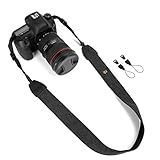
- 1. waka Rapid Camera Neck Strap with Quick Release and Safety — Best overall
- 2. Peak Design Slide Camera Strap — Best premium
- 3. TARION Quick Release Magnetic Camera Neck Strap Magislide — Runner-up
- Neck, shoulder, sling or wrist: which carry suits you?
- 4. K&F CONCEPT Camera Neck Strap — Best upgrade
- 5. USA Gear TrueSHOT Camera Strap — Best minimal setup
- 6. Peak Design Cuff Camera Wrist Strap — Best for pros
- 7. WANBY Camera Strap Canvas Black Shoulder Strap — Best budget pick
- How much adjustment range do you actually need?
- What the listings do not tell you
- The verdict
- FAQ
The best professional camera strap is the waka Rapid Camera Neck Strap, because it mounts through the tripod socket and carries a full-size SLR with a zoom on an anti-slip neoprene pad, adjustable from 20.8 to 31.5 inches. If you switch carry positions mid-shoot, the Peak Design Slide is the better buy, with a 39 to 57 inch adjustment range and Anchor connectors the listing rates over 200 lb each.
One number splits this field, and it isn't the padding. It's the load figure published for the connector: 200 lb on both Peak Design picks, 110 lb on the TARION, and nothing stated at all on the rest. That single gap decides which of these seven you should trust with a body and lens you can't replace this week.
A note on the word professional. Amazon's results for this term return general-purpose straps, and none of these seven listings publishes a professional-grade certification or a pro-only spec. So treat "professional" as your own bar, not a claim any of these products makes, and judge it on the published load rating and the connector design below.
Best professional camera strap at a glance
| Pick | Connector load | Length range | Price |
|---|---|---|---|
Best overall waka Rapid Camera Neck Strap |
Not published 1/4" tripod stud |
20.8–31.5 in | Check Price |
Best premium Peak Design Slide |
200 lb per Anchor claim | 39–57 in | Check Price |
Runner-up TARION Magislide |
110 lb Dyneema claim | 32.5–55.5 in | Check Price |
Best upgrade K&F Concept Neck Strap |
Not published metal O-rings |
100 cm fixed | Check Price |
Best minimal setup USA Gear TrueSHOT |
Not published 3/8" loop straps |
One size, adjustable | Check Price |
Best for pros Peak Design Cuff |
200 lb per Anchor claim | 9.7 wrist size | Check Price |
Best budget pick WANBY Canvas Strap |
Not published plastic buckles |
28 in stated | Check Price |


How the seven picks were weighted, and why
I compared the published specifications side by side and weighted three things, in this order.
- Connector strength and design, at roughly half the decision. A strap is a chain, and the weakest link is where it meets the camera. Three of these seven publish a load figure. Four don't, which is itself information.
- Adjustment range, at about a third. A strap that only sits at one length forces one carry position. The Slide moves through an 18-inch span; the K&F Concept is a fixed 100 cm loop.
- Weight and bulk, the remaining slice. Every ounce on your neck compounds over a six-hour shoot. The spread here is enormous: 1.41 oz for the WANBY, 0.62 lb for the waka.
Why that order? Because comfort is recoverable and failure isn't. You can shift a strap that digs in. You can't un-drop a body onto concrete. Padding claims also resist comparison, since "stretch neoprene" and "internally padded nylon" describe feel, not measurable support. Load ratings and inches don't have that problem.
What got cut: anything without a stated mounting method, and anything whose only differentiator was a print pattern. Every pick here states how it attaches to a camera.
What actually decides a camera strap: the connector, not the pad
Most guides to the best professional camera strap compare shoulder padding. That's the wrong lens. Padding decides whether hour five is pleasant. The connector decides whether there's a camera at hour five.
There are four attachment methods in this set, and they behave very differently:
- Tripod-socket stud. The waka threads a 1/4" screw into the camera's base. It's the widest contact surface of any method here, and it uses a mount already engineered to hold a camera on a tripod head.
- Anchor Link loops. Both Peak Design picks thread a cord loop through the camera's factory lugs, and the listing rates each Anchor over 200 lb.
- Magnetic anchors. TARION uses Dyneema fiber anchors rated in the listing for 110 lb, with what it calls a three-layer wear indicator so you can see when a cord is going.
- Split rings and plastic buckles. The K&F Concept uses double-ended metal O-rings. The WANBY and the USA Gear use quick-release plastic fasteners on nylon webbing.
Here's the trick with plastic quick-release buckles: they're genuinely convenient, and they're also the part that ages. Nothing in these listings states a cycle count or a rated load for them. So if you're carrying pro glass, the published-figure picks are where I'd look first, and the unrated ones I'd reserve for lighter bodies.
1. waka Rapid Camera Neck Strap with Quick Release and Safety — Best overall
A tripod-socket mount and a wide neoprene pad make this the most confident carry here for a heavy body and zoom.
Best for: shooters carrying one heavy DSLR and zoom all day Skip it if: your camera has no tripod socket free
Within this set, the waka is the only pick that mounts through the tripod stud rather than the camera's lugs. That matters more than it sounds. The 1/4" socket is a threaded metal insert built into the body chassis, and waka says the strap supports a full-size SLR with a zoom attached. The strap adjusts from 20.8 to 31.5 inches, which is a shorter span than the sling-style picks here but perfectly matched to a chest-height neck or cross-body carry.
At 0.62 lb, this is the heaviest pick of the seven, and that weight is mostly pad and hardware. waka describes the neoprene as anti-slip with weight distributed across the pad. There's also a safety tether, plus a slider clip that locks into a slot once you've set your length, which is the fix for the classic problem of a strap creeping longer through a shoot.
The trade-off against the Peak Design picks is honest: no published load figure, and no way to detach in seconds and re-attach to a second body. This is a one-camera strap that does one camera very well.
Pros:
- Mounts to the 1/4" tripod socket, not the lugs
- Wide anti-slip neoprene pad for heavy bodies
- Locking slider stops length creep mid-shoot
- Safety tether included as backup
- Rated by waka for full-size SLR plus zoom
Cons:
- Heaviest pick here at 0.62 lb
- No published load rating for the connector
- Occupies the tripod socket, so plate users need to swap
- Shortest maximum length of the adjustable picks
2. Peak Design Slide Camera Strap — Best premium
The widest adjustment span in this set, with the only 200 lb connector claim on a full-length strap.

Best for: photographers switching between sling and shoulder mid-shoot Skip it if: you never change strap length
The Slide is the most expensive pick here, and the adjustment range explains why. Peak Design states 39 to 57 inches, moved with dual quick-adjusters you can work with one finger. That 18-inch span is what turns one strap into three carries: tight across the back as a sling, longer over the shoulder, shortest around the neck. No other pick in this set covers that much ground.
The Anchor Link system is the other half of the case. Peak Design says each Anchor holds over 200 lb, and the cords thread through the camera's own strap lugs, so you can pop the strap off and leave the anchors in place. The webbing is described as smooth on one face to slide over a jacket and grippy on the other to stay put, and the strap measures 1.4 x 12.7 x 3.7 in packed.
Against the waka, you're paying a clear premium for versatility rather than raw pad width. And against the TARION, the connection is manual: no magnets guiding the anchor home when you're not looking down.
Pros:
- 39 to 57 in range, the widest here
- One-finger dual adjusters for mid-shoot changes
- 200 lb per Anchor claim, highest published in this set
- Anchors stay on the camera between strap swaps
- Reversible smooth and grippy webbing faces
Cons:
- Highest price position of the seven
- Anchor cords are a wear part you monitor and replace
- No magnetic guidance, unlike the TARION
- Nylon webbing is narrower than a neoprene pad
3. TARION Quick Release Magnetic Camera Neck Strap Magislide — Runner-up
Magnetic anchors that click home without looking, plus four beads for switching between two bodies.

Best for: two-body shooters who swap cameras constantly Skip it if: you want the lightest strap possible
The Magislide is the only pick here with magnets in the connector, and it's the reason it sits third. TARION describes a magnetic guide that pulls the anchor into place with an audible click, so you can reattach a camera by feel while your eyes stay on the scene. Four orange magnetic beads come in the box, which means two bodies can stay permanently anchored and you move one strap between them.
The published load figure is 110 lb of tension on Dyneema fiber anchors, with a three-layer wear warning TARION says shows visually when a cord needs replacing. That's a genuinely useful design detail, and it's the only wear indicator described in this set. Length runs 32.5 to 55.5 inches via a one-piece quick pull ring, and the webbing is high-tensile seatbelt nylon at 47.2 inches long by 1.38 inches wide.
The costs are real. At 5.29 oz it's the second-heaviest here, and the 110 lb figure sits well under the 200 lb both Peak Design picks claim. Magnets also mean metal hardware near your gear.
Pros:
- Magnetic anchors connect without looking down
- Four anchor beads included for two-body use
- 110 lb Dyneema claim with visual wear indicator
- 32.5 to 55.5 in one-handed adjustment
- Seatbelt-grade nylon webbing, 1.38 in wide
Cons:
- 5.29 oz, second-heaviest of the seven
- Load claim under half the Peak Design figure
- Premium price position without the widest range
- Magnetic hardware adds metal near the body
Neck, shoulder, sling or wrist: which carry suits you?
The picks in this guide cover four carry styles, and choosing the wrong one is the most common mistake I see in this category. Match the style to how you actually shoot.
Neck carry hangs the camera at chest height on a short loop. The waka at 20.8 to 31.5 inches and the K&F Concept at a 100 cm fixed length are built for this. It's fast to raise the camera to your eye, but the full weight loads your cervical spine, which is why pad width matters most here.
Shoulder carry drops the camera to hip height on one side. It's kinder over long days and slower to deploy. The USA Gear TrueSHOT and the WANBY both sit in this territory.
Sling carry runs the strap diagonally across your back so the camera rides at your hip and slides up on demand. Only the Slide, at 39 to 57 inches, and the TARION, at 32.5 to 55.5 inches, extend far enough to do it properly.
Wrist carry removes the neck and shoulder from the equation entirely. The Peak Design Cuff is the only pick here in this camp, and it suits a small body you're holding anyway.
Most shoppers miss that these aren't interchangeable. A 100 cm neck loop cannot become a sling, no matter how you wear it.
4. K&F CONCEPT Camera Neck Strap — Best upgrade
A 2.12 oz rope strap that rolls into a jacket pocket, which is the whole argument for it.

Best for: street shooters with a small mirrorless body Skip it if: you carry a battery grip and long glass
The K&F Concept is the upgrade for anyone who currently uses the branded webbing strap that came in the camera box. It weighs 2.12 oz, or 60 grams by K&F's own figure, and it measures 100 cm end to end. The construction is nylon rope rather than flat webbing, and K&F says it rolls up for storage in any bag, which is the practical benefit: it stops being a dangling loop the moment you put the camera down.
Attachment is via double-ended metal O-rings, which K&F states are compatible with most camera strap loops. That covers the standard triangular lugs on nearly every mirrorless and DSLR body. It's the second-cheapest pick in this set, and it's one of two picks here listed by more than one seller.
The limits follow from the design. The 100 cm length is fixed, so you get one carry position and no sling option. There's no pad, so a heavy body concentrates its weight onto a narrow rope across your neck. And no load figure is published for the O-rings. Against the waka, that's the trade: a fraction of the weight and bulk, none of the padding or the tripod-socket security.
Pros:
- Just 2.12 oz, among the lightest here
- Rolls up small for pocket or bag storage
- Metal O-rings fit standard camera lugs
- Second-cheapest pick in this set
Cons:
- Fixed 100 cm length, no adjustment
- No shoulder pad at all
- No published load rating for the O-rings
- Narrow rope concentrates weight on heavy bodies
5. USA Gear TrueSHOT Camera Strap — Best minimal setup
The only pick here with storage pockets and the only one with a published warranty.

Best for: hikers who want cards and a spare battery on the strap Skip it if: you hate bulk around your neck
Two things make the TrueSHOT the odd one out in a good way. First, USA Gear states a 3-year manufacturer's warranty, and it is the only pick in this set with any warranty term published. Second, it has pockets: USA Gear describes protective memory card storage plus side pouches sized for spare batteries, lens caps and pens. That's the "minimal setup" case in one line. Strap on, camera on, nothing else in your pockets.
The pad is stretch neoprene, which USA Gear says distributes weight across shoulders and back. Connection is via dual quick-release buckles on 3/8" adjustable reinforced loop straps, and the whole thing weighs 3.53 oz across a 2.24 x 9.25 x 6.5 in body. That's a mid price position, sitting between the entry picks and the two premium Peak Design straps.
The cost of the pockets is thickness. This is a bulkier object around your neck than the K&F rope or the WANBY canvas, and there's no published load figure for the buckles. If you already carry a card wallet, the main reason to buy this one disappears.
Pros:
- Only pick here with a published warranty term
- Card and battery pockets built into the pad
- Stretch neoprene spreads load across shoulders
- Dual quick-release buckles on reinforced loops
- Listed by more than one seller
Cons:
- Bulkiest profile around the neck in this set
- No load rating published for the buckles
- Pockets are dead weight if you carry a wallet
- Mid price for no extra published load capability
6. Peak Design Cuff Camera Wrist Strap — Best for pros
A 1.9 oz wrist tether with the same 200 lb Anchor claim as the Slide, for when a neck strap is in the way.

Best for: pros already running Anchor Links on a second body Skip it if: you need your hands free
The Cuff earns its place as the second strap in a working kit, not the only one. It's a wrist loop, sized 9.7 and weighing 1.9 oz, at 1.2 x 6.6 x 2.4 in. Peak Design describes it as drop protection in a minimalist design that doesn't get in the way, with slimmer hardware than the Slide.
The important detail for anyone already in this ecosystem: it uses the same Anchor Link system, with each Anchor rated in the listing at over 200 lb. So if your primary body wears a Slide, the Cuff clips into the same anchors on your second body, and you can swap in a couple of seconds. That interoperability is the reason this sits above the budget picks despite doing far less.
What it doesn't do is carry a camera for you. Your hand still holds the weight, so a body with a heavy zoom is fatiguing in a way no neck or sling strap is. It's also the second-most expensive pick here, which is a lot for a loop of webbing if you're not already invested in the anchors. Buy it as an addition, not a replacement.
Pros:
- 200 lb per Anchor claim, matching the Slide
- Just 1.9 oz and 1.2 in thick when stored
- Shares anchors with other Peak Design straps
- Nothing crosses your neck or shoulders
Cons:
- Your hand carries the full camera weight
- Second-highest price position in this set
- No help for long-lens or all-day carry
- Poor value if you own no other Anchor gear
7. WANBY Camera Strap Canvas Black Shoulder Strap — Best budget pick
The cheapest and by far the lightest pick here, at 1.41 oz, with an elastic neck section instead of a pad.
Best for: light compact bodies and occasional shoots Skip it if: you shoot with a pro zoom
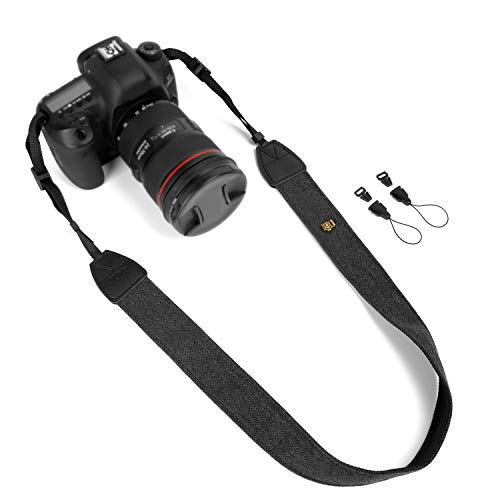
At 1.41 oz, the WANBY is the lightest pick in this set by a clear margin, and it's the cheapest of the seven. The construction is cotton canvas webbing with PU leather ends, and the strap runs 28 inches long by 1.5 inches wide. WANBY specifies nylon and high-tensile plastic fasteners with quick-release buckles, and describes an elastic section around the neck to reduce tension plus an anti-slip inner layer.
That elastic panel is the interesting bit at this price. On a light mirrorless or compact body, a little give absorbs the bounce when you walk, which a rigid webbing strap transmits straight to your neck. WANBY also states it fits DSLR and SLR bodies from any brand, and mentions binoculars, monoculars and rangefinders as alternative uses.
The honest picture: there is no shoulder pad, no published load figure, and the fasteners are plastic. The stated 28-inch length is short, which puts the camera high on the chest with limited room to adjust. Against the waka, you're giving up the tripod-socket mount, the neoprene pad and the safety tether. Against the K&F, you gain elasticity and lose a little weight. Fine for a small body, wrong for a gripped one with fast glass.
Pros:
- Lightest pick here at 1.41 oz
- Cheapest of the seven
- Elastic neck section absorbs walking bounce
- Canvas and PU leather rather than bare nylon
- 1.5 in webbing width for a budget strap
Cons:
- No shoulder pad of any kind
- Plastic fasteners with no published load rating
- 28 in stated length limits carry positions
- Not suited to heavy bodies or long lenses
How much adjustment range do you actually need?
Adjustment range is the specification I'd check second, right after the connector. Here's how the seven line up, and what each span buys you.
- Fixed length. The K&F Concept is a 100 cm loop. The WANBY states 28 inches. One position each. Fine if you always shoot the same way.
- Narrow adjustable, roughly 10 inches of travel. The waka moves from 20.8 to 31.5 inches. That covers neck carry through to a loose shoulder carry, and its locking slider means the setting stays put.
- Wide adjustable, 20 inches or more. The Slide covers 39 to 57 inches, the TARION 32.5 to 55.5 inches. Both reach true sling length and both shorten enough for a quick shoulder carry.
The cutoff is about 45 inches. Below it, you cannot run a camera across your back at hip height with any comfort, so sling carry is off the table. Above it, you can, and you can still cinch down for a neck carry when the crowd gets tight.
In practice, I'd pick a wide-range strap if you shoot events or travel, where you're constantly moving between hands-free walking and shooting. A fixed length is perfectly adequate for studio work or a single-location shoot where the camera goes up and stays up.
What the listings do not tell you
Four things are missing across these seven listings, and knowing the gaps is part of buying well.
No load figure on four of seven. The waka, K&F Concept, USA Gear and WANBY publish no rated capacity for their connectors. That is not proof of weakness. It does mean you cannot compare them numerically against the 200 lb and 110 lb claims, so match them to gear weight you'd be comfortable losing.
Almost no warranty information. USA Gear states 3 years. Nobody else in this set publishes a term at all. If a warranty matters to you, that narrows the field to one.
Pad width isn't stated for most. The waka and USA Gear both describe neoprene padding, but neither publishes a pad width in inches. You can infer something from overall dimensions, 2.36 x 7.99 x 3.35 in for the waka and 2.24 x 9.25 x 6.5 in for the USA Gear, but that's packaging, not pad.
Lug compatibility is described in general terms. "Most camera shoulder strap loops" and "all brands" are the phrasing used. Check your own body's lugs, especially on compact cameras with a single small eyelet, before assuming a metal O-ring will pass through.
The verdict
The entry tier of this set is more capable than you'd expect. The waka Rapid Camera Neck Strap wins outright at an entry price position, because its 1/4" tripod-socket mount, wide anti-slip neoprene pad and locking slider give you the most secure single-camera carry here without touching the premium picks. The WANBY at 1.41 oz and the K&F Concept at 2.12 oz sit alongside it for light bodies where padding is irrelevant.
The middle tier buys accessories rather than strength. The USA Gear TrueSHOT adds card and battery pockets plus the only published warranty in this set, 3 years, and that's genuinely the whole pitch. Buy it if you want to leave the card wallet at home.
The premium tier buys published load figures and range. The Peak Design Slide is the runner-up on merit: 39 to 57 inches of one-finger adjustment and a 200 lb claim per Anchor, which is the exact advantage the waka lacks. The TARION Magislide adds magnetic connection and four anchor beads for two-body work at a 110 lb rating, and the Peak Design Cuff makes sense only as a second strap on a body that already wears anchors.
So: waka for one camera carried well, Slide if you change carry position all day.
FAQ
Is a professional camera strap worth the extra money?
A professional camera strap is worth the extra money in exactly one case: when the connector publishes a load figure and yours doesn't. The Peak Design Slide states over 200 lb per Anchor and covers 39 to 57 inches. If you shoot with irreplaceable glass or switch bodies mid-job, that's real. For a light mirrorless kit, the entry picks here do the job.
What is the best professional camera strap for a heavy DSLR?
The best professional camera strap for a heavy DSLR here is the waka Rapid, because it mounts through the 1/4" tripod socket rather than the camera's lugs and waka states support for a full-size SLR plus zoom. The anti-slip neoprene pad is the widest in this set, and at 0.62 lb the strap itself is substantial enough to spread that load.
Will these straps fit a mirrorless camera?
These straps fit mirrorless bodies with standard strap lugs, according to each listing. The K&F Concept uses double-ended metal O-rings described as compatible with most strap loops, and both Peak Design picks thread Anchor cords through factory lugs. The waka is the exception worth checking: it needs a free 1/4" tripod socket, so remove any quick-release plate first.
Peak Design Slide or TARION Magislide: which should I pick?
Choose the Slide or the Magislide on how you connect. The Slide claims over 200 lb per Anchor and a 39 to 57 inch range, so it wins on strength and reach. The Magislide claims 110 lb, adds magnetic anchors that click home without looking, and includes four beads for two bodies. Two cameras, take TARION. One camera, take the Slide.
What mistake do people make buying camera straps?
The mistake is buying for pad comfort and ignoring the connector. Four of these seven listings publish no load rating, and plastic quick-release buckles are the part that ages fastest. The second mistake is length: a fixed 100 cm or 28 inch strap can never become a sling, so check the range before you commit to a carry style.
Start with your camera's tripod socket. If it's free, the waka Rapid gives you the widest mounting surface and the best pad in this group, and the locking slider means you set the length once and forget it. If you've got a quick-release plate living down there permanently, jump to the Peak Design Slide and thread its anchors through your lugs instead. Either way, decide your carry style first, neck, shoulder, sling or wrist, then buy the strap whose range actually reaches it. A strap that can't hold the position you shoot in is the one you'll stop using.