Best Lightweight Trail Camera for Sharp Field Clips

Six trail cameras ranked by weight, resolution and stealth for anyone filming wildlife clips. The CEYOMUR CY50 wins on portability, with picks for pros, beginners and stealth setups.

By Carter LoganUpdated 14 min read
On this page
- How I screened these six down to a ranking
- Best lightweight trail camera for content creators at a glance
- Does lightweight actually help a content creator?
- 1. CEYOMUR Trail Camera — Best overall
- 2. Loatos Trail Camera — Best for pros
- 3. HXMBFBF Trail Camera — Runner-up
- 4. Zonetiger Trail Camera — Best large-capacity
- 5. GardePro E5S Trail Camera — Best for beginners
- 6. GardePro E6 WiFi Trail Camera — Best premium
- What resolution numbers really mean for your clips
- No-glow versus low-glow: which night vision to pick?
- What owning one actually involves
- The verdict
- FAQ
The best lightweight trail camera for content creators is the CEYOMUR CY50, a 0.63 lb body that captures 36MP stills and 2K video while staying the easiest of these six to carry between shooting spots. If you need footage pushed to your phone from a remote location instead of walking in to swap cards, the Loatos 4G LTE camera is the better call. Weight, not resolution, is what most guides get wrong here. A lighter body changes how many spots you can rig in a day.
How I screened these six down to a ranking
I lined up the published weight, dimensions, resolution and night-vision figures for all six cameras and compared them side by side. The word "lightweight" only means something if you can check it against a number, so I started there. Three of these list a weight under 0.7 lb. Two list no weight at all, which is a mark against them for a creator who cares about carry load.
Here is how the cut worked:
- Weight first. The CEYOMUR CY50 at 0.63 lb and both GardePro bodies at 0.66 lb lead. The HXMBFBF sits heavier at 0.8 lb.
- Resolution and video next. 4K bodies and 64MP stills separate the mid and premium picks from the entry-level 36MP CEYOMUR.
- Delivery method. Only the Loatos pushes footage over 4G LTE. The rest need a card pull or a short-range app connection.
A quick note on the phrase "for content creators." Amazon's search treats it loosely, and none of these listings is built or marketed as a creator tool. They are wildlife and game cameras. I've ranked them on the specs that matter to someone filming clips, but judge the creator fit yourself against your own workflow.
Best lightweight trail camera for content creators at a glance
| Pick | Resolution | Weight | Price |
|---|---|---|---|
Best overall CEYOMUR Trail Camera |
36MP / 2K video | 0.63 lb | Check Price |
Best for pros Loatos Trail Camera |
2K live view | Not listed | Check Price |
Runner-up HXMBFBF Trail Camera |
4K / 48MP | 0.8 lb | Check Price |
Best large-capacity Zonetiger Trail Camera |
4K / 48MP | Not listed | Check Price |
Best for beginners GardePro E5S Trail Camera |
64MP / 1296p | 0.66 lb | Check Price |
Best premium GardePro E6 WiFi Trail Camera |
64MP / 1296p | 0.66 lb | Check Price |




Does lightweight actually help a content creator?
Lightweight helps most when you rig more than one camera in a session. A 0.63 lb body versus a 0.8 lb body is not a dramatic gap on its own. Carry four of them, plus mounts, batteries and cards, and the difference starts to matter on a long walk in.
Where the weight figure earns its keep for a creator:
- More angles per trip. Lighter bodies mean you pack more without a heavier bag.
- Easier repositioning. You'll move a light camera more freely to chase a better frame.
- Less strain on cheap mounts. A lighter body puts less load on a strap or a small tripod head.
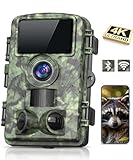
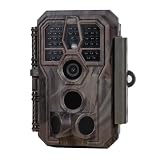
The catch is that two of these six, the Loatos and the Zonetiger, publish no weight at all. That is a real gap. If carry load is your deciding factor, you are buying blind on those two, and I'd treat that as a reason to lean toward the three that state a figure. The best lightweight trail camera for content creators should tell you what it weighs before you commit.
1. CEYOMUR Trail Camera — Best overall
The CEYOMUR CY50 wins because it is the lightest body here at 0.63 lb and still lands solid 36MP stills and 2K video.
Best for: creators hauling gear between spots who want the lightest body Skip it if: you need remote footage delivery to your phone
What sets the CY50 apart in this group is the combination of the lowest published weight, 0.63 lb, and the friendliest price position. It's the cheapest of the six and the one buyers here pick most often. For a creator building out several angles, that pairing is hard to beat. The dimensions run 7.1 x 5.71 x 4.02 in, which is longer than the GardePro bodies but still easy to strap to a trunk.
CEYOMUR says the camera uses 24 built-in 850nm infrared LEDs for black-and-white night footage, and rates the housing at IP66 for weather. It also lists a one-year warranty, which two cameras in this set do not publish. The night vision is 850nm, a low-glow type that emits a faint red glow up close, so it's less stealthy than a 940nm no-glow system. That's the main trade-off against the pricier GardePro E6. You also give up any remote delivery: this is a pull-the-card camera.
Pros:
- Lightest body in the set at 0.63 lb
- Cheapest pick of the six
- The one buyers here choose most often
- 36MP stills and 2K video per CEYOMUR
- Published one-year warranty and IP66 rating
Cons:
- 850nm night vision glows faintly up close
- No remote footage delivery
- Longest body of the three lightweight picks
- Lower resolution than the 4K and 64MP rivals
2. Loatos Trail Camera — Best for pros
The Loatos is the only camera here that pushes footage to your phone over 4G LTE, which changes how a creator works remote spots.

Best for: creators who need footage pushed to their phone from remote spots Skip it if: you avoid app-and-SIM setups
The Loatos is the outlier of this set, and for the right creator it's the most useful. Loatos says it ships with a built-in U.S. SIM and 7 days of unlimited trial data, works over 4G LTE, and streams a 2K live feed through its Ucon app. That means you check a distant camera from home instead of walking in and risking a spooked scene. Loatos also claims a 0.2-second trigger speed.
It's the second-cheapest here, which is striking for a cellular body. The catch is the missing data: no published weight and only a rough 3 x 6 x 5 in dimension listing. For a "lightweight" guide, that's a genuine blind spot. It also lists no warranty. The cellular workflow depends on ongoing data after the trial, and app-and-SIM setups add friction the card-pull cameras avoid. Against the CEYOMUR, you trade a known weight and a warranty for remote access.
Pros:
- Only 4G LTE remote-delivery camera here
- 2K live feed per Loatos
- Built-in U.S. SIM with 7-day trial data
- 0.2s trigger speed claim
- Second-cheapest pick of the six
Cons:
- No published weight
- No stated warranty
- Data plan needed after the trial
- Slower seller than most of this set
3. HXMBFBF Trail Camera — Runner-up
The HXMBFBF gives you 4K video, 48MP stills and a 130-degree frame, the widest capture spec in this group.

Best for: creators who want 4K stills and a wide frame on a mid budget Skip it if: carry weight is your top concern
This is the runner-up because it matches the top picks on capture quality without the premium price of the GardePro bodies. HXMBFBF lists 4K video, 48MP images, a 130-degree wide-angle lens, and a trigger of 0.05 to 0.3 seconds. The wide frame matters for a creator: more of the scene lands in each clip, so you crop later without losing subjects at the edges. The company also cites night-vision clarity up to 98 feet.
The compact 4 x 5.5 x 3.5 in body is smaller than the CEYOMUR. But it's the heaviest here at 0.8 lb, which costs it the top spot in a lightweight ranking. It publishes no warranty either, unlike both GardePro cameras and the CEYOMUR. Its no-glow LEDs make it stealthier than the CEYOMUR's 850nm system, though. Against the Zonetiger, which shares the same 4K and 48MP claims, the HXMBFBF at least states its weight.
Pros:
- 4K video and 48MP stills per HXMBFBF
- 130-degree wide-angle frame
- Fast 0.05–0.3s trigger claim
- Compact 4 x 5.5 x 3.5 in body
- No-glow night vision for stealth
Cons:
- Heaviest body here at 0.8 lb
- No published warranty
- No remote footage delivery
- Sits mid-range for no weight advantage
4. Zonetiger Trail Camera — Best large-capacity
The Zonetiger pairs a 4K, 48MP sensor with a 130-degree wide angle and a fast 0.05s trigger claim for fixed wide-frame setups.

Best for: creators mounting a wide-frame 4K rig in one fixed spot Skip it if: you move the camera often
The Zonetiger reads like the HXMBFBF's twin on paper, and that's no accident: same 4K resolution, same 48MP still claim, same 130-degree angle, same "TrailCam Go" app control over Bluetooth. Zonetiger says it triggers in as little as 0.05 seconds and carries an IP66 waterproof rating. For a creator who sets a rig and leaves it, that wide 4K frame captures a generous slice of the scene.
Where it slips is the data. Its 4 x 8 x 5 in listing makes it the largest body here, and it publishes no weight, which is a problem in a lightweight guide. No warranty is listed either. The larger body and unknown weight point toward a fixed mount rather than a camera you shuffle between spots each session. Against the HXMBFBF, you get the same headline capture specs but a bulkier frame and a missing weight figure, which is why it ranks below it here.
Pros:
- 4K video and 48MP stills per Zonetiger
- 130-degree wide-angle capture
- Fast 0.05s trigger claim
- Bluetooth app control via TrailCam Go
- IP66 waterproof rating claim
Cons:
- Largest body in the set at 4 x 8 x 5 in
- No published weight
- No stated warranty
- No remote footage delivery
5. GardePro E5S Trail Camera — Best for beginners
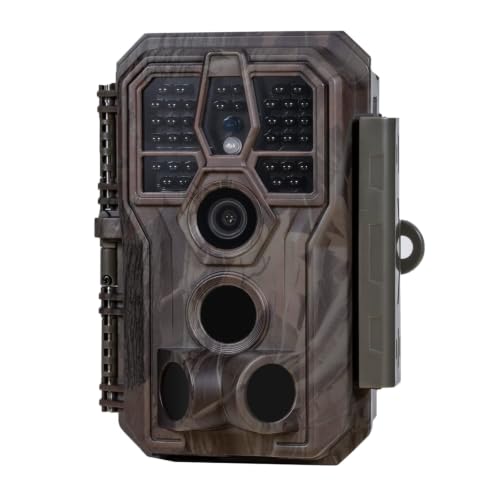
The GardePro E5S is the easiest first camera here: 64MP stills, a fast 0.1s trigger and simple SD-card retrieval.
Best for: first-timers who want fast triggering and simple SD-card retrieval Skip it if: you want live footage on your phone
The E5S is the pick for a creator starting out. It's light at 0.66 lb, and GardePro builds it around a no-fuss workflow: pull the SD card, see what you caught. That simplicity is a feature for a beginner who doesn't want to fight an app on day one. GardePro claims 64MP photos, 1296p HD video, and a fast 0.1-second trigger backed by three PIR sensors. It also lists a one-year manufacturer warranty and an IP66 rating with a 1/4"-20 mounting thread.
It sells faster than any other camera in this set, which tells you it lands with buyers. The trade-off is that the card-pull design means no live view and no remote delivery, so you walk in every time to see footage. It sits in the premium price tier despite that simpler feature set, which is the main knock against it. Against the E6, you give up WiFi app access and stealth 940nm night vision.
Pros:
- Light 0.66 lb body
- 64MP stills and 1296p video per GardePro
- 0.1s trigger with three PIR sensors
- Published one-year warranty
- Simple card-pull setup for first-timers
Cons:
- No WiFi or app access
- No remote footage delivery
- Premium price for a simpler feature set
- Weaker night-vision stealth than the E6
6. GardePro E6 WiFi Trail Camera — Best premium
The GardePro E6 is the stealth pick: 940nm no-glow night vision, WiFi app access and a light 0.66 lb body.

Best for: creators who want stealth 940nm night vision and app access Skip it if: you want the cheapest way in
The E6 is the most expensive pick here, and its case rests on stealth and connectivity. GardePro says the 940nm no-glow infrared LEDs make it invisible at night, which matters when you're filming skittish subjects that a faint red glow would spook. It pairs that with ultra-low-power WiFi plus Bluetooth through the GardePro app, with no monthly fee and a live view up to 45 feet away in open areas. Claimed capture is 64MP photos and 1296p HD video.
At 0.66 lb it's among the lightest here, sharing the same 5.6 x 4.2 x 2.4 in body as the E5S. It lists a one-year warranty and runs on 8 AA batteries with optional solar support. The cost is the price position: it's the priciest of the six for capture specs that match its cheaper E5S sibling. What you're paying for is the no-glow IR and the app. If stealth night footage isn't your priority, that premium is hard to justify.
Pros:
- 940nm no-glow IR for stealth night footage
- WiFi and Bluetooth app access, no monthly fee
- Light 0.66 lb body
- Live view up to 45 ft in open areas
- Published one-year warranty and solar support
Cons:
- Most expensive pick of the six
- Same capture specs as the cheaper E5S
- No remote cellular delivery
- Batteries not included
What resolution numbers really mean for your clips
Higher megapixel counts on a listing sound like sharper footage, but they don't decide clip quality on their own. Two things matter more for a creator: the video resolution and the lens angle.
- 48MP or 64MP stills are photo numbers. They help crops and thumbnails, not your video.
- 4K versus 2K video is the real divide. The HXMBFBF and Zonetiger claim 4K; the CEYOMUR lists 2K; both GardePro bodies list 1296p.
- Lens angle shapes your frame. The 130-degree lens on the HXMBFBF and Zonetiger captures a wider scene than a narrower lens.
So a 64MP body isn't automatically better for video than a 48MP one, because those numbers describe stills. If clean 4K clips are your goal, the two 4K cameras lead. If wide framing is your goal, those same two win on the 130-degree spec. Match the number to what you actually publish.
No-glow versus low-glow: which night vision to pick?
Night vision splits this set into two camps, and the difference shows up on screen and in the field. Low-glow 850nm LEDs, like those on the CEYOMUR, emit a faint red glow visible up close. No-glow 940nm LEDs, like the GardePro E6's, stay dark.
Here's how to choose:
- Filming shy or nocturnal subjects? Go no-glow. The E6's 940nm system won't cast a visible glow that spooks a subject.
- Filming in a spot where theft is a risk? No-glow is harder to spot at night.
- On a tight budget and shooting less-skittish scenes? The CEYOMUR's 850nm system is the cheaper route and still delivers black-and-white footage.
The HXMBFBF and Zonetiger both claim no-glow LEDs too, so stealth isn't exclusive to the premium tier. The E6 is the one that names the 940nm figure outright, which is why it's the clearest stealth pick.
What owning one actually involves
Owning a trail camera for content work is mostly about power and retrieval, and the listings hint at both. Both GardePro bodies run on 8 AA batteries, not included, with optional solar panel support sold separately. The Loatos is the only one that spares you the walk-in, streaming over 4G LTE, though that means managing data.
Plan for these realities:
- Batteries and cards are usually extra. Budget for AA cells and an SD card on the GardePro and card-pull models.
- Card-pull cameras need site visits. The CEYOMUR, both GardePro bodies, HXMBFBF and Zonetiger all need you to retrieve footage in person.
- Weather sealing is rated, not guaranteed. IP66 claims appear on the CEYOMUR, Zonetiger and E5S, but placement still matters.
For a creator, the retrieval method shapes your whole rhythm. A card-pull camera means planned trips. The Loatos means checking your phone. Pick the workflow you'll actually keep up with.
The verdict
If you're a creator moving between spots and rigging several angles, the CEYOMUR CY50 is the buy. It's the lightest here at 0.63 lb, the cheapest of the six, and the one buyers pick most often, with 36MP stills and 2K video that hold up for clips. The cutoff is your workflow: card-pull versus remote delivery.
If you scout remote locations and can't keep walking in to swap cards, the Loatos is the better track. Its exact advantage is delivery: it's the only camera here that pushes a 2K live feed to your phone over 4G LTE, with a built-in U.S. SIM. You trade a known weight and a warranty for that reach, and you take on data management after the trial week.
Between those two poles sit the specialists. The GardePro E6 is the stealth pick for shy subjects thanks to its 940nm no-glow IR. The E5S is the fast, simple starter that sells quickest of the six. The HXMBFBF and Zonetiger bring 4K and a 130-degree frame if wide, sharp video outranks carry weight. Start with the CY50 unless a specific need pulls you elsewhere.
FAQ
Is a lightweight trail camera worth it for content creators?
A lightweight trail camera is worth it when you rig multiple angles per session. The CEYOMUR CY50 at 0.63 lb versus the HXMBFBF at 0.8 lb won't feel different for one camera. Carry four plus mounts and batteries, and the lighter bodies save real strain on a long walk in, letting you set more angles per trip.
What is the best lightweight trail camera for content creators on a budget?
The best lightweight trail camera for content creators on a budget is the CEYOMUR CY50. It's the cheapest of these six and the lightest at 0.63 lb, capturing 36MP stills and 2K video with a published one-year warranty. You give up remote delivery and settle for 850nm low-glow night vision, but nothing here matches its weight-to-price position.
How do the CEYOMUR and Loatos cameras compare?
The CEYOMUR and Loatos cameras solve different problems. The CEYOMUR CY50 is lighter at a stated 0.63 lb, cheaper, and carries a one-year warranty, but needs a card pull. The Loatos streams 2K footage to your phone over 4G LTE with a built-in SIM, though it publishes no weight or warranty. Pick delivery over portability if you scout remote spots.
Does resolution or video quality matter more for clips?
Video quality matters more than photo resolution for clips. A 64MP still figure describes photos, not footage. What decides your clips is video resolution and lens angle. The HXMBFBF and Zonetiger claim 4K video and a 130-degree frame, while the CEYOMUR lists 2K. Match the video spec to what you publish, not the headline megapixel number.
What is the biggest trail camera pitfall to avoid?
The biggest trail camera pitfall is buying on missing specs. Two of these six, the Loatos and Zonetiger, publish no weight at all, which is blind buying in a lightweight guide. Others list no warranty. Check whether a listing states weight, warranty and video resolution before you commit, because a marketing bullet is a claim, not a measured fact.
Start with the CEYOMUR CY50 and pair it with a spare SD card and a set of batteries so you're filming the day it arrives. It's the default because it wins on the spec that quietly shapes your whole shoot: weight. A 0.63 lb body means you say yes to one more angle instead of leaving the fourth camera in the car. If your work pulls you into remote country where card pulls aren't practical, jump to the Loatos and let 4G LTE do the walking for you.