Best Pocket Microscope for Beginners With LED

Optical or digital? Screen or eyepiece? Five pocket microscopes compared on weight, magnification and warranty, with a clear winner and the conditions that flip it.

By Carter LoganUpdated 13 min read
On this page
- Best pocket microscope for beginners at a glance
- How I screened these five down
- 1. Carson MicroBrite Plus 60x-120x — Best overall
- 2. TOMLOV P50 Handheld Digital Microscope — Best for families
- 3. BMDSAE 1000X Handheld Digital Microscope — Best for heavy use
- 4. BEAVERLAB Finder 4.0" — Best premium
- 5. Carson Pocket Micro 20x-60x — Best budget pick
- Optical or digital: which suits a beginner?
- What the magnification numbers don't tell you
- How to read a pocket microscope listing
- When a different pick wins
- The verdict
- FAQ
The best pocket microscope for beginners is the Carson MicroBrite Plus, a 2.08 oz optical scope with a 60x-120x zoom and a limited lifetime warranty. Nothing else here pairs that reach with that little weight or that long a promise on paper. If you'd rather look at a screen than through an eyepiece, the TOMLOV P50 and its 2.4-inch IPS display is the better buy. The price map is simple: the cheapest picks are eyepiece scopes, the pricier ones add a screen and a camera, and what you pay for is the display, not sharper optics.
Best pocket microscope for beginners at a glance
| Pick | Magnification | View type | Price |
|---|---|---|---|
Best overall Carson MicroBrite Plus |
60x-120x | Eyepiece | Check Price |
Best for families TOMLOV P50 |
Adjustable focus | 2.4" IPS screen | Check Price |
Best for heavy use BMDSAE 1000X |
1000X claim | 2.0" IPS screen | Check Price |
Best premium BEAVERLAB Finder |
100X-1600X claim | 4.0" IPS screen | Check Price |
Best budget pick Carson Pocket Micro |
20x-60x | Eyepiece | Check Price |



How I screened these five down
I lined up the published specifications side by side and looked for the numbers a beginner can actually check: weight, size, magnification claim and warranty. Marketing bullets came last, and I attributed them rather than trusting them.
Here is what I weighed, in order:
- Weight and size, because a pocket microscope that stays in a drawer teaches nothing.
- View type, eyepiece versus screen, since that single choice changes who the device suits.
- Warranty on paper, because it's the one durability signal in the data.
- Magnification honesty, since a big printed number often hides a digital multiplier.
A quick note on the word "beginners." The listings don't standardise on it, and Amazon's search treats it loosely here, so I won't promise any of these is objectively the easiest to learn. What I can do is match each to a starting profile. Two picks are true eyepiece scopes. Three add a screen and a camera. That split does most of the sorting for you before you read a single feature bullet.
1. Carson MicroBrite Plus 60x-120x — Best overall
The MicroBrite Plus is the best pocket microscope for beginners because it pairs real optical reach with the lightest body and the longest warranty in this set.
Best for: a beginner who wants a light, pocketable optical scope Skip it if: you want a screen to share the view
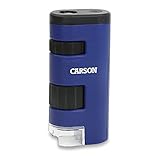
At 2.08 oz and 3.7 x 2.3 x 1.2 in, this is the smallest and lightest pick here. It's an eyepiece scope, so you look straight through the lens at the specimen. Carson says the range runs 60x to 120x optical, and calls it "lab tested" for accurate magnification. I'd treat that phrase as the maker's claim, not a measured fact, but the numbers themselves are modest and believable in a way the 1000X screen scopes are not.
The standout on paper is the warranty. This is the only pick with a limited lifetime warranty, where the rest offer one year or nothing stated. For a device a child will carry outdoors, that coverage matters. A built-in LED lights the specimen evenly, per the listing. The model is the MM-300, released in 2020.
The trade-off is honesty about what it isn't. There's no screen, no camera and no way to save an image. Two people can't watch at once. You get optics and portability, and you give up sharing.
Pros:
- Lightest pick here at 2.08 oz
- Only limited lifetime warranty in the set
- Believable 60x-120x optical range
- Small 3.7 x 2.3 x 1.2 in body
- Even LED illumination per the listing
Cons:
- No screen, so only one viewer at a time
- No photo or video capture
- Eyepiece viewing frustrates very young kids
- No price position listed to judge value
2. TOMLOV P50 Handheld Digital Microscope — Best for families
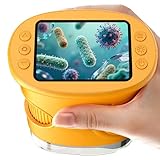
The P50 is the pick for a shared table, because its 2.4-inch IPS screen lets several people watch the same specimen at once.

Best for: families passing one device around a table Skip it if: you want the smallest possible body
The P50 swaps the eyepiece for a 2.4-inch IPS screen, and that's the whole reason to buy it. Everyone sees the image at the same time, which turns a solo activity into a group one. It measures 1 x 4.1 x 2.4 in and, TOMLOV says, weighs only 3 oz. Among the screen scopes here, that's a genuinely light body.
TOMLOV pitches it at close-up inspection of coins, stamps, gems, circuit boards and plant detail, with an adjustable focus wheel for fine control. The listing describes 6 LEDs with 4 brightness levels, which is fewer lights but more brightness steps than some rivals. It carries a one-year warranty, and two sellers stock it. It also sells faster than most of this set.
The catch is the missing headline magnification figure. The other screen scopes shout 1000X or 1600X; the P50 leans on adjustable focus instead. For general viewing that's arguably more honest, but if a child wants the biggest number on the box, this one won't win the argument.
Pros:
- 2.4-inch IPS screen for group viewing
- Light for a screen scope at 3 oz claimed
- Adjustable focus wheel for fine control
- One of the faster sellers here
- Stocked by more than one seller
Cons:
- No headline magnification figure listed
- Premium price position for a beginner
- Screen adds bulk over the eyepiece picks
- Only 6 LEDs versus 8 on rivals
3. BMDSAE 1000X Handheld Digital Microscope — Best for heavy use
This BMDSAE scope earns the nod for capture, letting a kid save and share what they find rather than just look.

Best for: a kid who wants to save and share what they see Skip it if: you want the lightest thing in a pocket
Where the Carson scopes only let you look, this one records. BMDSAE claims 32 MB of storage for 200-plus photos or AVI videos, so every discovery gets kept. For a curious child, that documentation loop is the draw. It ships in a gift box with a one-year warranty, model 382.
The listing states a 2.0-inch IPS screen, a 2MP camera and an 8-LED system with three brightness modes. It also advertises a 600mAh battery and anti-shake, plus CE, FCC and CPC safety certification and eco-friendly ABS plastic. The "real 1000X optical plus digital" line is the maker's claim, and I'd read that number as a combined figure, not pure optics. Take it as marketing, not a promise.
At 7.76 oz, it's by far the heaviest pick here, nearly four times the Carson MicroBrite Plus. "Pocket" is generous for a body this weight. The trade-off is plain: you gain a camera, storage and a rechargeable battery, and you give up the featherweight portability that defines the eyepiece scopes.
Pros:
- Saves 200+ photos or videos per the listing
- 8 LEDs with three brightness modes
- Rechargeable 600mAh battery claimed
- CE, FCC and CPC safety certification stated
- Second-cheapest pick in the set
Cons:
- Heaviest here at 7.76 oz
- 1000X is a combined, not optical, figure
- Small 2.0-inch screen versus rivals
- Slowest seller among the screen scopes
4. BEAVERLAB Finder 4.0" — Best premium
The Finder is for the buyer who wants the biggest screen and the largest headline number, and will pay the top position here to get them.

Best for: someone who wants the biggest screen here Skip it if: you need a published warranty on paper
The Finder's calling card is its 4.0-inch IPS display, the largest screen in this group by a wide margin. BEAVERLAB says it delivers 1080p high-definition imaging from a 2MP CMOS chip, capturing photos and video at 1920x1080. For a child who struggles with a small screen or a tiny eyepiece, that big bright panel is the reason to choose it.
The listing quotes a 100X-1600X range and 8 adjustable lights for tuning brightness to the specimen. The dimensions read 1.59 x 7.4 x 4.5 in, so the footprint is larger than the other screen scopes, and the model is DDL-M2. Treat 1600X the way you'd treat any four-figure claim on a beginner device: a combined number, not measured optical power.
Two gaps stand out in the data. There's no weight figure and no stated warranty, while cheaper picks here publish both. It sits in the premium tier and is the slowest seller of the five. You're paying the most for the biggest screen, not for coverage or proven durability.
Pros:
- Largest screen here at 4.0 inches
- 1080p imaging claimed from a 2MP chip
- 8 adjustable lights per the listing
- Captures photos and video at 1920x1080
Cons:
- No stated warranty in the data
- No published weight to judge portability
- Top price position for no extra optics
- Slowest seller of the five picks
5. Carson Pocket Micro 20x-60x — Best budget pick
The Pocket Micro is the low-risk way in, the cheapest pick here and a light eyepiece scope for a first-timer testing the hobby.
Best for: a first-time buyer testing the hobby cheaply Skip it if: you need magnification above 60x
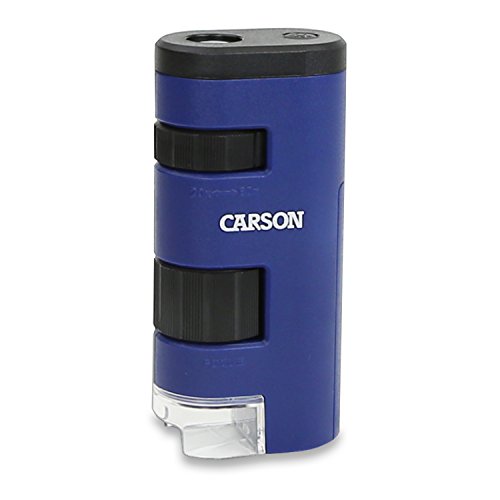
This is the cheapest of the five, which makes it the natural first buy if you're not sure the interest will stick. At 2.12 oz and 3.9 x 1.9 x 1.1 in, it's nearly as light as the MicroBrite Plus and just as pocketable. It's an eyepiece scope in blue, model MM-450, released in 2017.
Carson gives it a 20x-60x range, and that's the honest trade-off. The wider, lower magnification means a bigger field of view and an easier time finding your subject, which the listing calls "ease of use" for all ages. Beginners lose their target constantly at high power, so a lower ceiling is often a friendlier start. A built-in LED lights the specimen, and it carries a one-year warranty. It also sells fast in its category.
The limit is right there in the spec. Its 60x top end is half the MicroBrite Plus and a fraction of the screen scopes' claims. If a child quickly wants more reach, you'll be shopping again. Buy it as a tester, not a keeper.
Pros:
- Cheapest pick in the set
- Light and pocketable at 2.12 oz
- Wide field of view at 20x-60x
- Simple controls for all ages per Carson
- One of the faster sellers here
Cons:
- Lowest magnification ceiling at 60x
- Only a one-year warranty
- No screen, so single-viewer only
- No photo or video capture
Optical or digital: which suits a beginner?
This is the choice that decides everything else, so settle it first. An optical scope means you look through an eyepiece at the real specimen. A digital scope puts a small camera behind the lens and shows the image on a screen. Neither is better in the abstract; they suit different beginners.
- Eyepiece scopes here are the Carson MicroBrite Plus and Pocket Micro. Both are light, around 2 oz, and cheaper. One person views at a time.
- Screen scopes are the TOMLOV P50, BMDSAE 1000X and BEAVERLAB Finder. All add a display, most add a camera, and all weigh or bulk up more.
For a young child, a screen is often easier, because holding an eye steady on a tiny lens is hard. For quiet solo focus and true portability, the eyepiece wins. If you're buying for a group or a family table, the screen settles it. That single fork narrows five picks to two before you compare another number.
What the magnification numbers don't tell you
Magnification is where beginner listings mislead most, so read the figures carefully. A printed "1000X" or "1600X" almost always combines optical zoom with digital enlargement, and digital enlargement just stretches pixels. Past a point, you get a bigger, blurrier image, not more detail.
That's why the best pocket microscope for beginners here tops out at a modest 120x optical. Carson quotes 60x-120x for the MicroBrite Plus and 20x-60x for the Pocket Micro, both believable optical ranges. The BMDSAE 1000X and BEAVERLAB 100X-1600X figures are the makers' combined claims, and I've flagged them as such.
For a beginner, lower and honest beats high and inflated. At 20x-60x you can actually find your subject and hold it in view. At 1000X on a shaky handheld, most kids see a smear. If someone in your house is dazzled by the biggest number, aim them at the useful range instead, and treat any four-figure claim as marketing until proven otherwise.
How to read a pocket microscope listing
Even a scope I didn't cover can be judged from its listing if you know the four fields that matter. Use these to spot a good beginner buy fast:
- Weight. Under 3 oz is truly pocketable. The MicroBrite Plus at 2.08 oz sets the bar; the BMDSAE at 7.76 oz shows how heavy "pocket" can stretch.
- View type. Eyepiece or screen. This decides who can use it and whether people can share.
- Optical versus total magnification. If the listing only prints a huge total number, assume most of it is digital.
- Warranty. One clear durability signal. Only the MicroBrite Plus lists a lifetime warranty; the BEAVERLAB lists none at all.
Run any candidate through those four and you'll cut the guesswork. A listing that hides weight, hides its optical figure and states no warranty is telling you what it doesn't want compared. The best pocket microscope for beginners is usually the one that publishes plainly.
When a different pick wins
The MicroBrite Plus is my default, but three specific conditions flip it:
- If a child is under six or several people will watch together, the screen makes the TOMLOV P50 the better call. Its 2.4-inch IPS display beats squinting into an eyepiece.
- If saving and sharing images matters, the BMDSAE 1000X wins, with its claimed 32 MB storage for 200-plus photos and a rechargeable 600mAh battery. Accept the 7.76 oz weight as the price of a camera.
- If screen size is the priority and warranty isn't, the BEAVERLAB Finder's 4.0-inch display is the largest here.
The threshold is simple: do you want to look, or do you want to record and share? Under that line, the light eyepiece scopes win on portability and price. Over it, the screen scopes justify their bulk and cost.
The verdict
For most beginners, the entry route and the premium route split cleanly. The entry choice is the Carson MicroBrite Plus. At 2.08 oz it's the lightest pick, its 60x-120x optical range is honest, and it's the only one here with a limited lifetime warranty. That combination of portability, believable optics and long coverage is why it's the best pocket microscope for beginners overall. If budget is tight, the Carson Pocket Micro is the same idea with a 20x-60x ceiling for less.
The middle-to-premium route is about screens. Families and younger kids should take the TOMLOV P50, whose 2.4-inch IPS display lets a group share the view at a claimed 3 oz. Move up only if you want the specific extras: the BMDSAE 1000X for its capture and 32 MB storage, or the BEAVERLAB Finder for its 4.0-inch screen. The cutoff between the two routes is whether you want to look through glass or watch a display. Everything else, magnification claims included, is secondary noise once you've answered that.
FAQ
Is a pocket microscope worth it for a total beginner?
A pocket microscope is worth it for a beginner if you match the type to the user. A light eyepiece scope like the 2.08 oz Carson MicroBrite Plus suits solo, portable use, while a screen model suits sharing. Both here start affordable. The risk is overpaying for a huge magnification number that's mostly digital, so buy for honest optics and portability instead.
Is the Carson MicroBrite Plus worth choosing over cheaper options?
The Carson MicroBrite Plus is worth choosing over the cheaper Pocket Micro for two reasons. It reaches 120x optical against the Pocket Micro's 60x ceiling, doubling your usable range, and it carries a limited lifetime warranty where the cheaper Carson offers only one year. If you expect the interest to last, that extra reach and longer coverage justify the step up.
What magnification do beginners actually need in a pocket scope?
The magnification beginners actually need is a modest, honest optical range, roughly 20x to 120x. The Carson picks cover exactly that. Higher printed figures like 1000X or 1600X combine optical and digital zoom, and digital enlargement blurs detail rather than revealing it. On a handheld device, low and steady beats high and shaky every time for a new user.
TOMLOV P50 or BMDSAE 1000X for a young child?
Between the TOMLOV P50 and BMDSAE 1000X, pick by weight and purpose. The P50 has a larger 2.4-inch screen and a lighter claimed 3 oz body, better for a child to hold and for a group to share. The heavier 7.76 oz BMDSAE wins only if saving photos matters, thanks to its claimed 32 MB storage and rechargeable battery.
What mistake do first-time pocket microscope buyers make?
The mistake first-time buyers make is chasing the biggest magnification number on the box. A "1600X" claim is mostly digital zoom, which stretches pixels without adding real detail. Beginners also underrate weight; a scope that's too heavy stays home. Focus on optical range, view type and a stated warranty, and ignore inflated four-figure headline figures.
Start by answering one question: does the user want to look, or to share and save? That single choice sends you to two picks, not five. For a light, honest, well-covered scope that a beginner can carry anywhere, the Carson MicroBrite Plus is the safe default, small enough to slip in a pocket and backed by the only lifetime warranty here. If a screen matters more, the TOMLOV P50 puts the same discovery in front of the whole table. Either way, buy for real optics and portability, not for the number printed largest on the box.