Best Audio Interface When Desk Space Is Tight

A spec-by-spec look at six compact USB interfaces, from a 0.66 lb M-Track Duo to a 192 kHz PreSonus Studio 24c, with the warranty and input differences that actually decide the buy.

By Carter LoganUpdated 16 min read
On this page
- Best audio interface for professional studio at a glance
- How six interfaces survived the cut
- Does a 2-in interface really count as a professional studio rig?
- Sample rate, preamps or warranty: what decides it?
- 1. Focusrite Scarlett Solo 3rd Gen USB-C Audio Interface — Best overall
- 2. M-AUDIO M-Track Duo USB Audio Interface — Best lightweight
- 3. PreSonus Studio 24c 2x2 — Best premium
- 4. PIYONE Audio Interface — Best for heavy use
- 5. PreSonus AudioBox 96 25th Anniversary USB Audio Interface — Best for families
- 6. Synido USB C Audio Interface for Recording Music — Best budget pick
- How much desk space will each one eat?
- What the listings leave out
- The verdict
- FAQ
The best audio interface for professional studio work in this group is the Focusrite Scarlett Solo 3rd Gen, because it pairs a 2-year warranty with the smallest footprint here at 3.77 x 1.71 x 5.65 in. If you need two microphones open at the same time, the PreSonus Studio 24c is the better buy, with two XMAX-L preamps and two balanced TRS outputs. The deciding specification across this field is not sample rate. It's how many mic inputs you get and how much desk you surrender to get them.
Best audio interface for professional studio at a glance
| Pick | Mic inputs | Footprint | Price |
|---|---|---|---|
| 1 XLR | 3.77 x 1.71 x 5.65 in | Check Price | |
Best lightweight M-AUDIO M-Track Duo USB Audio Interface |
2 combo | 2.13 x 4.34 x 7.5 in | Check Price |
Best premium PreSonus Studio 24c 2x2 |
2 combo | 1.77 x 7.09 x 6.3 in | Check Price |
Best for heavy use PIYONE Audio Interface |
2 combo | 5.51 x 9.25 x 2.24 in | Check Price |
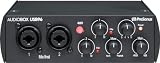
Best for families PreSonus AudioBox 96 25th Anniversary |
2 combo | 1.75 x 5.5 x 5.5 in | Check Price |
Best budget pick Synido USB C Audio Interface |
1 XLR | 1.77 x 4.53 x 5.51 in | Check Price |




How six interfaces survived the cut
Three things knocked candidates out before I compared anything else.
- No published warranty. A listing that stays silent on coverage tells you nothing about what happens in month eight. Every pick here states a term, from 30 days on the Synido to 2 years on the Focusrite and the PIYONE.
- No stated dimensions. You cannot plan a desk around a missing figure. All six publish length, width and height.
- Missing input detail. If the listing won't say whether a jack takes XLR, line or instrument, the comparison collapses.
What survived is six USB or USB-C boxes in the Computer Recording > Audio Interfaces category, all rated 2 in and 2 out, all bus-powered. Weights run from 0.66 lb to 1.63 lb. That's a narrow band, which is exactly the point. Nothing here is a rack unit.
I lined up the published specifications side by side and ranked on the fields that repeat across every listing: warranty length, footprint, weight, and how many microphones the box can host. Feature bullets came second, because those are the manufacturer's words. Two of the six list only one seller each pair, and the Focusrite and the M-Track Duo each show two sellers.
Does a 2-in interface really count as a professional studio rig?
Partly, and you should be honest with yourself about which part. The phrase professional studio usually implies eight inputs or more, so a drum kit and a room mic can go down at once. Nothing in this group does that. Every one of these six is a 2-in, 2-out box.
What the listings do support is professional-grade conversion on a small number of channels. The PIYONE claims 24-bit/192kHz. The PreSonus Studio 24c is listed at 192 kHz. The AudioBox 96 claims 24-bit/96 kHz. The M-Track Duo and the Synido both claim 48 kHz.
So the honest framing is this. If your work is vocals, voiceover, guitar, bass and software instruments, one of these will do professional-grade work all day. If your work is tracking a band live, you're shopping in the wrong shelf and no spec sheet here will change that. Judge the modifier against your own session list, not against a marketing line.
Sample rate, preamps or warranty: what decides it?
Most guides to the best audio interface for professional studio use lead with sample rate. That's the least useful number on the page for most buyers. The gap between 48 kHz and 192 kHz matters at the margins of mastering and sound design. It does not decide whether you can finish a vocal take tonight.
Three things decide it instead:
- Mic input count. One versus two changes what sessions are possible. The Focusrite and the Synido give you one XLR. The other four give you two combo jacks.
- Warranty term. These are bus-powered boxes with knobs and jacks that get handled daily. The Focusrite and PIYONE state 2 years. The three PreSonus and M-Audio units state 1 year. The Synido states 30 days.
- Balanced outputs. If you run studio monitors, you want balanced TRS. The Studio 24c specifies 2 balanced 1/4-inch TRS main outputs. The Focusrite lists 2 low-noise balanced outputs.
Here's the trick with phantom power. Every listing that mentions it treats 48V as a headline feature, and it is table stakes for condenser microphones. It's not a differentiator. Look past it to the count and the coverage.
1. Focusrite Scarlett Solo 3rd Gen USB-C Audio Interface — Best overall
The smallest box here, with the longest stated warranty of any pick, which is why it's the default answer for a one-microphone workflow.
Best for: a solo tracker who wants one mic input and a long warranty Skip it if: you need two mics open at once
At 3.77 x 1.71 x 5.65 in and 0.77 lb, the Scarlett Solo takes less desk than any other pick in this set. That matters more than it sounds. A shallow desk with a keyboard, a monitor stand and a mic arm already has no room left, and this red box slots into a corner most of the others won't fit.
The warranty is the other reason it leads. Focusrite states 2 years, matched only by the PIYONE, and doubled against the three units that state 1 year. This also sells faster than anything else here by a wide margin, so it's the one buyers in this category reach for most often.
Focusrite says the 3rd Gen mic preamp produces a brighter recording, and the listing claims two high-headroom instrument inputs for guitar or bass. The bundled software is spelled out in full: Pro Tools Intro+, Ableton Live Lite, Cubase LE and the Hitmaker Expansion.
The trade-off is real and it's structural. One XLR input means no simultaneous two-mic session, ever. Four of the other five picks here give you two combo jacks, and two of those sit at a lower price position. You're paying a premium spot in this lineup for a smaller box and a longer warranty, not for more channels.
Pros:
- Smallest footprint of all six picks
- 2-year warranty, longest term stated here
- 0.77 lb, second-lightest in the set
- Fully itemised software bundle on the listing
- Two sellers stock it, unlike four rivals
Cons:
- Only one XLR mic input
- Premium price position for fewer inputs than most rivals
- Listing does not state a maximum sample rate figure
- No MIDI I/O mentioned, unlike the AudioBox 96
2. M-AUDIO M-Track Duo USB Audio Interface — Best lightweight
The lightest pick at 0.66 lb, with two combo inputs, which makes it the one to throw in a bag.

Best for: anyone packing a rig into a backpack every week Skip it if: you want to record above 48 kHz
Weight is where this one wins. At 0.66 lb it undercuts every other pick, including the Focusrite, and it's less than half the 1.63 lb PIYONE. If your recording space is a spare room on Tuesday and a friend's kitchen on Saturday, that difference shows up in your shoulder.
You also get two combo XLR/line/instrument inputs with phantom power, which the cheaper Synido does not offer. M-Audio calls its preamps Crystal Preamps and says they suit condenser mics. The listing specifies a 1/4-inch headphone output, stereo 1/4-inch outputs, and a USB/Direct switch for zero-latency monitoring. MPC Beats software is included.
Released in 2020, it sits mid-range in this group on price and sells second-fastest here.
The ceiling is the catch. M-Audio states 48 kHz audio resolution, which is the lowest figure published across these six alongside the Synido. The PreSonus Studio 24c claims 192 kHz for a step up in price. The warranty is 1 year, half the Focusrite's term. And at 7.5 in long it's deeper front to back than the Scarlett Solo, so the lightest box is not the smallest one.
Pros:
- Lightest pick here at 0.66 lb
- Two combo inputs with phantom power
- Zero-latency USB/Direct monitoring switch
- Two sellers list it
- MPC Beats software included
Cons:
- 48 kHz ceiling, lowest stated in this set
- 1-year warranty against the Focusrite's 2
- 7.5 in depth, longer than four rivals
- No MIDI I/O listed
3. PreSonus Studio 24c 2x2 — Best premium
The only pick that names balanced TRS main outputs for studio monitors alongside a 192 kHz spec.

Best for: someone wiring into balanced studio monitors Skip it if: you want the cheapest route to two mic inputs
This is the most expensive pick here, and the monitor path is what you're buying. The listing specifies 2 balanced 1/4-inch TRS main outputs to connect professional studio monitors, plus a high-power headphone output and a mixer knob for low-latency direct input monitoring. If your speakers take balanced connections, that's the spec line that matters.
It's rated 192 kHz and carries 2 mic/instrument/line inputs with XMAX-L preamps. Simultaneous I/O is stated as 2 in, 2 out. Released in 2019, it weighs 1 lb and measures 1.77 x 7.09 x 6.3 in, so it's slim vertically but the widest of the three PreSonus and Focusrite boxes.
The problem is the value case. It's the slowest seller of the six by a large margin, and it states a 1-year warranty while the Focusrite states 2 at a lower price position. You're also getting the same input count as the M-Track Duo and the AudioBox 96, both of which sit cheaper. Only one seller lists it. For most home setups, the extra spend buys the balanced output pair and the sample-rate headline, and little else you'll notice.
Pros:
- Balanced 1/4-inch TRS main outputs specified
- 192 kHz stated on the listing
- XMAX-L mic preamps on both inputs
- 1 lb, third-lightest in this group
- Mixer knob for direct input monitoring
Cons:
- Highest price position of all six picks
- 1-year warranty despite the premium spot
- Slowest seller in this set
- Only one seller stocks it
- Same 2-in count as two cheaper picks
4. PIYONE Audio Interface — Best for heavy use
A 1.63 lb alloy body with a 2-year warranty and 192 kHz on the listing, at the second-cheapest position here.

Best for: a desk setup that stays put and gets used daily Skip it if: your desk is shallow
Weight usually reads as a negative. Here it's the pitch. At 1.63 lb this is the heaviest pick, more than double the M-Track Duo, and a heavier box doesn't skate across the desk when you pull a cable or twist a gain knob. PIYONE describes an alloy build with fixed LED light rings on each gain knob.
The specification list is the strongest value story in this group. It states a 2-year limited warranty, matching the Focusrite, at the second-cheapest price position of the six. PIYONE claims 24-bit/192kHz fidelity, two combo XLR/TRS jacks, zero-latency monitoring, a 3.5mm connection, plus monitor mix and loopback. Loopback matters if you stream or record calls, and no other pick here names it.
Now the size. At 5.51 x 9.25 x 2.24 in, it's the largest footprint of the six by a clear margin, more than 3.5 in deeper than the Focusrite. On a shallow desk it will crowd your keyboard. Only one seller lists it, and it's a much slower seller than the Focusrite or the M-Track Duo, so it's a less proven name than the brands beside it.
Pros:
- 2-year warranty at the second-cheapest position
- Loopback and monitor mix, unique in this set
- Two combo XLR/TRS inputs
- Claims 24-bit/192kHz resolution
- Heaviest body resists desk slide
Cons:
- Largest footprint here at 5.51 x 9.25 in
- Heaviest pick at 1.63 lb, poor for travel
- Only one seller lists it
- Sells far slower than the Focusrite or M-Audio picks
- No MIDI I/O mentioned
5. PreSonus AudioBox 96 25th Anniversary USB Audio Interface — Best for families
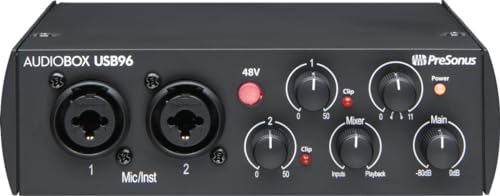
The only pick with MIDI I/O plus two mic preamps, in the second-smallest footprint here.
Best for: two people sharing one recording corner Skip it if: you want 192 kHz on paper
If more than one person uses the same desk, this is the pick that flexes. It's the only one here whose listing names MIDI I/O, so a keyboard player and a vocalist can both stay plugged in. Two Class-A mic preamps let two people track together, and PreSonus lists 2 high-headroom instrument inputs for guitar, bass and line-level gear.
The footprint helps too. At 1.75 x 5.5 x 5.5 in it's a near-square block, second-smallest in this group behind the Scarlett Solo, and it leaves the desk edge free. Studio-grade converters are stated at up to 24-bit/96 kHz. The bundle covers Studio One Artist, Ableton Live Lite and the Studio Magic plug-in suite.
Where it slips: the 96 kHz ceiling sits below the 192 kHz claimed by the PIYONE and the Studio 24c. It's the second-heaviest pick at 2.01 lb, so it's no travel companion. The warranty runs 1 year, and this design dates to 2017, making it the oldest listing in the set. Only one seller stocks it, and it sells slowly compared with the Focusrite.
Pros:
- Only pick listing MIDI I/O
- Two Class-A mic preamps
- Second-smallest footprint at 5.5 x 5.5 in
- Three-title software bundle named on the listing
- Two high-headroom instrument inputs
Cons:
- 96 kHz ceiling, below two rivals
- Second-heaviest at 2.01 lb
- 2017 design, oldest listing here
- 1-year warranty only
- Single seller
6. Synido USB C Audio Interface for Recording Music — Best budget pick
The cheapest way into this category, with three monitoring modes and a 0.91 lb body.

Best for: a first interface for podcasting Skip it if: warranty length matters to you
This is the cheapest pick of the six, and for a single-microphone podcast or voiceover setup it covers the basics. Synido lists 48V phantom power, an XLR input, three monitoring modes on a switch, and three independent control areas on the front panel. The listing gives the weight as 300g and the dimensions as 14 x 11.5 x 4.5 cm, which converts to 0.91 lb and 1.77 x 4.53 x 5.51 in.
Its footprint is genuinely tight, a shade narrower than the Studio 24c and only slightly wider than the Focusrite. Synido claims a high-quality independent audio chip with 24-bit depth and 48kHz sampling.
The warranty is the deal-breaker for anyone treating this as studio gear. Synido states 30 days, against 1 year on three picks and 2 years on two. That is the shortest coverage in the set by a factor of twelve. The 48 kHz ceiling ties it with the M-Track Duo at the bottom of the field, and you only get one mic input, matching the Focusrite but without its warranty. Only one seller lists it.
Pros:
- Cheapest pick in this comparison
- Three switchable monitoring modes
- 48V phantom power for condenser mics
- 0.91 lb and 1.77 in tall, compact on a desk
Cons:
- 30-day warranty, shortest in this set by far
- One mic input only
- 48 kHz ceiling
- No listed colour or software bundle
- Single seller
How much desk space will each one eat?
Footprint is the spec buyers skip and regret. Here's the field ordered by the largest face dimension, smallest first:
- Focusrite Scarlett Solo: 3.77 x 5.65 in
- PreSonus AudioBox 96: 5.5 x 5.5 in
- Synido: 4.53 x 5.51 in
- PreSonus Studio 24c: 7.09 x 6.3 in
- M-Track Duo: 4.34 x 7.5 in
- PIYONE: 5.51 x 9.25 in
The spread is wider than it looks. The PIYONE's 9.25 in depth is roughly 64% deeper than the Focusrite's 5.65 in. On a 24-inch desk with a monitor arm, that's the difference between a comfortable layout and a keyboard shoved to the edge.
Height matters for a second reason. The AudioBox 96 at 1.75 in, the Studio 24c at 1.77 in and the Synido at 1.77 in all sit low enough to slide under a monitor riser. The PIYONE at 2.24 in and the M-Track Duo at 2.13 in probably won't. Measure the gap under your riser before you order.
What the listings leave out
Three gaps run through all six product pages, and knowing them keeps expectations honest.
Latency is never quantified. Four listings promise zero-latency or low-latency monitoring. None of them give a buffer size or a round-trip figure in milliseconds. Those claims describe direct hardware monitoring, which routes input straight to your headphones. That's useful, and it's not the same as low software latency in your DAW.
Preamp gain range is absent. Focusrite says the preamps are high performing. M-Audio calls its Crystal Preamps transparent. PreSonus names Class-A and XMAX-L. Not one publishes a dB gain figure. If you use a low-output dynamic mic, that's the number you'd want, and it isn't there.
Sample rate isn't uniform reporting. The Focusrite listing trails off mid-sentence on its converter spec, so I've treated it as unstated rather than guessing. Two listings claim 192 kHz, one claims 96 kHz, two claim 48 kHz.
Most shoppers miss that bundled software has its own catch: registration and download requirements vary, and the listing text is your only guide.
The verdict
Split this field into three tiers and the choice gets simple.
At the entry end, the Synido is the cheapest way to get one microphone into a computer, and the PIYONE is the value standout of the whole set: a 2-year warranty and a claimed 192 kHz at the second-cheapest position, if you can spare 9.25 in of desk depth. In the middle, the M-Track Duo trades sample rate for the lightest body here at 0.66 lb and two combo inputs, while the AudioBox 96 adds MIDI I/O in a 5.5 x 5.5 in square.
At the premium end, the Focusrite Scarlett Solo is the best audio interface for professional studio use in this lineup for one-microphone work, because the 2-year warranty and the 3.77 in width beat everything else on the two specs you live with daily. The Studio 24c earns its higher position only on one point, and it's a real one: it's the only pick naming balanced 1/4-inch TRS main outputs for studio monitors, plus 192 kHz and two XMAX-L preamps.
The cutoff is input count. One mic, take the Focusrite. Two mics, take the Studio 24c if you run balanced monitors, the PIYONE if you don't.
FAQ
Is the best audio interface for professional studio work always the most expensive one?
The best audio interface for professional studio use is not the priciest here. The PreSonus Studio 24c holds the top price position but states only a 1-year warranty, while the PIYONE sits second-cheapest with a 2-year term and a claimed 192 kHz. Price position in this set tracks brand and monitor outputs more than it tracks published capability.
Is a 2-in, 2-out interface worth it for serious recording?
A 2-in, 2-out interface is worth it if your sessions are one or two sources at a time: vocals, guitar, bass, voiceover, software instruments. All six picks here are rated 2 in and 2 out. It stops being worth it the moment you need to track a drum kit or a full band live, which needs eight or more inputs.
Which of these interfaces supports MIDI keyboards?
MIDI keyboard support appears on only one listing in this group. The PreSonus AudioBox 96 25th Anniversary specifies MIDI I/O alongside its two Class-A mic preamps and two instrument inputs. The other five picks name no MIDI ports, so a keyboard would need to connect over USB directly to your computer instead.
Focusrite Scarlett Solo or PreSonus Studio 24c: which should I buy?
Focusrite Scarlett Solo or PreSonus Studio 24c comes down to microphone count. The Scarlett Solo gives one XLR input, a 2-year warranty and the smallest footprint here at 3.77 x 5.65 in. The Studio 24c gives two combo inputs, 192 kHz, and balanced TRS main outputs for monitors, with a 1-year warranty and a higher price position.
What mistake do first-time interface buyers make most often?
The mistake first-time interface buyers make most often is chasing sample rate. A 192 kHz figure looks impressive on a listing and changes almost nothing about finishing a vocal take. Input count, warranty length and desk footprint decide the daily experience. In this set, warranty terms range from 30 days to 2 years, a far bigger practical gap.
Start by measuring the free space on your desk and counting the microphones you'll ever have plugged in at once. Those two numbers point at one pick, and the rest of the spec sheet is detail. For most people recording alone, the Scarlett Solo is the sane default: it takes the least desk, carries the longest warranty here, and lists its software bundle in full so there are no surprises after unboxing. If you already own balanced monitors and a second microphone, spend up to the Studio 24c and wire it properly the first time.